
What does fact checked mean?
At SportsRec, we strive to deliver objective content that is accurate and up-to-date. Our team periodically reviews articles in order to ensure content quality. The sources cited below consist of evidence from peer-reviewed journals, prominent medical organizations, academic associations, and government data.
- American Council on Exercise: Strength Training for Kids -- A Guide for Parents and Teachers
- American Council on Exercise: Inchworms
The information contained on this site is for informational purposes only, and should not be used as a substitute for the advice of a professional health care provider. Please check with the appropriate physician regarding health questions and concerns. Although we strive to deliver accurate and up-to-date information, no guarantee to that effect is made.
Muscle Strengthening Activities for Kids
Muscle-strengthening activities are not just for adults. In fact, the American Council on Exercise claims muscle-building programs and activities can boost a child's self-esteem, increase his mental discipline and help with socialization. Stronger muscles also help kids with day-to-day activities, improve sports performance and reduce the risk of sports-related injury. To pique your child’s interest in exercise, get creative. Use fun activities to get your child moving and beef up his muscular strength.
Monkey Bars
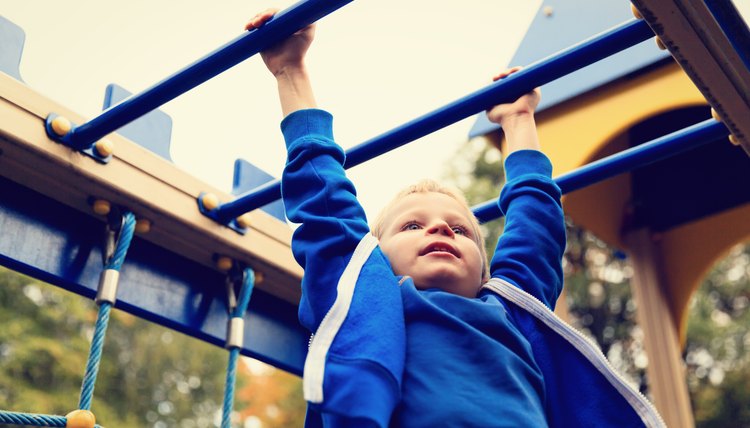
If you are looking for a fun outdoor activity to strengthen your kid’s muscles, head to the monkey bars at your local playground.
Swinging from one bar to the next strengthens the upper body, boosts muscular endurance and improves coordination. Challenge your child to move all the way across the monkey bars without stopping.
Closely supervise young children so you can catch them if they lose their grip.
Medicine Balls
Children typically like playing with basketballs, baseballs, footballs and soccer balls. To strengthen their muscles, introduce kids to the medicine ball. “Strength and Power for Young Athletes” recommends beginning with a light medicine ball and increasing the weight by small increments as your child gets stronger and more adept.
The squat toss effectively strengthens the legs, chest and arms. To practice this activity, your child stands with his feet about hip-width apart. Holding a medicine ball directly in front of his chest with both hands, he squats down until his thighs are parallel to the floor, then quickly jumps straight up while throwing the ball high in front of himself.
Wheelbarrow
Young children often enjoy partnering activities. The wheelbarrow exercise allows kids to work together to strengthen their muscles.
To perform the wheelbarrow, your child lowers himself to the floor in a pushup position. Another child stands behind him, grabs your child's ankles and raises them to the height of his own waist. Your child's body should be straight, without any sagging of the back. The "wheelbarrow" child walks on his hands as his partner steers him across the floor. At the far end of the room, the children switch positions.
In group settings, make this activity more fun by suggesting kids race each other. The wheelbarrow strengthens the pectorals, deltoids and triceps.
Inchworms
Another way to make muscle strengthening fun is to have kids mimic animals. For example, encourage children to try the inchworm.
The American Council on Exercise points out that inchworms are a full-body exercise that works the arms, shoulders, chest, abs and hips.
To practice the inchworm, your child spreads his feet about shoulder-width apart. While keeping his feet flat on the floor, he bends over and places his hands on the floor in front of himself. His body should form an inverted “V.” He walks his hands forward until his stomach is about three inches off the floor. When his body is parallel to the floor, he walks his feet forward, returning to the inverted “V” position. Kids can repeat the inchworm until they have moved across the floor.
References
- American Council on Exercise: Strength Training for Kids -- A Guide for Parents and Teachers
- Strength & Power for Young Athletes; Avery Faigenbaum and Wayne Westcott
- American Council on Exercise: Inchworms
Resources
Writer Bio
Mike McLaughlin has been writing news, entertainment and sports articles since 1990. McLaughlin has written for “The Maine Campus,” “The Bangor Daily News" and various websites. McLaughlin is also a martial arts instructor and certified personal trainer. He has a bachelor's degree in journalism and an associate degree in filmmaking.