What does fact checked mean?
At Healthfully, we strive to deliver objective content that is accurate and up-to-date. Our team periodically reviews articles in order to ensure content quality. The sources cited below consist of evidence from peer-reviewed journals, prominent medical organizations, academic associations, and government data.
The information contained on this site is for informational purposes only, and should not be used as a substitute for the advice of a professional health care provider. Please check with the appropriate physician regarding health questions and concerns. Although we strive to deliver accurate and up-to-date information, no guarantee to that effect is made.
How to Identify Eye Grade
Your ophthalmologist or optometrist (eye doctor) does a variety of tests when checking your vision or eye test grade 1. It is important that you know and understand the results of your eye tests. Ask your eye doctor to tell you your eye test grade and what it means.
If you are experiencing serious medical symptoms, seek emergency treatment immediately.
How to Identify Eye Test Grade
Learn the meaning of eye test grades. If your visual acuity is 20/20 you can see the smallest letter on the eye test at a distance of 20 feet. A result of 20/40 means the smallest letter you can read at 20 feet could be read by a person with perfect vision if they were 40 feet away 1. Some people have 20/18 or 20/15 eye test grades; these are better than 20/20. If your eye test grade is 20/200 this means the smallest size letter you can see is 20 feet away, but a person with perfect vision could see it at 200 feet away 1. A person is "legally blind" if their eye test grade with corrective lenses is 20/200 or worse.
How to Read Contact Lens Power
Learn More
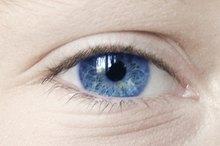
Find out what your PERRLA eye test grade is. PERRLA stands for "Pupils Equal Round Reactive to Light and Accommodation." This grade reveals how your pupils (the dark circle in the center of your eye) constrict or dilate in the light or dark, or when looking at something up close. A normal PERRLA eye test grade for an adult is between 2 to 4 mm in diameter in bright light, and between 4 to 8mm in darkness.
Find out what your diopter eye test grade is; this grade tells how well your eyes focus. A lens with a focal length of 1 meter (39 inches) is graded as 1 diopter; a half meter is 2 diopters; 1/3 meter is 3 diopters. The grade of a diopter goes higher as your focal length gets shorter; the higher the diopter correction, the more magnification you need to read or see things up close.
- Learn the meaning of eye test grades.
- This grade reveals how your pupils (the dark circle in the center of your eye) constrict or dilate in the light or dark, or when looking at something up close.
Related Articles
How to Read Contact Lens Power
Learn More

How to Use a Snellen Chart
Learn More
Human Eye Shape Types
Learn More
20/70 Eye Exam Results
Learn More
How to Make Your Own Eye Chart
Learn More
Different Color Blobs & Shapes in Vision
Learn More
Different Color Blobs & Shapes in Vision
Learn More

What Do Prescription Numbers Mean in Eye Glasses?
Learn More

How to Convert a Contact Prescription to a Glasses Prescription
Learn More

Eye Exercises for Esotropia
Learn More
References
Writer Bio
Jacqueline Trovato is a published writer with more than 25 years' experience in marketing communications and public relations. She specializes in health care communications. She holds a Bachelor of Science in education with a minor in psychology from James Madison University.