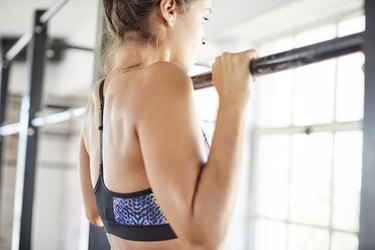
Few back exercises are as challenging — both mentally and physically — as doing pull-ups. But they're well worth the effort, because they work every single muscle in your back all at once.
Tip
Although the primary power for pull-ups comes from your latissimus dorsi, this exercise also works every major muscle in your back.
Video of the Day
Proper Form for Pull-Ups
No matter how you choose to grip the bar, basic form for pull-ups remains the same. The following example is given using an overhand grip, but otherwise applies to any hand position.
Video of the Day
- Reach up — or jump, or use an elevated step for an assist — and grasp the pull-up bar in an overhand grip, hands a little wider than shoulder-width apart.
- Use your core muscles to stabilize your torso, and pull your shoulder blades back and down; they should stay this way throughout the exercise.
- Breathe out as you pull your elbows down to your sides. Because the bar is fixed in place and you're not, this brings your body up to the bar. Stop when your chin is level with the bar.
- Slowly reverse the motion, lowering your body to the starting position, but still keeping your shoulders down and back. This completes one repetition.
Did you notice that you don't need to swing your body or do explosive, dramatic movements? That is, unless you're deliberately training to develop these aspects of athletic movement. Instead, this exercise is all about "putting your back in gear" (locking your shoulder blades in place) and then letting your most powerful back muscle, the latissimus dorsi, do its job.
Muscles Worked During a Pull-Up
Your latissimus dorsi is the most powerful pulling muscle in your back, and during a pull-up, it's the primary mover, or the muscle that provides most of the power to bring your body up to the bar. One of the movements it performs is shoulder adduction, or bringing your arms down toward the sides of your body. But because the pull-up bar is fixed in place and your body is not, it's your body that moves up to the bar.
Your lats aren't the only muscle that performs shoulder adduction. In particular, the teres major (sometimes called "lat's little helper") works synergistically with your latissimus dorsi to adduct the shoulder.
During a pull-up, your upper arm also extends at the shoulder, or swings down from the front of your body toward the rear of it; your lats do this too, along with the posterior or rear deltoid and the pectoralis major. That's right — your pecs, arguably the most powerful pushing muscles in your upper body, also help make this complex pulling motion happen.
A series of powerful muscles in your upper and lower arms kick in to help accomplish this motion too, flexing your arm at the elbow. These include the biceps brachii, brachioradialis and brachialis. Part of your triceps — the big muscle on the back of your upper arm — also helps to stabilize your arm.
And finally, if you remember that moment at the start of the pull-up when you bring your shoulder blades back and down, a series of muscles help you lock them in place and stabilize your shoulder girdle. These include the lower and middle fibers of the trapezius muscle, the pectoralis minor (a chest muscle that reaches from your ribs to your shoulder blade), the levator scapulae and your rhomboids, a diamond-shaped muscle whose only job is to help bring your shoulder blades together and down.
Meanwhile, all four muscles of your rotator cuff, the infraspinatus, supraspinatus, subscapularis and teres minor, work to stabilize the complex mechanism that is your shoulder joint, and your erector spinae and obliques work to stabilize your torso.
What About Your Pull-Up Grip?
As noted in a small study of 19 volunteers that was published in the February 2017 issue of the Journal of Electromyography and Kinesiology, researchers tracked muscular activity in the shoulder-arm-forearm complex and found similar levels of peak activation despite changes in hand position. (They tested normal pull-ups with a pronated grip, a supinated grip or chin-up, a palms-in neutral grip and rope pull-ups.)
Or, to put it another way: All the same muscles are at work no matter how you position your hands doing a pull-up. However, those different hand positions can affect how the stresses are distributed between your muscles. In the aforementioned study, the one notable difference was significantly greater activation of the middle trapezius fibers during regular pull-ups, as compared to doing pull-ups with a neutral grip.
Another small study, published in the August 2016 issue of the Journal of Science and Medicine in Sport and based on observation of scapular motion in a group of 11 participants who all regularly performed pull-ups, showed that hand position can affect your risk of shoulder impingement. Of the three pull-up varieties tested (normal, wide-grip and reverse-grip), wide-grip and reverse-grip both showed increased risk for shoulder impingement.
Making Pull-Ups Easier
Although pull-ups are an excellent back exercise, they're also very challenging — and many people can't do one pull-up unassisted, much less a full set. But if you're in that group of frustrated puller-uppers, you don't have to stay there. Instead, use some of the following alternative exercises to gradually build the strength and endurance you need to do real pull-ups.
Assisted Pull-Up Machine
This piece of equipment uses a knee or foot lever to counterbalance some of your weight, making it easier to do pull-ups. Just select how much of your weight you want the machine to counterbalance, grasp the pull-up handles, kneel or step onto the counterbalance bar and go for it.
Partner-Assisted Pull-Ups
If your gym doesn't have an assisted pull-up machine, you can use a workout buddy instead. Have your buddy stand just in front of or beside you and press up on your knees as you lift yourself up toward the bar. Because your friend may end up lifting a significant portion of your body weight, make sure she squats down and then lifts up with her legs, not her back or arms. If she stands close beside you she can support your knees on her upper arms, thus keeping the weight she's lifting — you! — close to her body.
Dip Bar Pull-Ups
If you have access to parallel dip bars or the contraption known as a captain's chair (which has handles that double as dip bars), you can do self-assisted pull-ups.
- Position yourself between the bars or handles, facing away from the upright support of the machine.
- Grab the handles in a parallel grip (palms facing in) and squat down so your body is below your hands.
- Pull yourself up between the bars. Aim to use your back and arm muscles as much as possible, adding pressure from your legs as needed to help complete the motion.
Band-Assisted Pull-Ups
Here's one more type of self-assisted pull-up, with a twist — or actually, a loop. Pull-up assist bands are like super heavy-duty versions of elastic resistance bands, molded in the form of a loop. You girth-hitch the assist band to a pull-up bar, slide your knee or foot into the dangling loop and let the band's contractile strength assist you in the pull-up motion.
The Lat Pulldown Substitute
If you don't have access to any of the other options described above, you can also do lat pulldowns to help build the strength needed for pull-ups. Because the motions are very similar — the real difference is whether you're pulling yourself up to the bar, or you're pulling the bar down to you — you'll be getting a very similar workout, too. But it's much easier to vary the amount of weight you're lifting with a lat pulldown machine.
Read more: 10 Exercises to Help You Conquer the Pull-Up
Tip
What if you've been working on your pull-ups so much that doing a full set is easy? Yes, that can happen — and when it does, one of your options is to wear a weight belt or weight vest to make the pull-ups more challenging. You can also switch to different variations of the pull-ups, or do heavy lat pulldowns for variety and increased challenge.
The Best Back Exercises
Are pull-ups the best back exercise possible? In a study of 19 healthy young volunteers with resistance-training experience, the American Council on Exercise concluded that there is no single "best" exercise for every muscle in the back — but that the pull-up and chin-up (or reverse-grip pull-up) both generated significantly greater activity in the latissimus dorsi than the six other exercises tested.
The other movements tested were the lat pulldown, seated row, bent-over row, inverted row, TRX row and I-Y-T raises.
So, although there's no single best exercise for all of your back muscles, pull-ups are definitely one of the best for your latissimus dorsi. But even if you love pull-ups, it's best to switch up your fitness routine occasionally to vary the stress on your body and reduce the risk of overuse injuries. When that time rolls around, the just-mentioned exercises are excellent choices for working your back in new ways.
However, as important as it is to develop a healthy, strong back, don't forget to work your other muscle groups. As recommended by the U.S. Department of Health and Human Services, you should strength-train all your major muscle groups twice a week. That includes not only your back, but also your chest, arms, shoulders, core, hips, quads, hamstrings and calves.
If you're into body-weight exercises like pull-ups, you can keep using that method to work your entire body. Some examples of exercises you can do include push-ups for your chest, arms and shoulders; planks, crunches and bicycle crunches for your core; glute bridges for your hips; and squats or a wide variety of lunges to work all your leg muscles.
- ExRx.net: "Pull-Up"
- American Council on Exercise: "ACE-Sponsored Research: What Is the Best Back Exercise?"
- Arizona State University: "Anatomical Analysis of Movement: Upper Extremity Exercises"
- Journal of Science and Medicine in Sport: "Scapula Kinematics of Pull-Up Techniques: Avoiding Impingement Risk With Training Changes"
- Journal of Electromyography and Kinesiology: "Electromyographic Analysis of Muscle Activation During Pull-Up Variations"
- Health.gov: "Dietary Guidelines for Americans, 2015-2020: Appendix 1. Physical Activity Guidelines for Americans"