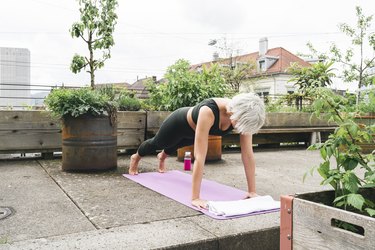
Almost all motions, from picking up a dropped pencil to swinging a baseball bat, start with the muscles in your core. In other words, your core — which is comprised of your abdominals, pelvic floor, obliques and lower back muscles — might be the most important muscle group in your body.
Harvard Health Publishing calls your core "the sturdy central link in a chain connecting your upper and lower body." The way to target these muscles is with core workouts that rely on your body weight as resistance to build strength, increase flexibility and improve balance.
Reasons to Care About Building a Strong Core
A strong core is the key to everything, says Bethany Lyons, founder of Lyons Den Power Yoga. It can help with with everyday tasks, from simply sitting at your desk and standing up straight to lifting boxes or heavy toddlers. Core strength also helps athletes with some of their most powerful motions, and it's a fundamental base for nearly every exercise.
"Core muscles keep the spine stable and protected, which allows and helps the body to do just about every movement including: bending, lifting, twisting, lifting heavy bags, picking up our dogs and kiddos and more," she says.
For those struggling with back pain, developing core strength can provide much-needed relief. Individuals with scoliosis had a 32 percent improvement after performing a side plank for just 10 to 20 seconds a day for seven months, according to a September 2014 study in Global Advances in Health and Medicine.
Read more: 5 Benefits of Abdominal Strength & Endurance
How to Create the Most Efficient Core Workout
Just like any other sweat session, there's a lot of freedom when it comes to structuring your core workouts. Nike master trainer Alex Silver-Fagan suggests choosing four or five movements that you like (check out the list below), and performing each of them for 45 to 60 seconds with 30 to 60 seconds rest in between each. Do 2 to 3 sets total.
Experts typically recommend waiting 48 hours to work the same muscle group again, as this is when recovery and muscle protein synthesis occurs. That rule doesn't hold true for the core, says Silver-Fagan.
"You should do something that strengthens your core every single day," she says. "Since the core supports every other part of the body — you're using it when you're working your legs, butt, arms, pecs, core — and stabilizes your spine, it's important you give it a lot of attention."
This doesn't mean you're doing a hardcore (pun intended) abs workout every day. Silver-Fagan recommends activating it regularly, with something as simple as a plank as active recovery on leg day. Also, make sure to warm-up before jumping into any core exercises.
"You wouldn't jump into a deadlift before warming up" she says. "Work the supporting muscles, like your hip flexors, glutes, adductors, abductors, with something simple like a glute bridge. This will help you avoid injury and stay safe in the long run."
The 5 Best Core Exercises
For the best core routine, you'll want to do your core exercises in a cycle. Spend a few minutes on each exercise, with 4 to 8 repetitions each.
For exercises that require you to hold a position, such as the front and side plank, keep holding the position for about 30 seconds or longer. You'll know you're done when you can no longer hold the position with good form (ex. your hips lift or drop).
Mix and match these core exercises into different routines to build strength in different ways each day, and add variety to your workout with cardio exercises such as running, cycling or swimming.
1. Forearm Plank
One of the best core workouts is the traditional forearm plank. The plank engages most of the muscles in your core, contracting your abdominals and strengthening your lower back and pelvis.
- Lie on your stomach with your forearms tucked underneath your body, elbows under your shoulder.
- Lift your hips and torso off the floor, supporting your body using your elbows, forearms and hands.
- Keep your body aligned from your ankles to your neck, keeping your back and hips as straight as possible. Look about 3 to 5 inches in front of you to keep your neck in alignment.
- Hold the position for 60 seconds, or as long as you can.
2. Side Plank
The side plank — based off the yoga pose Vasisthasana — engages the muscles in either side of your torso, giving you a deep core workout on your left and right side.
- Lie on your side with your feet together.
- Elevate your torso, placing one hand directly beneath your shoulders, with your arm forming a straight line that's perpendicular to the floor.
- Keep your other arm straight up for balance and align your hips with your shoulders, forming a straight line from your feet to your head.
- Hold the pose for 30 to 60 seconds, then repeat on the other side.
Tip
If you have trouble completing a full cycle of these exercises, start with the simple front plank and build strength for several weeks until you can add the rest of the exercises.
3. Quadraplex
The quadraplex helps develop your balance and coordination, challenging you to keep your alignment steady as you work nearly every muscle in your body.
- Start on your hands and knees with your back parallel to the floor.
- Slowly straighten your left arm and right leg until both are aligned with your back, pointing straight out.
- Hold this position for a few seconds, then slowly alternate to your right arm and left leg, returning to the starting position each time.
- As you alternate arms and legs, focus on keeping your back and torso as still as you can. Don't arch your back or allow your hips and shoulders to sag in either direction.
4. Heel Tap
The heel tap can really light your core on fire, Lyons says. Make sure to engage your obliques throughout.
- Lying on your back, bend the knees to the ceiling and place the feet hip-width distance apart.
- Lift your chest and shoulders to the ceiling and reach for the right heel with the right hand.
- Hold for 3 seconds and switch.
5. Dead Bug
Dead bug pose takes a lot of control that originates at the core. Engage your abs throughout the duration of the movement, keeping your lower back pushed into the floor below you. Remember, your head should stay in contact with the floor throughout the entire movement.
- Lie on your back with your legs lifted so the knees are balanced over the hips, shins are parallel to the floor and your arms are extended straight up to the ceiling over your chest.
- Draw your right arm back by your right ear as you extend your left leg straight to hover several inches above the floor. Keep your left arm straight over your chest and your right knee bent.
- Return the right arm and leg to their original position and extend the left arm and right leg to complete one repetition.
- Move deliberately and with control as you alternate the sides for a total of 10 to 15 repetitions.
Start With This Core Workout
Ready to really get things burning? This workout, packed with the best abs exercises for beginners, is a great place to start. Do it twice through, resting 2 minutes between sets, Lyons says.
1. Forearm Plank to Walk
- Start in forearm plank, with the abdominals tight, legs engaged and the back of the neck long. Take five breaths.
- Push yourself up into a high plank by placing the right hand where the right elbow is and then the left hand where the left elbow is.
- Move back down to a forearm plank, and hold for five breaths.
- Repeat, this time starting with the left hand and then the right. Move back down to a low plank and hold for five breaths.
- Repeat this sequence for three to five sets. The "walking" creates instability, which increases strength when moving through the exercise.
2. Simon Says Knee to "Fill in The Blank"
- From Downward Facing Dog, lift one leg into the air.
- Move to a high plank while drawing the knee to the nose, then the right triceps, then right wrist, left wrist, left triceps and back to the nose.
- Push back into a Downward Dog and place the foot down.
- Repeat with other leg. Do 3 to 5 sets.
Tip
Switch up the order and make it fun and random (for example: left triceps, right wrist, left wrist, right triceps) from set to set.
3. Side Plank
- From high plank, bring the feet and legs together and rotate the body, transferring the weight into one hand and lifting the other hand directly to the ceiling.
- Squeeze the legs together, flex the feet and stack the lungs and shoulders on top of each other.
- Hold for five to 10 breaths.
- Switch sides and repeat three to five times, taking a break in Child's pose if needed.
4. Heel Taps
- Lying on your back, bend the knees to the ceiling and place the feet hip-width apart.
- Lift your chest and shoulders to the ceiling and reach for the right heel with the right hand.
- Hold for 3 seconds and switch.
- Start with 15 holds on each side and work up to 100 total.