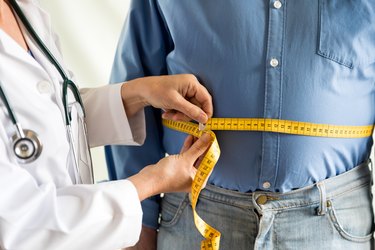
The rise of a hard, fat belly is like the sphinx of biology. Where does it come from? What exactly is it? And why are those who are assigned male at birth (AMAB) more likely to develop a big, protruding stomach then their counterparts assigned female at birth (AFAB)?
Video of the Day
Video of the Day
What Is 'Hard' Belly Fat?
"'Hard, fat belly' is not really a clinical term," says nutrition expert Tauseef Ahmad Khan, MBBS, PhD, a research associate in the Department of Nutritional Sciences at the University of Toronto in Ontario, Canada. "But what people mean by it is what clinicians refer to as 'visceral fat' in the stomach area."
Visceral fat is anchored very deep within the abdominal cavity, where it lodges around the stomach, liver and intestines, according to Johns Hopkins Medicine. The cause: taking in more calories than you burn.
"It's that simple," Khan says. "The more excess food you eat, the more visceral belly fat builds up over time." Your age and genetics, however, also influence how much weight you carry and where you carry it.
Sex and Your Body Shape
That said, a September 2012 review in Circulation points out that not all obesity is alike. For example, people AMAB are typically more prone to "android obesity," which favors the accumulation of the kind of centralized visceral fat that undergirds a hard, fat belly. Hence the male tendency toward an apple-shaped body, according to a January 2015 study in BMC Public Health, which analyzed data from more than 15,000 people.
By contrast, women are more prone to "gynoid obesity," the Circulation review notes, which favors the development of "subcutaneous fat," which often collects in the hip and thigh area, according to the Harvard T.H. Chan School of Public Health. The result is a tendency toward a pear-shaped body.
The Mayo Clinic describes subcutaneous fat as that extra layer of padding just below the skin's surface. Khan says it's sometimes referred to as soft fat "because it feels very pliable to the touch."
And that distinction, as BMC notes, leaves men on the short end of the stick because, as Khan says, "visceral belly fat is more dangerous than subcutaneous fat. The more you [have], the greater your risk for heart disease, diabetes and stroke."
The Role of Hormones
Genes certainly play a role in why some people are more prone to packing on visceral fat than others, according to both Johns Hopkins and Winchester Hospital. But the Circulation review and Khan say that the male tendency to gain more visceral fat likely has a lot to do with hormones.
The role hormones play can be seen in many trans men, according to the Circulation report. Some trans men who undergo hormone therapy experience both the loss of subcutaneous fat and the gain of visceral fat.
Why? Because so-called female and male hormones have different jobs, Khan says. Estrogen favors subcutaneous fat production because "that's the type of fat that can best serve as a regular energy supply" for pregnancy and lactation, he says.
By contrast, Khan says testosterone favors visceral fat storage as an on-demand extra fuel source for strength and muscle growth. But, while muscle is pretty efficient at burning through visceral fat quickly, some people AMAB may take in more calories than they burn, he says.
Your Belly's Not Actually Hard
Despite the turn of phrase, "hard" visceral belly fat isn't actually hard.
"I understand that it may feel hard when you push your hand against it," Khan says. "But that's just because it forms around the organs in that area, so there's nowhere for the fat to go. It's basically trapped in place. So the belly may feel hard, but visceral fat itself is not."
Bottom line: Chat with your doctor if you think you have a hard, fat belly.
- Tauseef Ahmad Khan, MBBS, MSc, PhD, research associate, Department of Nutritional Sciences, University of Toronto, Ontario, Canada
- Johns Hopkins Medicine: “The Skinny on Visceral Fat”
- Mayo Clinic: “Belly Fat in Women: Taking — and Keeping — It Off”
- Circulation: “Body Fat Distribution and Risk of Cardiovascular Disease”
- Harvard T.H. Chan School of Public Health: “Waist Size Matters: How Abdominal Fat Increases Disease Risk”
- Winchester Hospital: “The Dangers of Hidden Abdominal Fat”
- BMC Public Health: “A Novel Quantitative Body Shape Score for Detecting Association Between Obesity and Hypertension in China”
Is this an emergency? If you are experiencing serious medical symptoms, please see the National Library of Medicine’s list of signs you need emergency medical attention or call 911.