Time is money. And not having to pay for classes or commute to a studio saves you a lot of both. But a lot of people still avoid exercising at home because they don't have equipment or because they simply don't have any idea where to start.
Enter Pilates. All you need is a mat or a square of carpet, and you can do a variety of moves to strengthen and tone your entire body (especially your core), improve balance, flexibility and mobility.
Ready to give it a try? Find a space where you have room to move — because you'll be doing a lot of that — and try these 10 beginner-friendly Pilates moves.
1. Roll Up
The roll up helps you learn to articulate the spine and builds abdominal strength.
- Lie on your back with your legs extended and your arms overhead, palms up.
- Point your feet and press your lower back into the ground.
- Exhale to begin, then inhale and raise your arms up so your fingers point at the ceiling.
- Contract your abdominal muscles and begin to curl your spine off the mat vertebra by vertebra while keeping your chin tucked to your chest.
- Rise slowly and keep a curve in your spine as you come through a sitting position and reach toward your toes.
- Inhale and slowly reverse the move so your spine meets the ground vertebra by vertebra.
- Do three to 10 reps.
Tip
Beginner modification: Bend your knees and place your feet flat on the floor.
2. The Hundred
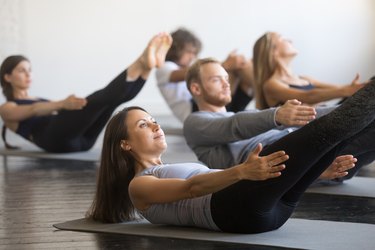
This staple of Pilates warms up the body and strengthen the abdominals. "This is a great exercise to begin working on intercostal breathing — inhaling into your ribcage and keeping your navel pulled in," says Robyn Martin, owner and founder of Proof Pilates in Atlanta. "A great example of how your abs can engage just from breath work."
- Lie down on your back and extend your legs at a 45-degree angle.
- Use your abdominal muscles to lift your head and upper back off the ground.
- Extend your arms alongside your body.
- Begin to pump your arms up and down while inhaling and exhaling in unison.
- Inhale five quick counts, and then exhale five quick counts — that's one cycle. Do 10 cycles.
Tip
Beginner modification: Keep your knees bent.
3. Criss Cross
Strengthen your obliques with this popular Pilates exercise that's similar to the bicycle crunch and also great for beginners.
- Hold your hands behind your head to support your neck in the lifted position and bend your knees back to a tabletop with shins parallel to the floor and feet pointed.
- Twisting through your ribs, reach your right elbow across your body toward your left knee.
- At the same time, lengthen your right leg straight out in front of you about a foot off the ground.
- Rotate back to the tabletop position.
- Twist to the other side, keeping your elbows wide and reaching the left elbow across the body toward the right knee as the left leg lengthens.
- Alternate side to side, slowly and with control.
Tip
Beginner modification: Place a towel under your head to help keep it lifted.
4. Swimming
No pool? No problem. The Pilates swimming exercise strengthen the glutes, hamstrings and back muscles, as well as lengthening the fronts of the hips.
- Lie on your stomach and extend your arms overhead.
- Inhale, contract the abdominals and lift your arms, chest and legs off the floor.
- Keep your legs straight.
- Exhale and hold.
- Begin active breathing as you move opposite arms up and down and scissor your legs at the same time as if swimming.
- Use the same breathing pattern as you did in the Hundred exercise — five quick inhales and five quick exhales. Do 20 to 50 reps.
Tip
Beginner modification: Rest your upper body on the mat while focusing on kicking your legs, or vice versa.
The 6 Best Pilates Exercises for Strong, Toned Arms
Does Pilates Help You Lose Weight? Here's What You Need to Know, According to an Expert
7 Benefits of Pilates Reformers for Every Body and Workout Goal
Mat Pilates Is an Equipment-Free Workout You Can Do Anywhere
How to Get Started With Pilates for Beginners
Mat vs. Reformer Pilates: What Are the Differences and Which Is Better?
5. The Swan
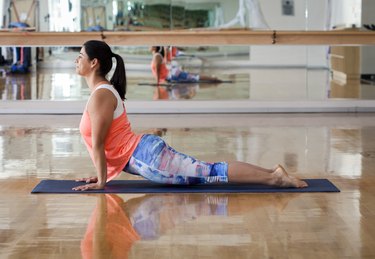
Build strength in the spine, backs of the legs and buttocks with the swan.
- Lie on your stomach with your legs separated hip distance apart and slightly rotated outward.
- Place your palms on the floor next to your face so your thumbs line up with your nose.
- Press into your palms and slowly lift your upper body off the floor, using primarily the strength of your lower and mid-back muscles.
- Press the tops of your feet into the mat. ("Keep your glutes engaged by actively pushing down on the hip you are reaching away from," Martin says.)
- Lower back down with control.
- Do six reps.
Tip
Beginner modification: Decrease the range your upper body comes off the ground, depending on the flexibility of your spine.
6. The Saw
The saw is great for strengthening and improving control of your oblique muscles, toning your waistline and lengthening your hamstrings and adductors.
- Sit up straight with your legs extended and slightly wider than your shoulders.
- Open your arms out to the side, palms facing forward.
- Contract your abdominal muscles and turn your shoulders, arms and torso to the right so your right arm is behind you and your left arm is in front. Keep your hips in place. Think of your hip bones like headlights pointing ahead.
- Rotate your back hand so your thumb points down, exhale and flex at the hips, reaching your left arm toward your right foot.
- Inhale as you come up and return to center.
- Do six reps on each side.
Tip
Beginner modification: Lessen the intensity of the stretch by sitting on a folded blanket or by bending your knees slightly.
7. Mermaid
Channel your inner mermaid as you stretch your oblique muscles and increase mobility in your spine with this beginner Pilates exercise.
- Sit cross-legged with your arms at your side.
- Inhale as you reach your left hand over your head and lean your torso to the right until you feel a stretch in your left side. For a deeper stretch, you can come down to your right elbow on the ground.
- Inhale deeply, then exhale.
- Inhale as you come back to the starting position.
- Do five reps on each side.
Tip
Beginner modification: Reduce the depth of the stretch.
8. Single-Leg Kick
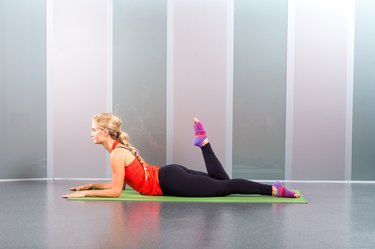
Strengthen your glutes and hamstrings and stretch your hip flexors and quadriceps with the single-leg kick.
- Lie on your stomach and prop yourself up on your forearms, with your shoulders aligned over your elbows and your forearms parallel.
- Exhale, contract your abdominals and the backs of your legs, keeping the legs straight and the toes pointed.
- Bend the left knee, inhale and raise the lower leg off the mat, pulling it in toward your buttock with two quick pulses. ("But don't over-reach the leg; that will strain the lower back," Martin says.)
- Extend the leg again.
- Do six reps on each leg.
Tip
Beginner modification: Rest your upper body on the mat by folding your arms and placing your forehead on the backs of your hands.
9. Single-Leg Circle
"This is a great way to strengthen your pelvic floor and create mobility in your hip and hamstrings," says Martin. "Using your transverse abdominals stabilize your hips while moving your leg freely inside the joint."
- Lie on your back with your arms alongside your body.
- Exhale as you pull your right knee into your chest, then inhale and extend your leg straight up with pointed toes.
- Point your toes at the ceiling and flex your left foot.
- Contract your core muscles and press your lower back into the mat.
- Exhale as you bring the right leg across the midline of the body, moving in an arc so your leg comes about a foot from the floor.
- Inhale at the bottom of the arc and bring the leg straight back to the starting position. Do 6 reps on each leg.
Tip
Beginner modification: Keep the top leg slightly bent or keep both knees bent with the foot of the lower leg flat on the floor.
10. Rolling Like a Ball
You'll love the feel of this exercise, as it massages your back muscles, while also helping to improve your balance.
- From sitting, place your feet on the floor and round your back slightly.
- Grasp gently behind your knees and inhale as you roll backward, maintaining the same distance between your knees and your torso.
- Inhale and roll back up, keeping your chin tucked in toward your chest. Stop for a moment to balance on your hips. Try not to touch your feet to the floor.
- Do six reps.
Tip
Beginner modification: Don't roll back. Just lift your feet off the mat and attempt to balance on your hips.