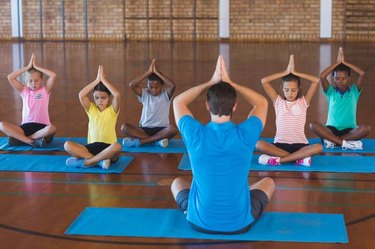
From first graders to college seniors, students may have youth on their side — but that doesn't mean their lives are pressure-free. Hours a day sitting at desk or computer monitor and more hours doing homework cause a young body to tense up. Social and family pressures and, unfortunately, anxiety, abuse and bullying also take their toll. It all adds up to the same high stress levels that have caused the grown-up world to flock to yoga classes to find Zen.
It's therefore not surprising that educators are becoming increasingly interested in providing yoga classes at school. In fact, a 2015 survey by the journal Advances in Mind/Body Medicine found yoga being offered in 940 U.S. schools. Whether you're a student or the parent of one, you'll find the benefits of yoga for students to be quite compelling.
Video of the Day
Video of the Day
Read More: Yoga Sequences for Kids
Overall Academic Improvement
Stress is a major obstacle to academic achievement, and yoga's stress relief powers have been shown to boost student performance. A 2009 International Journal of Yoga study of 300 students looked at yoga's effect on the stress levels of adolescent students. After seven weeks of practicing asanas, breathing exercises and meditation, the students registered lower stress levels and higher academic performance. A 2015 study in the journal Evidence-Based and Complementary Medicine of 95 high school students found that yoga was superior to regular physical education classes in protecting against a slide in GPA as the school year wore on.
Improved Memory
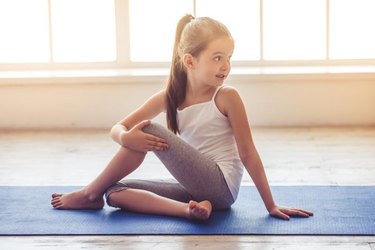
Yoga has been shown to improve memory in both adults and children, a benefit that would seem certain to improve academic performance. In a 2003 study in the Indian Journal of Physiology and Pharmacology, 30 children were divided into three groups: yoga camp, fine arts camp or control group. The yoga group trained in asanas, breathing exercises, meditation and cleansing rituals for 10 days. The result was a 43 percent improvement in spatial memory test scores in the yoga group. (By comparison, the fine arts and control groups showed no changes.) In another study by the journal Pediatric Physical Therapy, 108 school children were divided into 4 groups, each of whom practiced a different style of pranayama (breathing exercises). Each of the four groups saw spatial memory scores improve by an average of 84 percent.
Improved Attention Span
Controlling attention is a challenge for children, partly because the brain's frontal lobes, which control the power of attention, mature later than some other functions. Yoga requires attention, which can be a challenge for younger yogis, but it has also been found to enhance the ability to control attention, even in hyperactive children. In fact, studies of yoga as a palliative for ADHD have shown promise across the board. In several studies reviewed by the journal Psychiatry, children with ADHD showed decreased symptoms and in some cases were able to lower dosages of medication.
Read More: Yoga Lesson Plans for Kids
- Evidence Based Complementary and Alternative Medicine: Are There Benefits from Teaching Yoga at Schools? A Systematic Review of Randomized Control Trials of Yoga-Based Interventions
- Adv Body/Mind: School-based Yoga Programs in the United States: A Survey
- IJOY: Effect of yoga on academic performance in relation to stress
- Journal of Evidence Based and Complementary Medicine: Yoga May Mitigate Decreases in High School Grades
- Indian Journal of Physiology and Pharmacology: SPATIAL AND VERBAL MEMORY TEST SCORES FOLLOWING YOGA AND FINE ARTS CAMPS FOR SCHOOL CHILDREN
- PNAS: Dynamic mapping of human cortical development during childhood through early adulthood