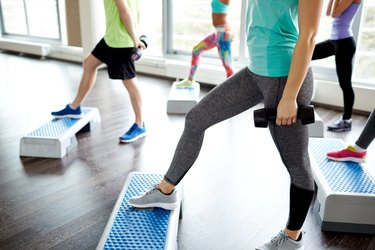
Step aerobics was introduced in the 1980s as part of the aerobics craze, and it's still popular in gyms and health clubs. Stepping up, over and around an adjustable step to the beat of high-energy music gives you an excellent total-body workout that's good for burning fat, building muscle and improving your fitness. A step class can be an intense, however, so consult your doctor before you start.
What It's All About
Video of the Day
You can expect sets of choreographed maneuvers on, off and around a raised platform. The accompanying energetic music inspires you to perform movements designed to work the lower body, upper body, core and cardiovascular system.
Video of the Day
In gyms and health clubs, plastic aerobic steps with nonslip surfaces on top are used. Make your workout easier or more challenging by adjusting the height. Many step aerobic classes also employ resistance training using weights or bands. Depending on the class, you might be encouraged to incorporate other equipment such as balls, kettlebells or even jump ropes.
If you can't get to a gym, buy a step and create your own routine or follow a YouTube video or DVD.
Get Your Heart Pumping
Exercising with an aerobic step provides several worthy fitness benefits. The stepping and jumping movements in a step aerobics class challenge your heart and lungs. Your heart rate rises, your breathing becomes more rapid and you begin to sweat. This type of activity challenges your cardiovascular system and makes it stronger over time. Regular cardio exercise, such as step aerobics, can help manage or lower high blood pressure and prevent heart disease.
Step Up Exercise for Weight Loss
Step aerobics can burn a lot of calories, especially if it's done vigorously. Doing step aerobics for 30 minutes can burn between 210 to 311 calories, depending on your weight and the intensity of the workout. Burning calories through exercise, when combined with a reduced-calorie diet, can help you lose body fat and achieve a healthy weight. Maintaining a healthy body weight can help prevent illnesses such as diabetes, heart disease and cancer.
Muscle and Bone Health
A step workout is a weight-bearing activity. Your body has to work against gravity, which puts stress on muscles and bones. This stress causes them to grow stronger. Stepping up and over the raised platform repeatedly is challenging for the leg muscles. Saying balanced while doing single-leg moves strengthens the core. Classes also include moves to tone and strengthen the upper body. Having more lean muscle mass boosts your metabolism and makes it easier for you to control your weight.
The Benefits Keep on Coming
Working with the step can be challenging at first, especially if your balance and coordination aren't strong. But regular step aerobics will actually help you improve your balance, agility and coordination, which is important for sports and as you age.
It's proven that cardio exercise improves your mood and can fight depression and anxiety. Step aerobics is typically a group class, which provides social engagement. The music and pace of the class are uplifting, which can elevate your mood.
Step aerobics is adaptable to all ages and fitness levels. Those just starting out can use a low step and do slow and controlled movements with no weights. Seasoned athletes can up the vertical challenge and add advanced steps and weights to really test their mettle.
Read more: Basic Aerobic Dance Steps