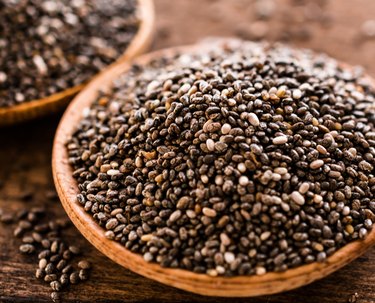
Touted for their health benefits, chia seeds are chock full of nutrients, including omega-3 fatty acids, fiber, protein and zinc, according to the Harvard T.H. Chan School of Public Health. But is it possible to have too much of a good thing?
Fiber: Pros and Cons
Video of the Day
As an essential part of your diet, dietary fiber aids with bowel health, cholesterol levels and maintaining a healthy weight, states the Mayo Clinic. The recommendation for men 50 or younger is to consume 38 grams of fiber a day and for women 50 or younger, 25 grams.
Video of the Day
"In just one ounce of chia seeds, there are 10 grams of fiber," says Caitlin Lewis, RD, a dietitian and founder of Lowcountry Nutrition, based in Bluffton, South Carolina. "Fiber is such an important part of a well-balanced diet, especially for gut health, metabolic flexibility, a healthy heart and stabilization of blood sugar."
"Like everything else, too much of a good thing can have consequences," she adds. "If you eat too much fiber at one time, or in one day, you may experience constipation, cramping, bloating, gas and even mineral deficiencies."
As Mayo Clinic points out, the soluble fiber content of chia seeds can help slow digestion, which in turn may help prevent blood sugar spikes after meals.
Mayo Clinic recommends that you moderately increase the fiber you consume so it allows your body and digestive system to adjust to the change. It's also important to stay hydrated as you increase fiber in your diet.
Swallowing Issues
Though they're small, chia seeds can really expand and swell up. Add water or any other liquid to chia seeds and they absorb up to 27 times their weight, according to the American College of Gastroenterology (ACG).
And as Harvard's School of Public Health points out, a case of an individual seen in the emergency room after eating dry chia seeds made national headlines when it caused a blockage of the esophagus. The ACG notes that this type of situation can be difficult to clear with standard tools used for removing foreign bodies from the digestive tract.
ACG recommends that people who deal with swallowing problems, such as dysphagia, be aware of the impact chia seeds can make if they're consumed dry. Mixing chia seeds with sufficient amounts of liquid and allowing them to expand fully, before eating them, prevents a choking hazard.
Harvard also notes that moist foods, such as oatmeal or yogurt, are good base options for sprinkling chia seeds, but it's still important to eat them with care. Always let them set in liquid before you consume them.
Read more: How Much Chia Seed Should Be Eaten?
Interactions with Medications
Due to the nutrient-rich fatty acid properties of chia seeds, their impact on cardiovascular markers, including cholesterol and blood pressure, have been studied in animals and humans, according to Harvard. Based on the evidence at this point, though, experts feel that chia seeds alone do not have a significant impact on cardiovascular health but may be a nice addition to an overall plant-forward diet rich in omega-3s from other sources.
For instance, one review of research, published in Nutricion Hospitalaria in November 2015, examined results from seven studies and concluded that further research is needed to glean any benefits because chia seeds did not show any significant effects on cardiovascular health markers in these studies, and most of the studies had methodological limitations.
Also, Memorial Sloan Kettering Cancer Center notes that, based on a small study, consuming large amounts of chia seeds may have blood-pressure-lowering effects, which could be a complication for people taking medication for high blood pressure (hypertension).
The study referred to was a very small but randomized study of 26 people, published in the November 2014 issue of Plant Foods for Human Nutrition. Participants consumed either 35 grams of chia flour or a placebo each day for 12 weeks. Results showed that blood pressure was reduced in both treated and untreated people with hypertension who consumed the chia flour.
While this is a possibility, more research would need to be done to make any definitive conclusions, Nonetheless, if you have high blood pressure concerns, checking with your doctor is always a good idea.
Read more: How to Use Chia Seeds for Weight Loss
- Harvard T.H. Chan School of Public Health: “Chia Seeds”
- Mayo Clinic: “Dietary Fiber: Essential for a Healthy iet”
- Caitlin Lewis, MS, RD, dietitian, Lowcountry Nutrition, Bluffton, South Carolina
- Nutricion Hospitalaria: “Effect of Chia Seed (Salvia Hispanica L.) Consumption On Cardiovascular Risk Factors in Humans: A Systematic Review”
- Memorial Sloan Kettering Cancer Center: “Chia”
- Plant Foods for Human Nutrition: “Chia Flour Supplementation Reduces Blood Pressure in Hypertensive Subjects”
- American College of Gastroenterology: “Watch It Grow: Esophageal Impaction With Chia Seeds”