
Difference Between a Triathlon Bike & a Time Trial Bike
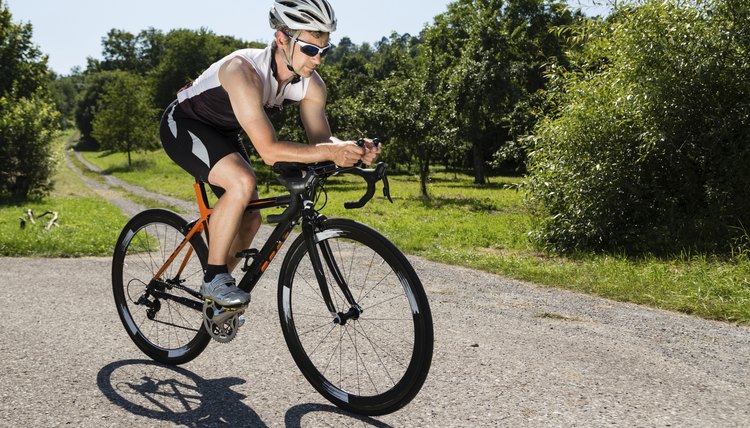
If you put a triathlon bike side-by-side with a time trial bike, it would be hard to tell the difference. In fact, at first glance, they look identical. Both are slender road bikes with aero-bars designed for performance. You wouldn't want to accidentally mix the bikes up, however, as each is specially engineered to fit the task at hand.
Comfort
The most significant difference is comfort. By design, triathlon bikes are made to go the distance. Triathletes often ride through hilly terrain, cover distances up to 112 miles during races and must transition to running quickly and efficiently. In contrast, time trial riders get off the bike completely spent. Their bikes are designed for only one thing—speed. As such, triathlon bikes favor a more relaxed position and a lighter frame than time trial bikes.
Seat Tube Angle
Triathlon bikes often have a steeper seat tube angle, which pushes riders' hips forward and keeps their hamstrings from working too hard, saving strength for the run. However, time trial bikes must adhere to International Cycling Union (ICU) requirements mandating that the saddle nose of the seat tube be 5 cm from the center of the bike’s bottom bracket. The positioning on a time trial bike is intended to help the rider obtain the maximum amount of power from his legs.
Aerodynamics
The steeper seat tube angle gives triathletes slightly better aerodynamics than time trial riders. However, the aero-bars on both bikes help competitors lean forward with their heads down to shave off valuable seconds. To obtain optimum performance, be sure to get your bike configured by a professional bike fitter. These specialists know how to custom-fit your ride to your body type for maximum performance.
Multi-Purpose Bikes
Some manufacturers are creating bikes that can be used for both triathlons and time trials. However, be sure to read through the bike specs clearly to ensure the bike meets strict ICU policies before purchasing one for time trials. According to the ICU, time trial bikes must not measure more than 185 cm in length and 50 cm in width, they must not contain elbow or forearm resting pads and no part of the handlebar can extend past a vertical line passing through the front wheel axle. The International Triathlon Union, ITU, is far less strict. Triathletes are allowed to ride whatever type of bicycle they prefer.
Writer Bio
Based in San Diego, California, Jill Blessing has been writing since 1997. Her work has been published in "Triathlete" magazine, "CMYK" magazine, "Kansas City Homes & Gardens" magazine and "The Columbia Missourian." She holds a bachelor's degree in journalism from the University of Missouri.