
Above-Ground Pool Workout Ideas
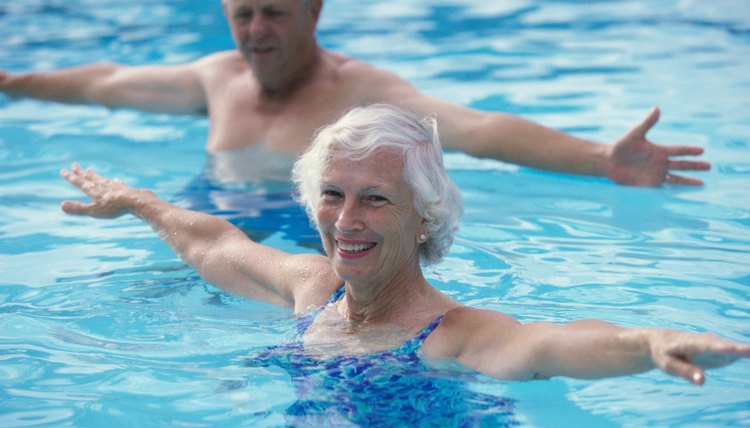
Swimmers who swim aerobically typically live healthier and longer lives than people who don’t exercise. Swimming represents only one method of aquatic activity that you can perform in any type of pool — including traditional below-ground models or less expensive above-ground pools. Understand how water workouts in your pool can contribute to your fitness to ensure your well-being. Obtain your doctor’s permission before starting any exercise regimen.
Swimming & Better Health
Swimming is a popular method of aerobic exercise that you can perform effectively in above-ground swimming pools. While you’ll be unable to dive — since above-ground pools typically have less depth than traditional pools — your ability to swim at a pace that increases your breathing and heartbeat won’t be compromised. The Merck Manuals Medical Library reports that swimming at a moderate pace provides a whole-body workout and is ideal for people with joint or muscle weakness. Swimming for up to 30 minutes on most days of the week also rewards your body with a lower risk for the flu or stroke, as well as for diseases like obesity and cancer.
Water Walking
Above-ground pools are ideal for water walking — a type of water aerobics that requires continuous movement in waist- or shoulder-high water. The exercise is ideal for older adults with balance issues, since the water eliminates the risk for falls against a hard ground. Perform a water walk by standing erect with your shoulder back. Step forward and place your entire foot — not your toes — on the bottom of the pool and allow your heel to touch ground first, followed by the ball of your foot. Reduce your risk for back strain by tightening the muscles in your back and stomach as you move. Some people water walk backward or to the side. Add more challenge to your exercise by lifting your knees as high as possible with each step.
Aquatic Weightlifting
Foam barbells — often called water weights — challenge your muscles with resistance in the same manner as regular barbells and dumbbells. Perform an arm exercise by standing in an above-ground pool with your arms down at your sides. Grasp the bars of the barbells with your palms up. Raise your forearms to the water’s surface with your wrists straight and your elbows close to your body. Rotate the weights so that your palms face the pool bottom. Extend your hands downward until your arms are straight. Perform between 12 and 15 repetitions.
Leg Strengthening Routine
Above-ground pools are an ideal locations for aquatic exercise that strengthens your leg muscles. Begin a leg exercise by tying a water noodle around your foot. Stand so that your back is to the side of the pool. Place your arms on the side of the pool for stability. Extend your leg to the front of your body and then flex your knee to a 90-degree position. Return to your original pose and repeat up to 15 times before switching to your other foot.
References
Writer Bio
Toby Pendergrass began writing and editing in 1998. He has served as editor for numerous custom health publications and physician journals. His work has appeared in publications such as Hospital Corporation of America's "YOU." He enjoys writing about cardiology and cancer care and holds a Bachelor of Arts in communication from the University of Tennessee at Chattanooga.