
How to Lessen Arm Pain When Using Crutches
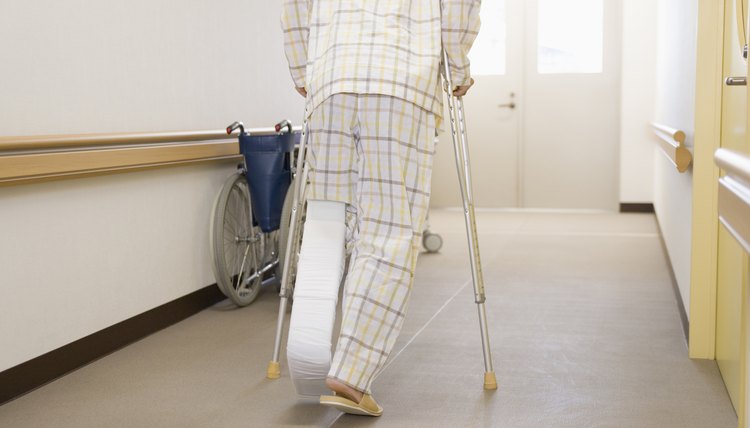
As your torso, shoulders, elbows and wrists work together to compensate for a hurt foot or leg, you may begin to experience arm pain. This is especially the case if you're using your crutches improperly. You can improve your overall experience by adopting a few pain-reducing basics of crutch operation.
Keeping Underarms off the Crutch Pad
The pad at the top of each crutch should not touch your underarms as you move around. Each pad should be set 1.5 to 2 inches below the armpits as you stand with your shoulders at ease. The pads are there only to stabilize the crutch between your inner arm and the side of your upper torso, not to carry your weight. When you aren't moving, resist the temptation to slump down onto the crutch pads. Your armpits are not designed to support your body's weight. Keeping your weight off the crutch pad lessens arm pain by removing harmful pressure on the brachial plexus nerves that run along your armpit and down the inside of your arm.
Improving Contact With the Crutch Pad
As the top of the crutches are stabilized by your upper torso and inner arm, the friction can become uncomfortable. Improving your technique by tightening your arm and torso squeeze on the crutches can reduce pad movement, which causes irritation. Do this by placing the tips of the crutches in front of your feet in a triangle formation that is just wide enough for you to move through but narrow enough for you to support your weight by pushing down on the handles. Also, high-glycerin gel pads that slip over the top crutch brackets are available. They're designed to reduce skin irritation and prevent friction.
Spread the Work Around
The hand grip of the crutch should be even with your hip so that when you grip it, your elbow is slightly bent. As you lift your weight up and swing forward with each step, use your triceps to initialize the motion while making a conscious effort to engage your chest, shoulders and forearms to help with the job of stabilizing your weight. Spreading the work around by activating your entire upper body will reduce soreness in your triceps and forearms.
Simplify Your Routine
Having to get around on crutches is like suddenly deciding to go to the gym every morning to exercise only your arms with no rest days in between workouts. Overworking any muscle can cause it atrophy and actually become weaker. Reduce how much running around you do every day, especially at first. Taking frequent breaks will help your sore arms recover between hobbling from one place to another. You can also reduce the pain from exertion in your arms by shortening your crutch stride. Smaller steps put less pressure on your muscles while reducing the chances of a falling accident.
References
- Warees WM, Slane M. Crutches. [Updated 2019 Mar 25]. In: StatPearls [Internet]. Treasure Island (FL): StatPearls Publishing; 2019.
- Maguire C, Sieben JM, Scheidhauer H, Romkes J, Suica Z, De bie RA. The effect of crutches, an orthosis TheraTogs, and no walking aids on the recovery of gait in a patient with delayed healing post hip fracture: A case report. Physiother Theory Pract. 2016;32(1):69-81.
Writer Bio
Luke Schmaltz has extensive experience in martial arts and personal training, which informs his writing on health and fitness. He also spends time in the entertainment world as a songwriter and performer. He has written and produced numerous studio albums and published many articles online.