
What does fact checked mean?
At SportsRec, we strive to deliver objective content that is accurate and up-to-date. Our team periodically reviews articles in order to ensure content quality. The sources cited below consist of evidence from peer-reviewed journals, prominent medical organizations, academic associations, and government data.
The information contained on this site is for informational purposes only, and should not be used as a substitute for the advice of a professional health care provider. Please check with the appropriate physician regarding health questions and concerns. Although we strive to deliver accurate and up-to-date information, no guarantee to that effect is made.
Good Exercises With Dumbbells for Kids
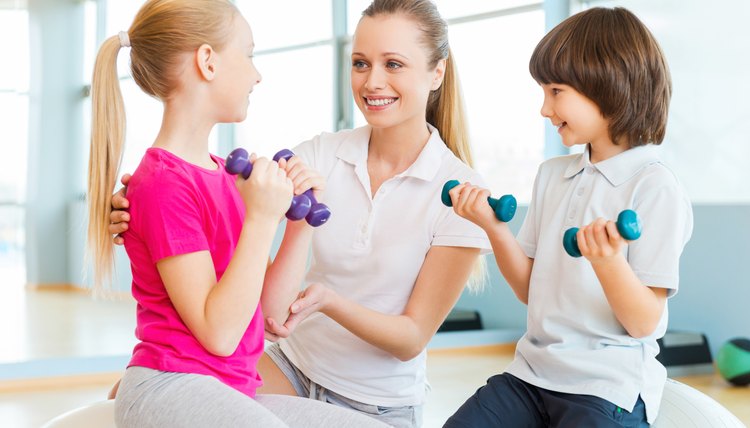
The American Academy of Pediatricians says children as young as 6 can benefit from weight exercise, with proper precautions and training. Proper weight training can improve muscle development and strengthen bones and joints. It should be combined with aerobic training and can be incorporated into training for other sports, like soccer or baseball. Dumbbells are ideal for such training because they can be light, are easy to use and can work all muscle groups.
Start Light
Start with very light weights, low repetitions and very basic dumbbell exercises. Use no more than 2- or 3-pound weights; some companies make special dumbbells for children with vinyl covers in bright colors. You can even do dumbbell exercises for young children with soda bottles filled with water or sand. It is the exercise and technique that are important, not the tool.
Technique
Emphasize technique with children, proper breathing out during lifting and breathing in during recovery, and consistent good posture. Teach the basic movements without weights at first, so the child learns the proper way to lift or step without risking injury. Avoid any exercises that put strain on the spine and discourage any competitive or bodybuilding type of lifting.
Low Reps
Use few repetitions, no more than a half dozen with each exercise at first, and work only two or theer days a week. Add more repetitions gradually but don't add more workouts; a body needs at least one full day of rest between each weight session and children require more intervals. Do aerobic or specific sports activity on days between weight sessions.
Curls, Presses, Raises
Begin with simple curls, presses and raises. Do curls with a dumbbell in each hand and the arm straight down, then lift the weight to the shoulder with the bicep. Basic presses are done on a bench. Lie on the back with dumbbells at the shoulders, then lift them straight up, or sit on the bench and lift the dumbbells overhead from the shoulders. Raises are done standing or seated, lifting dumbbells with arms at the sides until arms are fully extended, at first straight in front, then to each side.
Add Legs
Add leg exercises as training progresses. Use squats, holding a dumbbell in each hand at the sides. Bend the knees until the body is in a sitting position. Lunges are done holding a dumbbell in each hand and stepping forward with one leg, bending the other at the knee until it almost touches the ground. Change legs on lunges and do the same number of repetitions with each.
Add Options
Eventually offer a youngster, especially those in their teens, more dumbbell exercise options, such as lateral raises, flies and rows. Lateral raises are dumbbell lifts to the front and sides. Flies are lifts with dumbbells on arms fully extended and moved from front to side. Rows duplicate rowing actions, moving the arms like pulling oars but holding dumbbells.
References
Writer Bio
Bob Haring has been a news writer and editor for more than 50 years, mostly with the Associated Press and then as executive editor of the Tulsa, Okla. "World." Since retiring he has written freelance stories and a weekly computer security column. Haring holds a Bachelor of Journalism from the University of Missouri.