
What does fact checked mean?
At SportsRec, we strive to deliver objective content that is accurate and up-to-date. Our team periodically reviews articles in order to ensure content quality. The sources cited below consist of evidence from peer-reviewed journals, prominent medical organizations, academic associations, and government data.
The information contained on this site is for informational purposes only, and should not be used as a substitute for the advice of a professional health care provider. Please check with the appropriate physician regarding health questions and concerns. Although we strive to deliver accurate and up-to-date information, no guarantee to that effect is made.
Ski Machine Vs. Elliptical
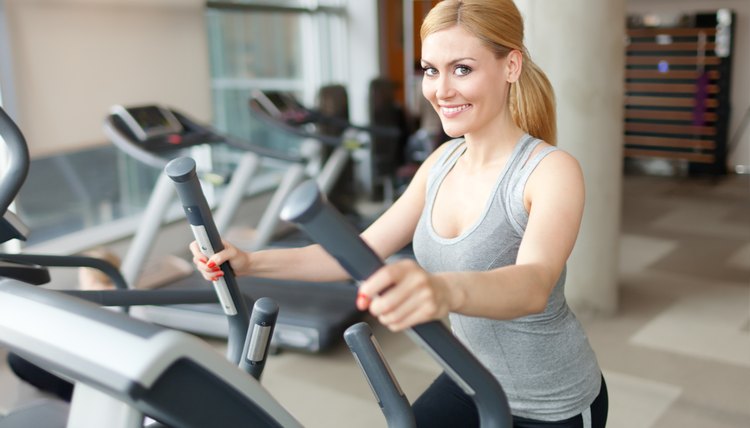
Both ski machines and ellipticals provide low-impact aerobic exercise. Working out on either machine burns roughly the same amount of calories as running; with little or no shock to the joints. The machines differ in the motion of their strides. Ski machines emulate the act of cross-country skiing, wherein the feet slide back and forth along the ground. Ellipticals mimic walking or running, where the feet travel in an oblong circle.
Function
Ski machines consist of footpads that slide on rails and an apparatus that mimics the act of using ski poles. This can be as simple as a cord with handles at each end, attached to a flywheel. Elliptical footpads attach to rails that rotate in an oval-shaped stride. This allows you to change the workout by alternately pedaling forwards and backwards. Ellipticals also include handles that enable the arms to share some of the work.
Types
Ski machines come in either independent or dependent leg motion. Dependent designs mean that the skis are attached, such that as you draw one foot forward, the other goes back automatically. Independent ski machines require you to exert forward pressure with one leg and backward pressure with the other to move the skis. Ellipticals generally use a dependent motion for the lower body. Some models use independently moving handles to demand more work from the arms. The All Ellipticals website states that certain designs allow you to alter the shape of the oval, changing which muscle group gets most of the burden.
Effects
Harvard Health reports that ski machines used by a 155-lb. person can burn up to 353 calories after a half an hour of working out. Compare this to about 335 in the case of elliptical machines. If you weigh more, you’ll burn more calories. Whether you use an elliptical or a ski machine, the best calorie burner is the machine that requires the user to synchronize the motion of each arm and leg on her own.
Expert Insight
When using either machine, keep your back straight, your head up and your shoulders back. To work your legs and trunk more intensely on an elliptical trainer, All Ellipticals suggests dropping your hands. This forces your core and lower body to take over keeping you balanced. When working out on a ski machine, find a smooth back-and-forth rhythm with your feet before coordinating the motion with your hands.
Considerations
As both ski machines and ellipticals are intended to provide aerobic workouts, they’re most effective when you keep your heart rate in the aerobic range for your body. Most ellipticals come with a heart-rate monitoring system. Often the ski machines that demand the most coordination from the user, and thus the best workouts, are not computerized. In these cases, a heart-monitoring watch can help you stay in the range that will give you the most out of your time on the machine. But unless you already own a ski machine, you might find a hard time finding a gym who hasn't supplanted them for the elliptical.
References
- Harvard Health Publications: Calories Burned in 30 Minutes for People of Three Different Weights
- All Ellipticals: How to Use Elliptical Trainers
- Women's Home Workout Bible; Brad Schoenfeld
- Tsai LC, Lee SJ, Yang AJ, Ren Y, Press JM, Zhang LQ. Effects of Off-Axis Elliptical Training on Reducing Pain and Improving Knee Function in Individuals With Patellofemoral Pain. Clin J Sport Med. 2015;25(6):487–493. doi:10.1097/JSM.0000000000000164
- Schleppenbach LN, Ezer AB, Gronemus SA, Widenski KR, Braun SI, Janot JM. Speed- and Circuit-Based High-Intensity Interval Training on Recovery Oxygen Consumption. Int J Exerc Sci. 2017;10(7):942-953.