List of All Chemicals in Cigarette Smoke
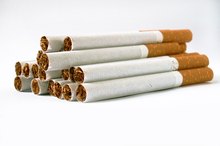
Cigarette smoking and other types of tobacco smoke are responsible for approximately 438,000 premature deaths in the United States every year, the National Cancer Institute reports. Although nicotine is responsible for the addictive qualities of tobacco smoke, it is actually the other chemicals in smoke that cause most of the damage to the body. Cigarette smoke contains over 4,000 chemicals. Fifty of those are carcinogens, compounds that are known to cause cancer, and another 200 are harmful in other ways. Some of the most harmful chemicals are listed below.
Benzene
Benzene is a colorless chemical derived from petroleum. In cigarettes, benzene is used as an adhesive to seal the paper holding the tobacco. Exposure to benzene has been linked to leukemia, a cancer of the blood cells. Benzene is also found in gasoline and rubber cement, according to the American Lung Association.
- Benzene is a colorless chemical derived from petroleum.
- Benzene is also found in gasoline and rubber cement, according to the American Lung Association.
Toxic Gases
Toxic Vapors Emitted From New Tires
Learn More
Carbon monoxide, abbreviated CO, is a colorless, tasteless, orderless gas that is also found in car exhaust. This gas can quickly kill people when breathed in large amounts. CO is produced from the burning of the tobacco and paper, explains QuitSmokingStop.com. Cigarette smoke also contains hydrogen cyanide, a highly poisonous gas that was used in Nazi gas chambers during World War II. Butane and methane are two additional toxic gases released in cigarette smoke.
- Carbon monoxide, abbreviated CO, is a colorless, tasteless, orderless gas that is also found in car exhaust.
- Butane and methane are two additional toxic gases released in cigarette smoke.
Acids and Cleaners
Acetic acid and stearic acid are two acidic compounds included in cigarette smoke. Ammonia, a common component of kitchen and bathroom cleaners, is also added to tobacco because it causes nicotine to be absorbed into the blood more quickly. Ethylene oxide is another harsh cleaning agent found in cigarettes that is also used to sterilize medical equipment, the National Cancer Institute explains. Cigarette smoke also contains acetone, a chemical used to dissolve other chemicals.
- Acetic acid and stearic acid are two acidic compounds included in cigarette smoke.
- Ammonia, a common component of kitchen and bathroom cleaners, is also added to tobacco because it causes nicotine to be absorbed into the blood more quickly.
Formaldehyde
Health Problems Related to Natural Gas Leaks
Learn More
Formaldehyde is a chemical that is widely used in many industrial processes. It is added to cigarettes to extend their shelf life, the American Lung Association explains. Formaldehyde is also highly poisonous and often used to preserve dead bodies because no forms of life can grow in it. Formaldehyde is known to cause cancer, and also irritates the skin as well as the respiratory and gastrointestinal systems.
- Formaldehyde is a chemical that is widely used in many industrial processes.
- Formaldehyde is also highly poisonous and often used to preserve dead bodies because no forms of life can grow in it.
Heavy Metals
Several heavy metals are also in cigarettes, including lead, mercury, cadmium, beryllium, chromium, nickel and arsenic, which is used in rat poison. Cigarettes also contain polonium-210, a radioactive element, according to the National Cancer Institute. Exposure to high levels of these heavy metals is linked to different types of cancer.
Vinyl Chloride
Vinyl chloride is a component of plastic that is used in cigarette filters. When smoke passes through the filter, it picks up some of the vinyl chloride. This chemical increases the risk of brain, liver and lung cancers, as well as leukemia and lymphoma, the National Cancer Institute reports.
Related Articles

Toxic Vapors Emitted From New Tires
Learn More

Health Problems Related to Natural Gas Leaks
Learn More

10 Causes of Air Pollution
Learn More

List of Toxic Ingredients Found in Skin Care
Learn More

Negative Effects of Black & Mild Cigars
Learn More
Marlboro Cigarette Ingredients
Learn More

The Risks of Smoking Black & Mild Cigars
Learn More

The Effects of Tar in Smoking
Learn More

Breathing Ionizer Dangers
Learn More

The Effects of Styrofoam Smoke
Learn More
References
- Nationcal Cancer Institute: Quitting Smoking: Why To Quit and How To Get Help
- Centers for Disease Control and Prevention. Chemistry and Toxicology of Cigarette Smoke and Biomarkers of Exposure and Harm. In: How Tobacco Smoke Causes Disease: The Biology and Behavioral Basis for Smoking-Attributable Disease: A Report of the Surgeon General. Atlanta, GA: Centers for Disease Control and Prevention (US); 2010.
- National Cancer Institute. Harms of Cigarette Smoking and Health Benefits of Quitting. Updated December 19, 2017.
- Jaishankar M, Tseten T, Anbalagan N, Mathew BB, Beeregowda KN. Toxicity, mechanism and health effects of some heavy metals. Interdiscip Toxicol. 2014;7(2):60-72. doi:10.2478/intox-2014-0009
- Seiler RL, Wiemels JL. Occurrence of ²¹⁰Po and biological effects of low-level exposure: the need for research. Environ Health Perspect. 2012;120(9):1230-1237. doi:10.1289/ehp.1104607
- Tsai J, Homa DM, Gentzke AS, et al. Exposure to Secondhand Smoke Among Nonsmokers - United States, 1988-2014. MMWR Morb Mortal Wkly Rep. 2018;67(48):1342-1346. doi:10.15585/mmwr.mm6748a3
- Health Risks of Secondhand Smoke. American Cancer Society.
- Environmental Tobacco Smoke (ETS): General Information and Health Effects. Canadian Centre for Occupational Health and Safety.
- Radiation in Tobacco. United States Enviromental Protection Agency.
- Centers for Disease Control and Prevention. How Tobacco Smoke Causes Disease: The Biology and Behavioral Basis for Smoking-Attributable Disease: A Report of the Surgeon General. Atlanta (GA): Centers for Disease Control and Prevention (US); 2010.
Writer Bio
Matthew Busse has pursued professional health and science writing since 2007, writing for national publications including "Science Magazine," "New Scientist" and "The Scientist." Busse holds a doctorate in molecular biology from the University of California-San Diego.