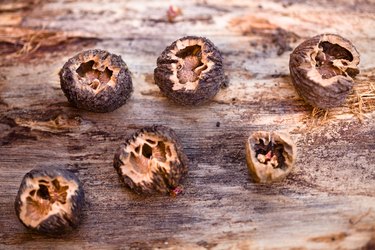
Black walnut has a long history of use in agriculture, medicine and commercial industry. Native Americans used the hulls to make dyes. Today, black walnut hull extracts are used in natural hair color formulas and self-tanning lotions.
In natural medicine, the hulls are made into preparations to treat gastrointestinal disorders and parasitic and fungal infections, according to a 2013 article published by Journal of Ecosystems & Management. However, there are some adverse black walnut side effects.
Video of the Day
Video of the Day
Avoid Allergic Reactions
According to Food Allergy Research & Education (FARE), you should avoid black walnut products if you have a known sensitivity to other tree-nuts. FARE also warns that tree nuts can sometimes be found in black walnut hull extract as well.
Allergic reactions to black walnut hull range in severity. You might experience mild symptoms such as an itchy nose or hives, or severe problems including difficulty breathing, swelling in the face and throat, vomiting, fainting and a weak or rapid pulse.
According to Mayo Clinic, seek immediate medical attention if you have any of the following symptoms of food allergy after consuming black walnut hulls: difficulty breathing, rapid pulse, dizziness/lightheadedness or a severe drop in blood pressure.
Toxicity of Black Walnut Hull
The active compound in black walnut is juglone. While this substance is found in all parts of the tree, according to Purdue University's Department of Horticulture, the fruit, roots and hulls contain the highest concentrations. The antimicrobial properties of this natural chemical that fights parasites and fungi also make it toxic. In fact, juglone is also used as a pesticide.
According to the University of Georgia, Warnell School of Forestry & Natural Resources, the effects of juglone on humans are similar to cyanide. The toxicity of juglone is so high that very small amounts can cause illness, sedation or even death for humans and animals.
Toxicity in Animals
Exposure to black walnut in any form is known to produce certain reactions in ponies and horses ranging from localized dermatitis to a type of vascular disease called equine laminitis that affects the feet. According to a paper written by Dr. Bob Wright and Todd Leuty for the Ontario Ministry of Agriculture Food and Rural Affairs, black walnut hulls are sometimes found in wood shavings used to produce horse bedding material.
The authors note that equine sensitivity to juglone is so great that as little as 20 percent black walnut hulls present in bedding material can result in laminitis within one to two days of exposure.
Another hazard exists from eating nuts that have fallen to the ground from nearby black walnut trees. If the walnuts become moldy, they may contain a neurotoxin called penitrem A, which can poison not only horses and ponies, but livestock and other animals as well.
Read more: 5 Side Effects of Eating Too Many Peanuts
Protect Your Garden
If you have black walnut trees on your property, be aware that juglone from falling nuts may affect other vegetation if planted in close proximity. The University of Georgia recommends keeping gardens and nurseries separated to avoid black walnut side effects.
Food plants that are particularly vulnerable to juglone poisoning include grades, tomatoes, blackberries, potatoes, peppers and other root-crop vegetables.
- Purdue University: "Black Walnut Toxicity"
- Ontario Ministry of Agriculture Food and Rural Affairs: "Black Walnut and Butternut Poisoning of Horses"
- Journal of Ecosystems & Management: "A Summary of Extraction, Synthesis, Properties, and Potential Uses of Juglone: A Literature Review"
- Food Allergy Research & Education: "Tips for Avoiding Your Allergen"
- Mayo Clinic: "Food Allergy"
- University of Georgia, Warnell School of Forestry & Natural Resources: "Black Walnut Allelopathy: Tree Chemical Warfare"