Ginseng's Effect on Your Urine Flow
Ginseng, derived from the root of the American and Asian ginseng plants, is not only one of the most popular herbs in the United States, but also one of the costliest herbs in the world, according to the “Gale Encyclopedia of Mental Disorders. 1”
If you are experiencing serious medical symptoms, seek emergency treatment immediately.
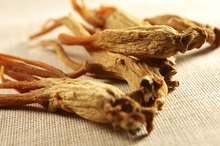
The tan-colored root slightly resembles the human figure and its Latin name, Panax, meaning cure-all, reflects its widespread use to treat conditions ranging from general fatigue to serious ailments such as cancer and asthma. Furthermore, the Overactive Bladder Treatment website states that ginseng may also be beneficial for the treatment of an overactive bladder and incontinence 2.
Ginseng and an Overactive Bladder
A frequent urge to urinate due to an overactive bladder affects about 33 million Americans, according to an article on Smart Publications 4. A weak urethral sphincter, obesity, irritable bowel syndrome, medications that increase urine production, an obstructed bladder or urethra, and even frequent urinary tract infections can cause:
- an overactive bladder
- increase flow of urine
Anti-Diuretic Effect of Ginseng
Side Effects of Red Ginseng
Learn More
Similarly, the Scott and White healthcare system website states that ginseng may hinder the diuretic effect of Lasix, a drug used to eliminate fluid from the body.
The anti-diuretic interaction of ginseng with these drugs indicates that ginseng may decrease flow of urine. However, as ginseng can also interact with other drugs, you should consult your physician before taking ginseng.
Interaction With Other Medications
3"
Other drug interactions associated with use of ginseng include risk of bleeding if taken along with anticoagulants and further lowering of glucose levels if taken with insulin or other medications for treatment of diabetes. Additionally, ginseng may also interact with other herbs.
Possible Side Effects
Spearmint Tea and Caffeine
Learn More
Other possible side effects that may result from intake of ginseng include:
- high blood pressure
- insomnia
- restlessness
- euphoria
- vomiting
- diarrhea
- anxiety
- breast pain
- vaginal bleeding
- nose bleeding
Although these side effects are rare, you should only take ginseng under medical supervision to prevent any complications.
Related Articles
Side Effects of Red Ginseng
Learn More
Spearmint Tea and Caffeine
Learn More

Korean Ginseng & Pregnancy
Learn More
What Are the Benefits of Passion Flower for Menopausal Women?
Learn More
Negative Side Effects of Royal Maca
Learn More
Dandelion & Breastfeeding
Learn More
Hawthorn Berry Herb as a Diuretic
Learn More

The Side Effects of Agnus Castus
Learn More
Stevia Vs. Saccharin
Learn More
Side Effects of Saw Palmetto, Pygeum And Nettle Root
Learn More
References
- Gale Encyclopedia of Mental Disorders: Ginseng
- The Natural Bladder: Natural Herbal Alternatives for an Overactive Bladder
- Glens Falls Hospital: Patient Guide to Herb and Supplement Use
- Smart Publications: Natural Solutions for Overactive Bladder Syndrome
- Mancuso C, Santangelo R. Panax ginseng and Panax quinquefolius: From pharmacology to toxicology. Food Chem Toxicol. 2017;107(Pt A):362–372. doi:10.1016/j.fct.2017.07.019
- Arring NM, Millstine D, Marks LA, Nail LM. Ginseng as a treatment for fatigue: A systematic review. J Altern Complement Med. 2018;24(7):624–633. doi:10.1089/acm.2017.0361
- Barton DL, Soori GS, Bauer BA, et al. Pilot study of Panax quinquefolius (American ginseng) to improve cancer-related fatigue: a randomized, double-blind, dose-finding evaluation: NCCTG trial N03CA. Support Care Cancer. 2010;18(2):179–187. doi:10.1007/s00520-009-0642-2
- Best T, Clarke C, Nuzum N, Teo WP. Acute effects of combined Bacopa, American ginseng and whole coffee fruit on working memory and cerebral haemodynamic response of the prefrontal cortex: a double-blind, placebo-controlled study [published online ahead of print, 2019 Nov 18]. Nutr Neurosci. 2019;1–12. doi:10.1080/1028415X.2019.1690288
- Jenkins AL, Morgan LM, Bishop J, Jovanovski E, Jenkins DJA, Vuksan V. Co-administration of a konjac-based fibre blend and American ginseng (Panax quinquefolius L.) on glycaemic control and serum lipids in type 2 diabetes: a randomized controlled, cross-over clinical trial. Eur J Nutr. 2018;57(6):2217–2225. doi:10.1007/s00394-017-1496-x
- Mousa HA. Prevention and treatment of influenza, influenza-like illness, and common cold by herbal, complementary, and natural therapies. J Evid Based Complementary Altern Med. 2017;22(1):166–174. doi:10.1177/2156587216641831
- Seida JK, Durec T, Kuhle S. North American (Panax quinquefolius) and Asian Ginseng (Panax ginseng) preparations for prevention of the common cold in healthy adults: A systematic review. Evid Based Complement Alternat Med. 2011;2011:282151. doi:10.1093/ecam/nep068
- PennState Hershey: Milton S. Hershey Medical Center. American ginseng. Updated April 27, 2016.
Writer Bio
As a scientist and educator, Sukhsatej Batra has been writing instructional material, scientific papers and technical documents since 2001. She has a diverse scientific background, having worked in the fields of nutrition, molecular biology and biochemistry. Batra holds a PhD in foods and nutrition, and a certificate in professional technical communication.