A Breast Lump in a Male
The male breast is composed of a mixture of tissue types, any of which may give rise to a mass or swelling. Cancerous breast tumors in men are rare but do occur 4.
Men can also develop noncancerous breast disorders, causing breast lumps. The characteristics of a lump and a man's age are important criteria in evaluating any breast mass.
Male Breast Anatomy
The male breast consists mostly of fat and fibrous tissue covered by skin. An interconnecting system of breast ducts with lining epithelial cells extends through this tissue to the nipple.
Normal male breast tissue does not include lobules, which are responsible for milk production in the female. Small lymph nodes may occasionally be present, most often in the outer portion of the breast near the underarm.
- The male breast consists mostly of fat and fibrous tissue covered by skin.
- Normal male breast tissue does not include lobules, which are responsible for milk production in the female.
Gynecomastia
Causes of Itching Breasts
Learn More
Gynecomastia is a noncancerous disorder characterized by increased breast tissue in a male. It is the most common type of breast growth in men. Gynecomastia appears as a swelling or lump in one or both breasts, is generally centrally located and may be tender. The lump is formed by a proliferation of breast ducts and fibrous tissue.
Gynecomastia usually occurs around the age of puberty or in older men, and is associated with hormonal or medication effects. Men with gynecomastia sometimes have an underlying medical problem, such as cirrhosis of the liver, chronic kidney disease, an over- or under-active thyroid, or a testicular tumor.
- Gynecomastia is a noncancerous disorder characterized by increased breast tissue in a male.
Breast Cancer
Breast cancer in men is uncommon, making up less than 1 percent of all breast cancers, according to the National Cancer Institute 4. It occurs most often between the ages of 60 and 70, but may appear at any age.
Typically, breast cancer in men presents as a hard painless lump, often under the nipple 4. Overlying skin discoloration or puckering, or nipple changes may be present.
Almost all cancers arise from the ductal component of the breast. Treatment is similar to that for female breast cancer 2.
- Breast cancer in men is uncommon, making up less than 1 percent of all breast cancers, according to the National Cancer Institute 4.
- Typically, breast cancer in men presents as a hard painless lump, often under the nipple 4.
Other Breast Lumps
What Is the Difference Between a Regular Mammogram & a Bilateral Mammogram?
Learn More
Although rare, simple fluid-filled cysts or fibroadenomas of the male breast may occur. Fibroadenomas are noncancerous growths that typically feel soft or rubbery rather than hard. Cysts may be tender. Both of these conditions tend to be easily movable within the surrounding breast tissue. Other noncancerous growths of the male breast can occur but are also rare.
- Although rare, simple fluid-filled cysts or fibroadenomas of the male breast may occur.
- Other noncancerous growths of the male breast can occur but are also rare.
Miscellaneous Lumps
The surrounding tissues of the male breast can give rise to a variety of lumps. Skin cysts, or tumors, inflammatory masses or abscesses -- pockets of infection -- may present as breast lumps.
Fatty or fibrous tumors may arise in the soft tissue of the breast. Enlarged lymph nodes may also develop either in response to inflammatory conditions or cancer.
- The surrounding tissues of the male breast can give rise to a variety of lumps.
- Fatty or fibrous tumors may arise in the soft tissue of the breast.
Evaluation
Men with any persistent breast lump or swelling should consult their doctor. A man's age, medical history and an examination of the breasts are important initial factors in the evaluation. Additional tests may be recommended, such as a mammogram and breast ultrasound. A needle aspiration or biopsy may be necessary to further characterize a lump and reach a final diagnosis.
Reviewed by: Tina M. St. John, M.D.
- Men with any persistent breast lump or swelling should consult their doctor.
- A needle aspiration or biopsy may be necessary to further characterize a lump and reach a final diagnosis.
Related Articles

Causes of Itching Breasts
Learn More

What Is the Difference Between a Regular Mammogram & a Bilateral Mammogram?
Learn More
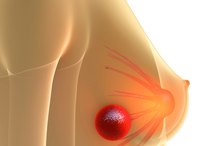
Characteristics of Breast Cancer Lumps
Learn More

Breast Bud Development Signs
Learn More

What Are the Causes of Thickness in Breast Tissue?
Learn More

Hernia Signs and Symptoms in a Male
Learn More

Causes of Testicle and Penis Pain
Learn More

What Are the Dangers of Finasteride With Testosterone?
Learn More
Early Warning Signs of Inflammatory Breast Cancer
Learn More

Soy Protein & Male Breasts
Learn More
References
- Sternberg’s Diagnostic Surgical Pathology, Fourth Edition; Stacey E. Mills, M.D.
- National Cancer Institute: Male Breast Cancer Treatment (PDQ) -- Health Professional Version
- FamilyDoctor.org: Breast Problems in Men
- American Cancer Society: Breast Cancer in Men
- Merck Manual Professional Version: Gynecomastia
- American Cancer Society. What Is Breast Cancer?
- American Cancer Society. Fibrosis and Simple Cysts in the Breast
- American Cancer Society. Fibroadenomas of the Breast
- American Cancer Society. Adenosis of the Breast
- American Cancer Society. Mastitis
- American Cancer Society. Duct Ectasia
- Nur Zeinomar Kelly‐Anne Phillips Mary B. Daly Roger L. Milne, et al. Benign breast disease increases breast cancer risk independent of underlying familial risk profile: Findings from a Prospective Family Study Cohort. Int J Cancer. 2019;145: 370-379. doi:10.1002/ijc.32112
- American Cancer Society. Intraductal Papillomas of the Breast
- Cohen MA, Newell MS. Radial Scars of the Breast Encountered at Core Biopsy: Review of Histologic, Imaging, and Management Considerations. AJR Am J Roentgenol. 2017;209(5):1168-1177. doi:+10.2214/AJR.17.18156
- American Cancer Society. Hyperplasia of the Breast (Ductal or Lobular)
- American Cancer Society. Lobular Carcinoma in Situ (LCIS)
- American Cancer Society. Phyllodes Tumors of the Breast
- American Cancer Society. Types of Breast Cancer
- American Cancer Society. Breast Cancer Signs and Symptoms
- American Cancer Society. Breast Cancer Early Detection and Diagnosis
- American Cancer Society. Treating Breast Cancer
- Jha A, Agrawal V, Tanveer N, Khullar R.Metaplastic breast carcinoma presenting as benign breast lump. J Cancer Res Ther. 2017 Jul-Sep;13(3):593-596. doi: 10.4103/0973-1482.183221.
- Salemis NS.Intracystic breast carcinoma. An important differential diagnosis in postmenopausal patients presenting with a rapidly growing breast cyst. Management and literature review. Breast Dis. 2018;37(4):219-224. doi: 10.3233/BD-170316.
Writer Bio
Fred Schubert is a retired physician with both writing and teaching experience during his professional career, reaching back to 1983. Since 2009 he has been writing periodic articles on general science for his local newspaper, "The Dalles Chronicle." Schubert holds a Bachelor of Arts degree in biology and a M.D. from the Oregon Health Sciences University.