Siri Stafford/Photodisc/Getty Images
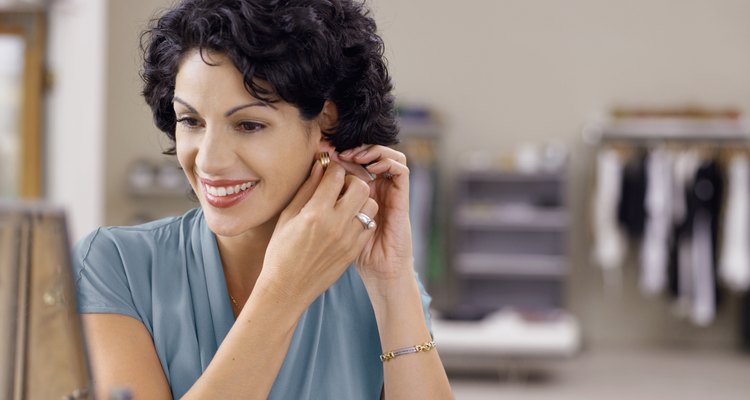
Ear piercing entails having a metal earring rod forced through a section of the outer area of your ear, or the pinna. Ear piercing should be done in a safe, sterile environment by a certified piercing artist. Adults and children alike get their ears pierced -- although most states require children under the age of 18 to have a parent's permission first.
A Rich History
Piercing is one of the original types of body adornment. One of the oldest mummified bodies ever discovered, the Otzi Iceman found in Austria, had a piercing in his ear. People once used piercings as a way to modify their looks or to represent their authority within tribes or communities. As far back as 1440 B.C., Hebrew servants had their ears pierced to identify them as belonging to a particular family. In recent times, ear piercings have become a fashion statement in the modern world.
Types of Piercings
The lower lobe is the most popular place to pierce your ears. You can also choose to have a second hole directly above the hole in the lobe. This is mainly done for fashion purposes to wear multiple stud earrings or a loop and a stud together. Other areas you can have pierced include the helix or upper ear; the concha, or the area in the center of the ear; and the tragus, the area in the center, near the outer edge. Almost any area of your outer ear can be pierced. A barbell earring connecting from the lower to the upper helix, also called the industrial, is another popular type of piercing.
Pierced Ear Symbolism
While most people pierce their ears and other body parts without questioning what it means, you can associate the piercing with an event or symbol. As a couple, you and your significant other may have piercings done to symbolize your union. If you're single, you may get your ears pierced to embrace surviving abuse or a troubled relationship. Many parents give their daughters birthstone earrings after a baptism or communion. As a parent, you can have your daughter's ears pierced just a few days after birth so she can wear new or heirloom earrings for religious events.
Types of Earrings
Ear piercings are meant to create a fashion statement. Not all earrings are studs, and you can wear earrings in a variety of styles to accommodate your mood or outfit. Popular choices include bars, rings and gauges. Bars are placed through the cartilage in the ear. Rings can also be connected through the two holes in the cartilage or through one in the lobe area. A gauge is a type of jewelry stud that fits in your earlobe. The gauge thickens the size of a pierced hole and stretches it out in diameter.
Know the Piercing Risks
Because ear piercing involves puncturing the skin, some risks are involved. According to the Association of Professional Piercers, sometimes the piecing gun can get stuck midway through the ear. This can cause extreme discomfort and strain on your ear. If your ear is repierced, there is a great risk for hypertrophic scar formation or auricular chondritis -- a disfiguring infection of the cartilage and ear tissue. Infection can happen with any type of piercing. Keep the area clean and allow the initial piercing to heal to minimize the risk of infection.
Related Articles
What If They Make a Mistake When ...

Reasons to Get a Nose Ring

Places to Pierce Your Ear

Problems With Nose Piercings

When Did Pierced Ears Originate?
Facts on Nose Piercings

Piercing Ideas for Respectable Women

List of Body Parts That Can Be Pierced

How to Gauge Your Ears with Tapers

How to Put in a Hoop Nose Ring
How to Remove Pierced Earrings From ...
Reactions to Nose Piercings

How to Keep a Piercing From Rejecting
When Did Men First Start Wearing ...
How to Clean Smiley Piercings

How to Get a Guiche Piercing

Nose Hoop Vs. Stud

How Long Do I Have to Wait to Change My ...

How to Gauge Your Ears Without Tapers
How Long Should I Wait to Get My Nose ...
References
Writer Bio
Julie Boehlke is a seasoned copywriter and content creator based in the Great Lakes state. She is a member of the Society of Professional Journalists. Boehlke has more than 10 years of professional writing experience on topics such as health and wellness, green living, gardening, genealogy, finances, relationships, world travel, golf, outdoors and interior decorating. She has also worked in geriatrics and hospice care.
Photo Credits
Siri Stafford/Photodisc/Getty Images