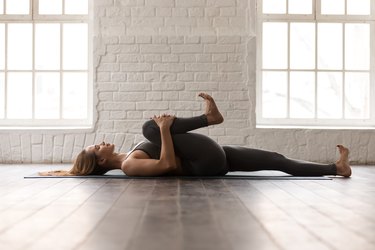
Your hips take a lot of hits every day. From sitting to running, climbing or jumping, your hips absorb much of the impact from your daily movements. So, if you experience pain or discomfort in the hip region, it may be a sign for you to start incorporating hip stretches into your daily routine.
Hip stretches are a great way to decrease tightness, relieve soreness and increase your flexibility. Here, Geoff Tripp, CSCS, certified personal trainer and head of fitness at Trainiac, shares the best stretches to keep your hips in tip-top shape.
Video of the Day
Read more: 7 Dynamic Stretches to Improve Hip Mobility
3 Simple Stretches for Hip Pain
"Usually, light walking can help improve and warm up tight hips as well as proper and focused hip strength exercises and stretches that work the glutes, quads and hamstrings," Tripp says. Below, here's a quick, well-rounded mobility routine for stretching each part of your hip joint.
1. Side-Lying Quad Stretch
This stretch is good for improving mobility in your upper hip flexors, which are often the culprit of stiff hips, and for increasing flexibility in your quadriceps muscles, which, if tight, can create imbalances and muscle tension in the hip region, Tripp says.
- Lie on your right side and pull your knees in front of you, bending to 90 degrees.
- With your left hand, pull your left heel up toward your left glute muscle.
- As you pull, engage your glutes to intensify the stretch in your quad muscle.
- Hold for 30 to 60 seconds, then switch sides.
2. Figure Four Stretch
This move targets the side of your hips, including the gluteus maximus and medius and the piriformis (a small muscle located deep in the glutes that helps lift and rotate your leg), Tripp says. Since the main function of your gluteus maximus is to extend and rotate your hip joints, it's important to keep your glutes working right if you want to relieve — or avoid — hip discomfort.
- Lie on your back.
- Cross you right foot over your left thigh and bend your left knee.
- Pull the back of your left leg gently toward your chest.
- When you feel a comfortable stretch, hold for 30 to 60 seconds.
- Switch sides and repeat.
3. Supine Hamstring Stretch
This stretch works the posterior muscles of your leg and is ideal for improving hamstring mobility, Tripp says. Why does that matters for your hips? Tight hamstrings can pull down on your glute muscles, which then tilt your pelvis, resulting in hip (and back) pain.
- Lie on your back with your legs extended.
- Keeping you legs straight, pull one leg in toward your chest.
- Pull from behind your thigh, hugging your leg close to your body. Try to keep your leg as straight as possible without locking your knee.
- Switch legs, pulling in the opposite leg toward your chest.
- Complete 10 to 15 reps per leg.
Tip
Loop a resistance band or a belt around your foot and gently pull from there instead of from behind your thigh to ease into this stretch.
So, What Causes Hip Pain?
While there are many possible explanations for your hip discomfort, several reasons come up time and again. For starters, sitting too much. If you have stiff, sore hips, odds are your sedentary lifestyle is to blame. That's because spending hours in a chair forces your hip flexors into an unnaturally shortened position. The result? Hip tension and pain.
Conversely, if you're super active, you might be putting too much stress on your hips. "In general, most hip pain issues are related to overuse or improper use," says Tripp. Performing the same activity repeatedly — like running or kicking a soccer ball — or not doing a movement properly in the first place can create wear and tear on your hip joint.
Overuse — and the damage that occurs with age — may also make you more susceptible to hip conditions like bursitis (joint inflammation), tendonitis (inflammation or irritation of a tendon) and osteoarthritis (the breakdown of protective cartilage that cushions the ends of your bones).