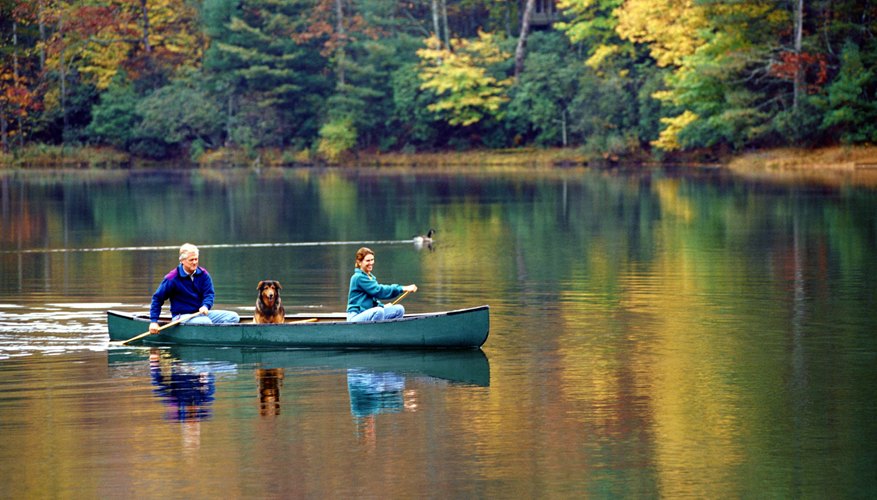


Paddling a two-person canoe requires not only an understanding of the gear required and how to paddle, it also demands a coordinated effort between both paddlers. Each person in the boat has specific roles and responsibilities that, if followed, can make for an enjoyable and rewarding experience. There are, obviously, two positions in two-person paddling. The stern paddler controls the direction of the canoe while the bow paddler is primarily for power. Different coordinated strokes, executed by both paddlers, will effectively control the speed and direction of the canoe.
Canoe
Proper safety gear
Paddles
Canoe with someone you get along with. Working in tandem requires communication and listening skills.
Always put on your life-vest before getting into your canoe.
Take your position in the canoe and push off. Since steering is done from the stern, place the more experienced paddler in that position. Once well in the water, begin to paddle with the person in the bow position paddling on one side of the canoe and the stern position paddling on the other.
Practice for a while on flat, slow-moving water to get the feel for the position you are working, if you are new to tandem paddling,
Establish a cadence to the paddling, working to keep in sync with each other to make the canoe run straight. It is the responsibility of the bow paddler to set cadence and the stern paddler should follow.
Steer the canoe from the stern by placing the paddle along either side of the canoe and trailing it toward the stern. For minor corrections use a "J" stroke, pushing the paddle at the end of the stroke in a slight J shape to steer. For major turns, use the paddle as a rudder to turn. Push the paddle against the flow of water to the left to turn left, or right to turn right.
Brake the canoe by simultaneously placing both paddles straight down and flat against the flow of water. This will bring the canoe to a relatively quick stop in still water and will slow the canoe to the rate of the current in moving water.
Reverse the direction of the canoe by simply using a reverse stroke in the same positions you would use a forward stroke.
Turn the canoe on its center by executing a draw stroke. Each paddler places their paddle out into the water on opposite sides.The blade of the paddle is facing the side of the canoe. Then the paddle is drawn toward the side of the canoe. The canoe will turn on its axis in the opposite direction in the stern and the desired direction in the bow.
Communicate regularly to maintain a comfortable cadence, determine proper direction and decide on each action of the canoe.
Change paddling sides regularly to avoid fatigue. Ensure that each person continues to paddle on opposite sides.
Items you will need
Tips
Warnings
References
Writer Bio
In Jacksonville, Fla., Frank Whittemore is a content strategist with over a decade of experience as a hospital corpsman in the U.S. Navy and a licensed paramedic. He has over 15 years experience writing for several Fortune 500 companies. Whittemore writes on topics in medicine, nature, science, technology, the arts, cuisine, travel and sports.