
What Are the Treatments for Achilles Bone Spurs?
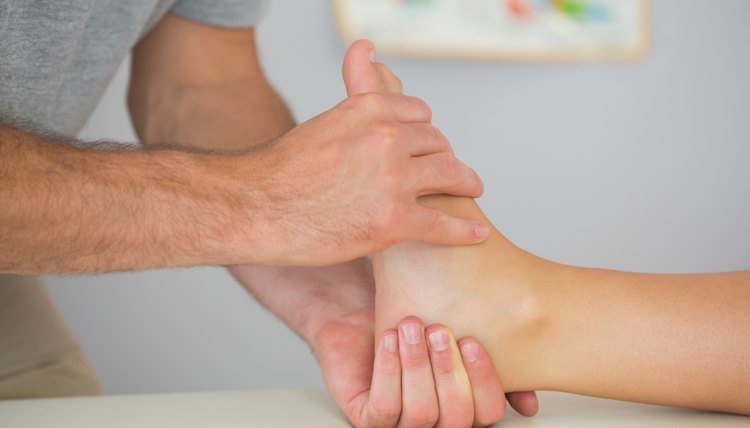
Bone spurs are caused by extra bone growth and can exist for years without ever causing any symptoms. In these cases, no treatment is required. However, they can also rub on nearby tissues, nerves and muscles and cause pain and swelling. If a bone spur forms near the Achilles tendon -- at the back of your ankle -- it can cause pain with various movements. Treatment for this condition ranges from rest to surgery, depending on the severity of your symptoms.
RICE
If a bone spur near the Achilles tendon rubs on nearby tissues, it can lead to bursitis in the heel area. This condition usually affects the retrocalcaneal bursa, which is a fluid-filled sac located near the heel, where the calf muscle attaches to the heel bone. The first step of treatment is to reduce inflammation. This includes resting, applying ice, compressing or wrapping the area, and elevating the foot -- the RICE treatment. Anti-inflammatory medications may be prescribed if swelling is severe. It is not usually recommended to inject steroids into this area because they may weaken the Achilles tendon and cause it to rupture.
Alterations to Shoes
Overuse or overtraining can stress the Achilles tendon and the heel bone. As these areas weaken, bone spurs may form in an attempt to strengthen the heel bone. To help manage symptoms, it may be necessary to make adjustments to footwear. This can include wearing extra padding in the shoes, using a heel cup to elevate the heel or changing the type of shoe worn. In addition, a podiatrist can evaluate walking patterns and examine your arches. Orthotics to correct any problems can be designed to take pressure off of the heel and Achilles tendon.
Physical Therapy
A physical therapist can design a strengthening program for the muscles around the Achilles tendon. This will help to take pressure off the tendon. A gentle stretching program should also be developed to keep the area flexible and less prone to injury. It may also be helpful to have a trainer or coach review training techniques and make suggestions to avoid overuse and improper training principles that may be contributing to this condition. The goal is to remain active while reducing the amount of wear and tear on the heel and Achilles tendon.
Surgery
When conservative measures fail to relieve symptoms, surgery may be necessary. After the symptoms become chronic, it may be necessary to remove the bone spur and then reattach the Achilles tendon. Because this area has poor blood supply, recovery from this operation can take up to three months. After this period, physical therapy may be required, and it can take up to one or two years to return to presurgery levels of activity. The best bet is to seek treatment as soon as symptoms appear to prevent this condition from worsening and becoming chronic.
References
- American Family Physician: Common Conditions of the Achilles Tendon
- U.S. Department of Health & Human Resources -- National Guideline Clearinghouse: Heel Spur Syndrome
- Lopez RG, Jung HG. Achilles tendinosis: treatment options. Clin Orthop Surg. 2015;7(1):1-7. doi:10.4055/cios.2015.7.1.1
- Medina Pabón MA, Naqvi U. Achilles Tendonitis. Treasure Island (FL): StatPearls Publishing. Updated April 8, 2019.
- Tu P. Heel Pain: Diagnosis and Management. Am Fam Physician. 2018;97(2):86-93.
- Fakoya AOJ, Otohinoyi DA, Fakoya FA. Correlation of some predisposing intrinsic conditions with the morphological integrity of the Achilles tendon. Ann Afr Med. 2018;17(2):58-63. doi:10.4103/aam.aam_49_17
- Bass E. Tendinopathy: Why the Difference Between Tendinitis and Tendinosis Matters. Int J Ther Massage Bodywork. 2012;5(1):14-17.
- Gulati V, Jaggard M, Al-nammari SS, et al. Management of achilles tendon injury: A current concepts systematic review. World J Orthop. 2015;6(4):380-6. doi:10.5312/wjo.v6.i4.380
- Vyas S, Bhalla AS, Ranjan P, Kumar S, Kumar U, Gupta AK. Rheumatoid Arthritis Revisited - Advanced Imaging Review. Pol J Radiol. 2016;81:629-635. doi:10.12659/PJR.899317
- Kim J, Sung DJ, Lee J. Therapeutic effectiveness of instrument-assisted soft tissue mobilization for soft tissue injury: mechanisms and practical application. J Exerc Rehabil. 2017;13(1):12-22. doi:10.12965/jer.1732824.412
- Park YH, Jeong SM, Choi GW, Kim HJ. How early must an acute Achilles tendon rupture be repaired? Injury. 2017;48(3):776-780. doi:10.1016/j.injury.2017.01.020
- Maughan KL, Boggess BR. (2018). Achilles tendinopathy and tendon rupture. Fields KB, ed. Waltham, MA: UpToDate Inc.
Writer Bio
I hold a Master's degree in exercise physiology/health promotion. I am a certified fitness specialist through the American College of Spots Medicine and an IYT certified yoga teacher. I have over 25 years experience teaching classes to both general public and those with chronic illness. The above allows me to write directly to the reader based on personal experiences.