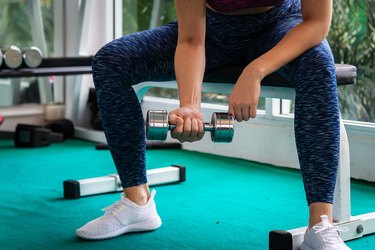
Exercise provides good stress for your body. It puts extra demands on your muscular, cardiorespiratory and nervous systems so they grow stronger and more resilient. But too much stress has the opposite effect, notes the American Council on Exercise.
It can leave you with overtraining syndrome, also know as OTS, with symptoms such as poor workout performance, constantly sore muscles, unsatisfying sleep, frequent illness and an overall sense of burnout. What leads to overtraining syndrome is often quite personal. Some people have built up the stamina to tolerate a regular weights and Pilates workout four or more times per week. For someone just getting back to exercise, or starting out, this regimen could burn you out after a month or two.
Video of the Day
Video of the Day
The frequency, intensity and effects of your workouts tell you if you're overtraining. One day of hitting the weight floor and then heading to Pilates class isn't going to push you over the edge, though. Ask yourself the following questions to decide if you need to dial your workouts back a bit.
Tip
Lifting weights and doing Pilates will not generally lead to overtraining, unless you're lifting a lot of weight at a high intensity.
How Intense Are Your Workouts?
When considering whether you're overtraining, ask yourself about the quality and intensity of your workouts. Does "weights" mean lifting 8-pound dumbbells in a class for multiple repetitions to build muscular endurance, or are you doing a full-blown 45-minute session of max lifts on the Olympic platform? The former is unlikely to lead to overtraining, but the latter — when done without intelligently placed rest — just might.
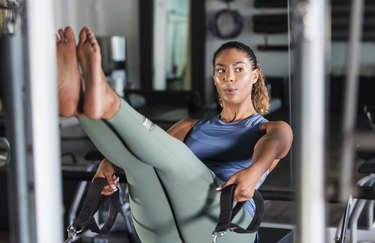
The same is true for your Pilates sessions. A rigorous total-body reformer routine puts more intense stress on the body than a mat-based class that targets important stabilizing muscles. A beginner class will be much milder than an intermediate or advanced class too.
How Often Are Your Workouts?
Pilates and strength training on consecutive days would likely count as overtraining. It may or may not push you into full blown overtraining syndrome, but it is counterproductive. You want to leave at least 48 hours between strength-training sessions, so if you're lifting heavy weights to fatigue, you deserve a day off weights the next day.
Rest is essential to the muscle building process, says the American Council on Exercise. Without it, your muscle fibers can't repair or have the time to grow stronger and thicker. A good approach would be to alternate your Pilates workout days with your weight-training days, then leave at least one day for rest. Therefore, your schedule might look like:
- Monday: Strength train legs and hips
- Tuesday: Pilates
- Wednesday: Upper-body strength training workout
- Thursday: Pilates
- Friday: Full-body strength training
- Saturday: Pilates
- Sunday: Rest


How Do You Feel?
A big clue as to whether you're doing too much weight training and Pilates is how you feel. If you're chronically sore, it's time to give it a few days off and when you return to training, back off the number of days you do each discipline. If you come to dread your workouts or feel obligated to go, even though you really want a day off, it's another sign you're headed toward workout self-sabotage.
What About Outside the Gym?
Typically, overtraining strikes people who are running, cycling, swimming or doing high-intensity work, such as CrossFit, to an excess. However, any heavy training can leave you feeling overtrained. Irritability, mood swings, fatigue and abnormally high heart rates are symptoms of overtraining. You might also find yourself getting sick more often than usual. Your sleep cycles often get thrown off, so you have trouble sleeping soundly and wake earlier than usual.
Functional Versus Nonfunctional Overtraining
If you're trying to overcome a plateau in your max bench press, or achieve a certain look for an upcoming fitness or bodybuilding competition, you might employ functional overtraining — also referred to as overreaching, according to the Human Performance Resource Center — for a few weeks to achieve your goal.
It might include rigorous weight training and Pilates and, if you kept up this training schedule for several weeks, it could lead you to eventually develop overtraining syndrome. However, when used strategically — perhaps under the auspices of a coach — it can actually lead to gains.
Overtraining usually occurs over time, not all at once. Your body wears down from the stress and once you're in the full-blown syndrome, it's a hard hole to dig out of. So, it's smart to check in often with how you're feeling and your workout progressions. If either start to fail, take a day or two to recoup. Overtraining syndrome can take days or even weeks to resolve.
- American Council on Exercise: "Overtraining - 9 Signs of Overtraining to Look Out For"
- Human Performance Resource Center: " Overtraining — What Happens When You Do Too Much"
- American Council on Exercise: "Top Strategies for Optimal Recovery Between Workouts"
- MedlinePlus: "Are You Getting Too Much Exercise?"