You probably know your weight, more or less, and if you know how tall you are, you can easily calculate your body mass index (BMI). But that doesn't tell you how much excess fat is hugging your organs. So what do experts consider a healthy body fat percentage?
It really depends on who you are. Age, sex and fitness level all make a difference. If you're an athlete at the top of your game, a healthy body fat percentage may be in a range that's several percentage points below what would be considered reasonable for a typical woman or man. Makes sense, right? People striving for peak performance in their chosen sport would likely have considerably more lean muscle and less fat than other folks.
Even if you're not Sports Illustrated material, knowing what experts consider a healthy body fat percentage for a woman or a man can be helpful. If your fat level falls within an acceptable range, your goal might be to keep up what you're doing to stay fit. But if you're lugging around significantly more fat than a similar man or woman your age, knowing where you stand may help motivate you to make positive changes.
More than 70 percent of American adults have overweight or obesity, according to the Centers for Disease Control and Prevention. Excess fat, especially belly fat, puts people at higher risk of a litany of health problems, including heart disease, stroke, diabetes, fatty liver disease and certain cancers, per the National Institute of Diabetes and Digestive and Kidney Diseases. If your fat percentage is too high or too low, taking steps to adjust your diet and exercise routine can help you realize your health and fitness goals.
What Is a Healthy Body Fat Percentage?
If you're striving to attain that perfect ratio of fat to, well, all the other stuff that makes up lean mass — your muscles, blood, bones, skin, organs and connective tissue — we've got news for you: No one has defined exactly what that looks like.
"There are no universally accepted norms for body composition," according to the editors of ACSM's Guidelines for Exercise Testing and Prescription (Tenth Edition), which is produced by the American College of Sports Medicine (ACSM). Nor do experts agree on the percentage of body fat associated with "optimal" health, they add.
"People can still be healthy with a wide range of percent body fat," Laurie Milliken, PhD, associate professor or exercise and health sciences at the University of Massachusetts, Boston, tells LIVESTRONG.com. "There are many other things that will affect their health, like whether they are active, whether they have high cholesterol [and] whether they have high blood pressure," she explains.
However, there's at least some consensus around a range of body fat percentages considered "satisfactory" for health, the ACSM editors point out.
Tip
A healthy body fat range is 14 to 38 percent for women and 6 to 24 percent for men, but a lot of factors play into what number is right for you.
Read more: How to Lose Body Fat Naturally
Why Women Need More Fat
A healthy body fat percentage for women is different than it is for men. "For women it's a little higher because women have breast tissue and other sex-specific tissues that require fat," Milliken explains. Women need to maintain a certain level of body fat just to ovulate and have regular periods, for example.
Plus, every person — female and male — needs a certain amount of body fat to live. It cushions and protects your organs, insulates your body and serves as a source of energy. Your nerves, brain, muscles and other organs need some fat to function properly. This baseline level of fat is known as "essential fat." (So, just to be clear, zero percent body fat is not possible!)
A woman needs roughly 10 to 13 percent essential body fat, according to the American Council on Exercise (ACE). So even if you're a super-fit athlete, it would not be uncommon to have a total body fat percentage of 14 to 20, based on ACE's general body-fat percentage categories, published in the American Council on Exercise Personal Trainer Manual (Fifth Edition).
ACSM's guidelines say 20 to 32 percent body fat for a woman is considered satisfactory for health. But, again, a variety of factors play into what may be appropriate for any individual. Older adults, especially, ought to have a little bit more body fat to withstand illness or hospitalization, Milliken says. For a woman, about 20 to 24 percent is generally the minimum, she says.
A body fat percentage of 32 percent up to even 38 percent might be OK if a woman is exercising and doesn't have any other risk factors for disease, Milliken allows. But if she has risk factors (high blood pressure, unhealthy cholesterol levels, poorly controlled blood-sugar levels and smoking are a few of the biggies, according to the American Heart Association), "then it might be time to start reducing body fat," Milliken says.
Men Have Less Leeway
In general, a healthy body fat percentage for men is lower than it is for women. Men only need 2 to 5 percent essential body fat, according to the ACE. A male athlete might have 6 to 13 percent total body fat, while a guy who's fit might fall into the 14 to 17 percent range, based on ACE's table of body fat percentage categories.
Of course, not every man can or should meet those levels. So what's an acceptable range for health? About 18 to 24 percent, says the ACE, while the ACSM suggests 10 to 22. A body fat percentage chart developed by The Cooper Institute in Dallas (and recently adopted by ACE) provides percentile values by age bracket. The 50th percentile for a man 20 to 29 years old is 16.6 percent body fat; for a male 60 or older, it's 24.2.
There's actually more agreement on the importance of where fat is stored and its affect on health than on the precise amount of body fat any one person ought to have, explains Chris Gagliardi, an ACE-certified health coach and personal trainer in San Diego. Research shows that visceral belly fat, the type that resides deep in the abdomen and surrounds the internal organs, raises the risk of chronic disease. It's the reason why apple-shaped men who carry fat in the chest and belly are at greater risk of heart disease than pear-shaped women with bigger hips, thighs and butts.
Read more: The 7 Principles of Fat Loss
BMI vs. Body Fat Percentage
BMI is a simple calculation based on a person's height and weight. It's widely used to screen for obesity and its associated health risks. For most people, BMI provides a very good estimate of body fat, according to the Harvard T.H. Chan School of Public Health. But it's not perfect, the Harvard school explains, because it doesn't account for muscle and bone, which are denser than body fat.
As a result, a muscle-bound athlete can have a high BMI but a low percentage of body fat. Conversely, someone can have a normal BMI but be "overfat," Milliken says, which tends to happen as people age. "Their body weight is the same, their height has not changed much, so their BMI is going to be stable," she explains, but they have too much fat and not enough lean muscle.
How Do You Calculate Body Fat Percentage?
Various tools and methods may be used to determine your body fat percentage. Just be aware that there are trade-offs — some are more accessible, less expensive and easier to use than others, for example.
Skinfold thickness measurement is one widely used method. Using calipers, your clinician, health coach, nutritionist or physical trainer measures skinfolds at specific sites on your body. Could you do it on your own or with a friend? Perhaps. But unless you know what you're doing, there's a lot of opportunity for error.
Use a Body Fat Calculator
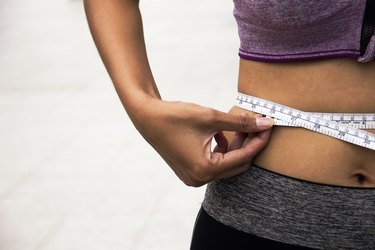
A simpler method involves taking your measurements, in inches, at select points of your body. Once you take these measurements, you can input them into an online calculator, such as LIVESTRONG.com's Body Fat Calculator, to estimate your percentage.
If you aren't comfortable calculating your number at home, visit your doctor to ensure that your body fat percentage reading is accurate.
In terms of tools to measure body fat, there's a method called bioelectrical impedance analysis (BIA), which involves "passing an extremely low-strength electrical current thought the body," according to ACSM's Body Composition Assessment. This technology, found in handheld devices and some scales, is available for home use and in some gyms and medical settings. BIA estimates body fat percentage based on how tissue reacts to the current: Lean tissue is mostly water and a much better conductor of electricity than fat. It's a decent technology, but buyer beware: "Some devices have a really horrible error rate," Milliken, one of the ACSM book editors, cautions.
The gold standard for body fat assessment, according to Milliken, combines three different laboratory technologies: dual-energy X-ray absorptiometry (DXA), Bod Pod and underwater weighing. DXA is the same method used to assess bone mineral density. The Bod Pod is a computerized device that measures your weight and volume, per the Mayo Clinic. Underwater weighing, also called hydrostatic weighing, involves full submersion in a tank of water. Together, these technologies yield a very accurate reading with a low error rate, but they are hard to come by and very expensive to use, Milliken says.
How to Reduce Body Fat Percentage
Unfortunately, there's no magic formula for reducing body fat percentage. It's all about making healthy eating choices to lower your caloric intake without skimping on nutrients and exercising to maintain any weight loss you've managed to rack up. Exercise can also help you build lean muscle mass.
Most healthy adults need at least 150 minutes of moderate-intensity aerobic exercise (or 75 minutes of vigorous activity) each week, plus two or more strength-training sessions, according to the the U.S. Department of Health and Human Services' Physical Activity Guidelines for Americans.
If you can manage 300 minutes or more of aerobic activity a week , all the better. In a randomized controlled trial of 400 previously inactive postmenopausal women, 300 minutes of moderate to vigorous exercise per week burned more body fat than 150 minutes of activity, according to a September 2015 study in JAMA Oncology.
To lose about a pound a week, you need to consume 500 fewer calories a day, says the US National Library of Medicine. Try swapping chips for healthier alternatives; skipping seconds; cutting out soda, high-calorie sweets and fried foods; and making low-calorie substitutions. These efforts will help you reduce your body fat.
Read more: 7 Easy Ways to Cut 300 Calories From Your Diet