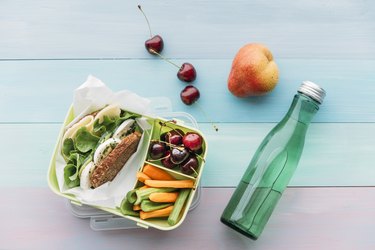
If you've ever glanced at the bottom of your water bottle or meal prep container, you may have seen a number printed on the plastic.
That's the Resin Identification Code (RIC) or recycling number that identifies the type of plastic. These numbers are crucial for indicating and understanding the type of plastic you're using.
Video of the Day
Video of the Day
Are Plastics Used in Food Packaging Safe?
Generally, yes: All plastic types (1 through 7) are approved by the FDA and safe to use, according to Chemical Safety Facts.
That said, some types are still best avoided. Stick to packages with RICs labeled 1, 2, 4 and 5, per the Academy of Nutrition and Dietetics. You may want to avoid containers with code 3, as these contain phthalates, code 6, due to styrene, and code 7, because of the bisphenols (which may include BPA unless it's labeled as "biobased" or "greenware"), per the American Academy of Pediatrics (AAP).
Keep scrolling for more details on all of these categories.
Plastic 1: Polyethylene Terephthalate (PET)
If your soda bottle or peanut butter jar has the number 1 printed on the bottom, it's a PET container, according to the Sea Studios Foundation. These containers are lightweight, clear and smooth in texture — and intended for single use only.
One of the most easily recycled plastic varieties, PET is commonly used for water or soda bottles, detergent containers and peanut butter jars. Currently, there are no known health issues or concerns associated with this plastic, and it is commonly recycled into new bottles or polyester fabric.
Plastic 2: High-Density Polyethylene (HDPE)
Like PET, HDPE is a frequently used, safe plastic container. It's denoted by a number 2. HDPE products are not known to transmit any chemicals into foods or drinks, according to Chemical Safety Facts.
This plastic is most often used for milk or water jugs, laundry detergents and shampoo bottles. Like PET, HDPE is a single-use container and should be properly recycled after use. Typically, these containers are either recycled back into new containers or converted into plastic lumber, pipes, rope or toys, according to the Sea Studios Foundation.

Plastic 3: Polyvinyl Chloride (PVC or V)
While PET and HDPE don't have any associated health risks, PVC (which is denoted by a number 3 on plastic) has been shown to produce harmful chemicals like lead, DEHA and dioxins in manufacturing, disposal or destruction, according to the Sea Studios Foundation.
Plastic with the RIC 3 may also contain phthalates, according to the AAP, which have been linked with obesity and changes to hormones.
PVC is often found in clear food packaging or cling wrap, some plastic squeeze bottles, vinyl pipes and shower curtains. This type of plastic is one of the least recyclable varieties due to the chemical additives.
Plastic 4: Low-Density Polyethelene (LDPE)
Low-density polyethelene is a generally safe plastic variety that has no known health risks associated with its use. However, the manufacturing of LDPE does produce organic pollutants, causing potential harm to the environment, according to the Sea Studios Foundation.
Not usually recycled, LDPE (denoted by the RIC 4) is most commonly used to package bread or frozen food. Most plastic wraps are also made of LDPE and are intended for single use only.
Plastic 5: Polypropelene (PP)
Polypropelene containers do not leach harmful chemicals into foods or liquids and are not associated with any known health issues. Typically, this plastic is translucent or opaque in color and has a high melting point, which typically makes these containers microwave- or dishwasher-safe, according to Chemical Safety Facts.
Type 5 plastic is used to make yogurt containers, cream cheese containers, maple syrup bottles or prescription bottles. Unlike other safe plastics, PP is not easily recycled, according to the Sea Studios Foundation.
Plastic 6: Polystyrene (PS)
Polystyrene can be either rigid or formed (aka styrofoam) and is denoted by the number 6. While recycling this plastic is possible, it's not generally economically beneficial.
Rigid forms of PS plastic are typically found in CD cases or disposable cutlery, whereas styrofoam is used for egg cartons or building insulation.
Plastic 6 contains styrene, a compound thought to likely be linked to increased risk of cancer. However, this association is mainly seen among people who work with styrene at high levels, such as those who manufacture car parts. Styrene levels are low in plastic packaging, according to the National Institute of Environmental Health Sciences.
Plastic 7: Mixed
The number 7 means your container is constructed with a mixed variety of other plastics. Typically, mixed plastics are practically impossible to recycle, according to the Sea Studios Foundation.
Mixed plastics are used to construct lids, medical storage containers, sports drink bottles and large water jugs, among other items.
Plastic 7 may contain BPA or bisphenol A. It's worth noting that in 2012, the FDA removed BPA from baby bottles and other products for young children. Although the FDA says this was not due to safety reasons, this chemical does have the potential to make its way into food and beverages from plastic containers, per the Mayo Clinic. BPA has been linked with estrogen-like effects on weight and puberty, according to the AAP.
What to Do About Your Plastic Containers
While certain plastics can be risky, this doesn't mean you have to go and toss all your meal prep containers and water bottles. Here are some steps you can take to safely handle your plastic:
- Avoid heating food in plastic containers
- Wash plastic with a mild detergent
- Opt for glass or stainless steel containers when you can
- Recycle what you can (find recycling solutions for many household items via search.earth911.com)
Correction: An earlier version of this story incorrectly identified the number on polystyrene. We appreciate readers who bring errors like these to our attention! If you spot something in one of our articles, please reach out: editorial@livestrong.com.
- Sea Studios Foundation: "Smart Plastics Guide"
- Chemical Safety Facts: "Types of Plastic Food Packaging and Safety: A Close-Up Look"
- AAP: "American Academy of Pediatrics Says Some Common Food Additives May Pose Health Risks to Children"
- AAP: "Food Additives and Child Health"
- Academy of Nutrition and Dietetics: "How to Use Plastic Food Storage Containers"
- National Institute of Environmental Health Sciences: "Styrene"
- Mayo Clinic: "What is BPA, and what are the concerns about BPA?"
Is this an emergency? If you are experiencing serious medical symptoms, please see the National Library of Medicine’s list of signs you need emergency medical attention or call 911.