
Short Tennis Rules
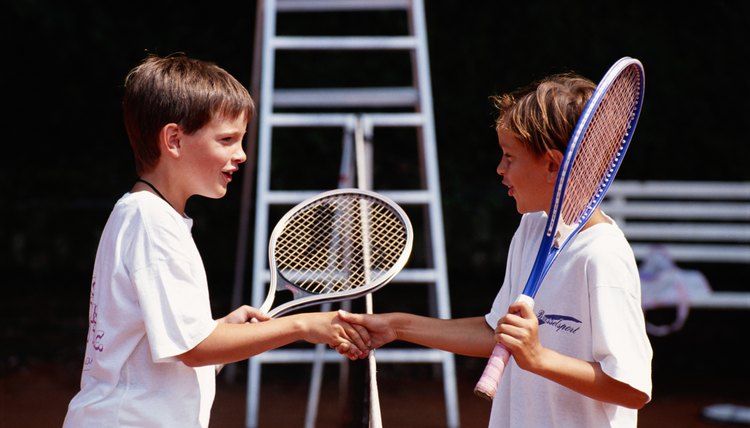
Short tennis, a game also known as short court tennis or mini tennis, is played predominantly by children as a means to learn the basics of tennis before progressing to the full version of the sport. Mini tennis is played with different equipment than used to play standard tennis, including soft balls, lowered nets and smaller rackets. Although many of the rules are similar to the long version of the game, short tennis does have a number of rules unique to the sport.
Starting a Point
Each point is started by an underarm serve. A service option for beginners is to bounce the ball and then hit it into play. Like traditional tennis, short tennis requires a player to stand behind the baseline of one box and serve into the box on the other side of the net that lies diagonally across from the server. Each server has two attempts to deliver a serve and failing to do so results in a point being awarded to the other player.
In Play
In short tennis, the ball must bounce once before it can be returned over the net by each player. Volleys are not permitted. However, as in the long form of the game, if the ball bounces more than once it becomes dead, with the point then declared over and the game returning to a serve.
Scoring Options
Unlike the full form of the sport, short tennis does not use the 15, 30, 40 scoring system but instead uses a numerical system, 1, 2, 3, 4. One point is awarded for the outcome of each play. With this scoring system, matches can be won using two-out-of-three sets scoring, table tennis scoring or volleyball scoring.
Determining the Winner
The first player to reach 4 points wins a game and the first to win four games, wins the set. If the set score is tied at three games, a 2-out-of-3-point tiebreaker is played. Win two out of three sets to win the match. With table tennis scoring players alternate serving five points and the game can be played to a score of 11 or 21. The winner must win by two points. If you use volleyball scoring, the winner of each point serves and the game can be played to a score of 15 or 21. The winner must win by two points.
Court Size
The short tennis court is made up of an area half the size of the traditional tennis court, incorporating solely the two service boxes on either side of the net. Because of the small dimensions of its court size, short tennis can also be played on a court marked out for badminton as long as the baselines are discounted. The side and back lines of the service boxes represent the out of bounds areas.
References
Writer Bio
Owen H. L. Davies has been writing for more than three years for various publications, both U.S.- and U.K.-based, particularly for the SEO market. He was awarded a Batchelor of Arts (honours) in English from Southampton University in 2008. He is also a freelance specialist broadcaster, filmmaker and photographer.