
Facts About BMX Biking
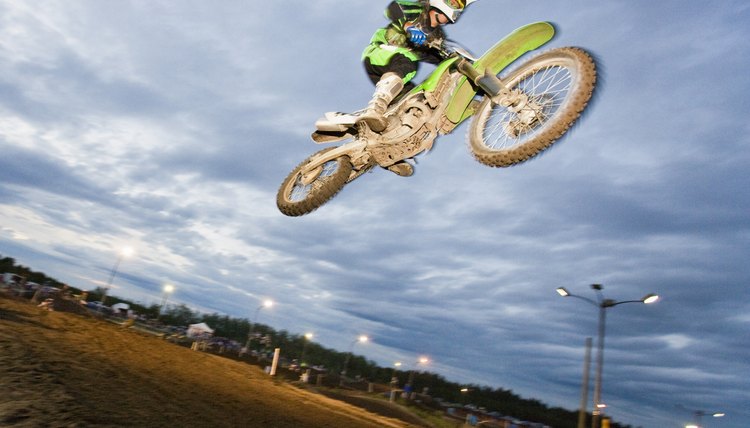
BMX, which stands for Bicycle Moto Cross, is a form of cycling that is considered to be an extreme sport. BMX bikes have a variety of uses and are tailored to the specific needs of the form of the sport that they are used for. BMX made its debut as an Olympic sport in the 2008 Games held in China.
History
According to bmx.bikebuy.co.uk, BMX originated in the late 1960s in Southern California. BMX was invented at the height of the popularity of motocross, a form of off-road motorcycling, as a result of youths seeking to imitate motocross styles of riding and racing but on pushbikes, which they modified and adapted to suit the dirt track conditions on which they raced.
Development
The adapted bikes that the first BMX racers used were typically based on transport bikes, particularly the Schwinn Sting-Ray. But these transport bikes were not well suited to racing, tending to be too large and structurally weak. As a result bicycle manufacturers began to make standardized BMX bikes to meet the specific needs of the BMX racer and to respond to the jumps and dirt conditions of the BMX race track.
Typical Race
According to hotsportslinks.com, the typical BMX race is fast, lasting 25 to 40 seconds. Races take place on a motocross modeled track of 900 to 1,100 feet in length with riders reaching speeds of 15 mph to 35 mph, according to the conditions of the individual track and the skill levels of the riders. A maximum of eight riders race at any time.
Key Features
The standard BMX bike has a number of distinguishing features. First, in terms of size, the BMX bike is much smaller than the standard road bike, with a strong fixed size frame. The BMX bike has only one fixed gear, making it simple to race although unsuited to transport riding. The BMX also features 20-inch wheels across the range, regardless of conditions, and high handle bars to give racers an upright position when riding.
Variations
Although BMX started predominantly with racing in mind, different variations of the sport were developed, including freestyle and dirt jump BMX. Freestyle BMX refers to the use of bikes for performing tricks on flatland and in skate parks. Dirt jump BMX involves riding off-road over dirt on bumpy surfaces. Accordingly, BMX bikes adapted to suit each variation. Freestyle bikes were given extra heavy-duty frames, axle pegs to allow riders to stand above the wheels and a headset on the handlebars to allow them to spin them through 360 degrees. Dirt jump bikes, meanwhile, were given a fusion of freestyle and race modifications, featuring knobbled tires, extra heavy duty frames and a only a back break.
References
Writer Bio
Owen H. L. Davies has been writing for more than three years for various publications, both U.S.- and U.K.-based, particularly for the SEO market. He was awarded a Batchelor of Arts (honours) in English from Southampton University in 2008. He is also a freelance specialist broadcaster, filmmaker and photographer.