
How Do Soccer Cleats Fit?
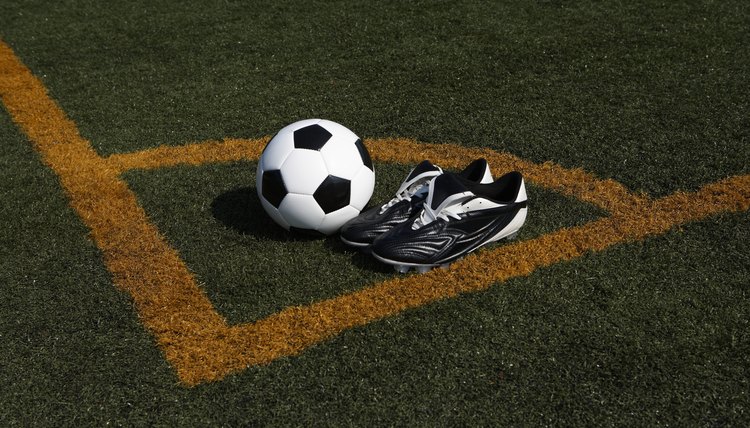
The way your soccer cleats fit can affect the way you kick and run the field. Soccer cleats fit differently than your regular shoes -- your normal shoe size won't necessarily be the same for soccer cleats. Properly fitting soccer cleats will enhance your ball-handling skills; it's best to go into a store where you can try then on and size them for the correct fit. The fit will depend on your individual foot shape and size.
General Fit
In general, soccer cleats need to fit your foot snugly. The goal is to eliminate extra space, which can negatively impact the way you kick. You want every part of your foot to be able to touch the ball without excess air inside your cleat. As a rule of thumb, many soccer experts recommend getting soccer cleats that are one size smaller than your normal shoe size. However, even this won't hold true for everyone, so it's best to take some steps to make sure your cleats fit perfectly for you.
Preparing for Your Fitting
Bring a pair of soccer socks along when you're trying to determine how your soccer cleats should fit. If you try on cleats while wearing no socks or thin socks, they may fit great in the store and then end up feeling too tight once you're out on the field wearing thicker socks.
Start With What You Know
If your regular shoe size is 10, start with that and work your way down. It is critical to put both shoes on and lace them all the way up. A good sizing method is to press down in the toe area and around the sides with your thumb to feel for extra space. You can then reduce the cleat size based on how much space you have. If there is quite a bit of space, go down a full size. If there is just a tad bit of extra space, try half a size smaller.
Walk, Run and Kick
Once you have a size that seems to fit snugly, walk around in them to see how they feel. Run to make sure they are comfortable to move in. It is also a good idea to do a short bunt kick with a soccer ball to see how the cleats feel when you kick. Your toes should reach the front of the shoe without causing pressure or discomfort.
Writer Bio
Janet Renee is a clinical dietitian with a special interest in weight management, sports dietetics, medical nutrition therapy and diet trends. She earned her Master of Science in nutrition from the University of Chicago and has contributed to health and wellness magazines, including Prevention, Self, Shape and Cooking Light.