What Are the Treatments for Thigh Splints?
Thigh splints refer to conditions that cause pain in the mid femur where the abductor muscles join the bones. The femur is the large bone that connects to the hip. According to the "American Journal of Roentgenolgy," MRI scans can help to diagnose the cause of the pain, which is typically a stress fracture 2. The condition is common among runners and those who participate in high-impact sports. Treatment usually involves rest and a number of other methods.
If you are experiencing serious medical symptoms, seek emergency treatment immediately.
Substitution
While your thigh splints can be treated with rest and ice applications on the painful areas, complete immobility is not encouraged because it could result in atrophy of the surrounding muscles, stiffness and loss of cardiovascular endurance. Instead, according to the American Academy of Family Physicians, athletes are encouraged to substitute other activities that don’t place weight on the injured leg 1. Physical activities such as swimming and cycling are effective non-weight-bearing exercises that you can engage in while healing from thigh splints. Make sure to gradually return to the sport that caused your injury in the first place.
- While your thigh splints can be treated with rest and ice applications on the painful areas, complete immobility is not encouraged because it could result in atrophy of the surrounding muscles, stiffness and loss of cardiovascular endurance.
- Instead, according to the American Academy of Family Physicians, athletes are encouraged to substitute other activities that don’t place weight on the injured leg 1.
Splints
If You Hurt Your Metatarsals, How Long Would You Be Out for Playing Sports?
Learn More
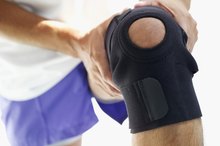
Various types of splints, or braces, can be used to stabilize your leg to allow for healing and to reduce the pain. According to the AO Foundation, if there are no injuries to the ankles, a tubular-shaped splint can be placed over your thigh and knee to hold the femur in place. The splint may be constructed of a wraparound padded brace with Velcro ties that can be removed for bathing and can be adjusted to allow for swelling. A splint is typically worn for 2 to 3 weeks following a thighbone stress fracture when surgery is required to repair the damage.
- Various types of splints, or braces, can be used to stabilize your leg to allow for healing and to reduce the pain.
- The splint may be constructed of a wraparound padded brace with Velcro ties that can be removed for bathing and can be adjusted to allow for swelling.
Cast
A cast may be required if the bone is displaced. Casts that are filled with air provide suitable treatments for thigh fractures because they can be adjusted as your swelling subsides, according to the American Academy of Family Physicians 1. A cast also allows you to continue exercising while the bone heals. Casts are usually worn for 6 to 8 weeks.
- A cast may be required if the bone is displaced.
Surgery
Femoral Bone Contusions & Stretching
Learn More
Surgery may be the most effective treatment for serious fractures that do not involve a joint in the hip or knee. According to the American Academy of Family Physicians, elite athletes who plan to continue competing often respond best to surgical procedures that implant nails or rods in the femur to prevent further fractures 1. More extensive surgical nailing may be required if your fracture extends to the joints. This typically requires months of rehabilitation, and you could be out of commission for up to a year following a major thigh splint operation.
- Surgery may be the most effective treatment for serious fractures that do not involve a joint in the hip or knee.
Related Articles

If You Hurt Your Metatarsals, How Long Would You Be Out for Playing Sports?
Learn More

Femoral Bone Contusions & Stretching
Learn More

Exercising with a Tibia Fracture
Learn More
Causes of Pain in the Upper Left Hip
Learn More
Ligament Tear & Knee Hyperextension
Learn More

Causes of Sharp Heel Pain Felt When Bending
Learn More

Your Thighs Hurt After Football Practices
Learn More

How to Treat Muscles Pulled From Bones
Learn More
Pain From a Torn LCL Ligament When Walking
Learn More
Rehab Exercises After MCL Injury
Learn More
References
Resources
Writer Bio
Linda Ray is an award-winning journalist with more than 20 years reporting experience. She's covered business for newspapers and magazines, including the "Greenville News," "Success Magazine" and "American City Business Journals." Ray holds a journalism degree and teaches writing, career development and an FDIC course called "Money Smart."