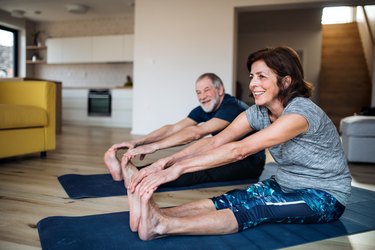
Exercise becomes even more important as you get older, but if you're dealing with arthritis or other types of age-related conditions that may have affected your mobility, then low-impact workouts could be the perfect way for you to stay active.
Low-impact exercises put little to no strain on your joints and can help you stay active and protect your health while minimizing wear and tear. In short: It's all gain, no pain.
Video of the Day
Video of the Day
Here's everything you need to know about low-impact exercises for seniors, their benefits and the best workouts for you to try.
What Is Low-Impact Exercise?
Whether an activity is low- or high-impact depends on how much force it puts on your body. "Low-impact exercises are ones that don't place a significant strain on your joints," explains Emily Johnson, founder of StrongerU Senior Fitness. Your feet aren't pounding on the ground with each step, so you're less likely to experience pressure or pain in places like your ankles or knees.
Walking might be what most of us picture when we think of low-impact activity, but there are plenty of other options. Water aerobics, swimming, using an elliptical machine, bicycling, yoga and even many strength-training exercises all fit the bill. Anything that involves a lot of jumping or pounding, on the other hand, is high-impact, like running, plyometrics, basketball or skiing.
Low-impact workouts can be gentler on the body, but that doesn't necessarily mean that they are easier or less intense.
"It's a common misconception that low-impact exercise, especially for older adults, has to be low intensity, but that's not the case," explains K. Aleisha Fetters, a certified strength and conditioning specialist (CSCS), personal trainer and author of Fitness Hacks Over 50. "Low-impact exercise can be performed at any intensity."
For example, walking is a low-impact exercise no matter your speed, but you can make it more intense by increasing your pace or climbing up a hill. Strength training doesn't involve pounding your joints on the ground or jumping, but it can be an intense workout if you lift heavy, increase the reps and limit rest in between sets.
Low-impact exercises are ideal for older adults because they reduce the risk of injury and put less pressure on the joints while still delivering plenty benefits.
Related Reading
5 Benefits of Low-Impact Exercises for Seniors
There are many good reasons to be active every day, especially for people in their 60s, 70s, 80s and beyond. And sticking with exercises that put minimal pressure on your joints can help you reap the biggest benefits. Here are some of the top reasons older adults should do low-impact exercises.
Pounds tend to pile on a little easier with age. But exercise helps you burn more calories and hang on to more lean muscle mass, which can promote a healthier body composition, Fetters says. "Muscle naturally declines as early as our 30s, and is a major determining factor in setting our resting metabolic rate, or the number of calories we burn at rest each day," she explains.
The key is being active regularly. The Physical Activity Guidelines for Americans recommend you do at least 150 minutes (2 1/2 hours) of moderate-intensity aerobic exercise per week, plus at least two sessions dedicated to strength training.
The National Institute on Aging says that being active at least three days a week is ideal for older adults. It can be easier to stay active if you stick with low-impact workouts because they're less likely to cause soreness or injuries that can sideline you for days or even weeks.
2. Low-Impact Exercises Allow You to Do More of What You Love
Staying in shape makes it easier to partake in daily activities — both the ones you have to do and the ones you want to do. "From getting onto the floor to play with grandkids, going on hikes in nature, dancing or taking the stairs in stride, exercise is the key," Fetters says.
But that doesn't mean you have to run a marathon. Low-impact exercises, like walking and functional strength and balance moves, can help make everyday tasks a breeze.
A daily walking program that includes strength and balance exercises is associated with fewer disabilities in older adults who were deemed relatively frail, according to a February 2020 review published in the Journal of the American Geriatrics Society.
3. They Help Reduce the Risk of Falls
Low-impact exercises that promote balance, coordination and lower-body strength, like lunges and planks, can help you steer clear of slips and trips. "For instance, if you lose strength in your shin muscles, you're more likely to shuffle and risk tripping when walking over a rug or a change in the floor," Johnson explains.
Research backs this up: An October 2016 meta-analysis of 88 studies in the British Journal of Sports Medicine linked regular balance exercises with reduced risk of falls in older adults. Exercise programs that involved at least three hours of balance exercises per week resulted in a 39 percent reduction in falls.
4. Low-Impact Exercises Can Ease Aches and Pains
Not only are low-impact exercises less likely than high-impact ones to trigger sore or creaky joints, but they can actually help relieve pain that you already have. That may be especially true if you have osteoarthritis (the breakdown of cartilage between bones), which commonly starts at the age of 50, according to the Arthritis Foundation.
Activities like walking, bicycling, swimming and gentle strengthening exercises all serve to fight stiffness and keep joints limber, per the Mayo Clinic. It's because doing low-impact exercises like these help keep your muscles strong to support your joints, reducing the stress on them.
5. They Keep Your Bones Strong
As you get older, sedentary lifestyles, lower calcium and vitamin D levels and hormonal changes cause bones to become less sturdy, according to the American Council on Exercise (ACE). But some low-impact exercises can help you fight back.
A 14-year study of some 77,000 postmenopausal people found that regular walking was associated with a significantly lower risk for hip fractures, according to an October 2019 study published in JAMA Network Open.
The key is making sure your low-impact activity involves some weight-bearing — meaning it's done on land against the forces of gravity. "Walking is one of the best weight-bearing activities, but aquatic activities, like swimming, aren't weight-bearing," Johnson says. "If you engage in aquatic exercise as your primary fitness regimen, be sure to spend at least two days a week exercising on land."
Strength training with your own body weight, resistance bands, machines, dumbbells and kettlebells are other great ways to condition your bones to bear more weight, making them stronger and more resilient, per Harvard Health Publishing. It might sound counterintuitive, but according to Wolff's law, when you put stress on your bones, it actually forces bone cells to reconstruct itself to withstand more strain.
The Best Low-Impact Exercises for Seniors
Older adults should aim for a mix of aerobic, strength, flexibility and balance exercises, per the National Institute on Aging. And there are plenty of low-impact options that fit the bill for beginner and veteran exercisers alike.
1. Walking
It's one of the easiest ways to keep up your cardiovascular endurance and protect your mobility as you age, Johnson and Fetters say. You can start out with an easy stroll or try dialing up the intensity by increasing your pace or adding Nordic walking poles. "The poles increase upper-body and abdominal activation and tend to increase the speed of walking," Johnson says.
2. Swimming or Water Aerobics
Think laps up and down the pool, water walking or a group fitness class (when it's safe to work out in groups again). "These are about as close to zero-gravity as you'll get on planet Earth," Fetters says. "They're ideal if you have osteoarthritis or other joint issues that give you trouble during on-land exercises."
3. Bicycling
Pedaling helps build leg strength while boosting endurance. "If you're doubting your balance or want to be able to work out at home, you can use a stationary bike or attach your existing road bike to a stationary mount," Fetters says. You can engage your core by using it to help you carry your weight. "Try not to 'dump' your upper-body weight onto the handlebars," she says.
4. Low-Impact Strength Training
Lifting weights, using resistance bands or body-weight exercises, like push-ups or bird dogs, all work. Just steer clear of any strengthening exercises that involve jumping or catching heavy objects, Johnson says.
If you're adding resistance, "choose a weight where you can perform 8 to 12 repetitions and the last 2 to 3 repetitions are difficult to complete," she adds.
5. Yoga or Tai Chi
Both can help keep you limber and protect your range of motion, which is especially important if you have arthritis, the ACE notes. "Tai chi is across the board a low-intensity exercise, which makes it very beginner-friendly. You can start yoga at a low intensity and increase from there," Fetters says.
Consider seeking out a yoga class specifically for older adults, or let your instructor know you're looking to stick with low-impact poses.
Low-Impact Workouts for Older Adults We Love
Ready to get started? These workouts can be modified according to your strength and fitness level.
- U.S. Department of Health and Human Services: "Physical Activity Guidelines for Americans"
- National Institute on Aging: "How Older Adults Can Get Started with Exercise"
- Journal of the American Geriatrics Society: "Impact and Lessons From the Lifestyle Interventions and Independence for Elders (LIFE) Clinical Trials of Physical Activity to Prevent Mobility Disability"
- British Journal of Sports Medicine: "Exercise to Prevent Falls in Older Adults: An Updated Systematic Review and Meta-Analysis"
- Arthritis Foundation: "Benefits of Exercise for Osteoarthritis"
- Mayo Clinic: "Exercise Helps Ease Arthritis Pain and Stiffness"
- American Council on Exercise: "Exercise Your Way to Stronger Bones"
- JAMA Network Open: "Association of Physical Activity and Fracture Risk Among Postmenopausal Women"
- Harvard Health Publishing: "Strength Training Builds More Than Muscles"
- Wolff's Law
- American Council on Exercise: "I Have Arthritis. What Are Some Exercises I Can Do and Tips I Can Follow?"