How Long After Conception Can You Tell If You Are Pregnant?
Conception
According to the American Pregnancy Association, the egg implants into the uterus six to twelve days after ovulation 12. After implantation, the body begins to produce the pregnancy hormone, hCG (human chorionic gonadotropin), which is what pregnancy tests detect to indicate a positive result. The hormone level doubles every 48 to 72 hours throughout the first trimester.
Home Pregnancy Tests
Can Low Progesterone Keep the HCG Levels From Rising?
Learn More
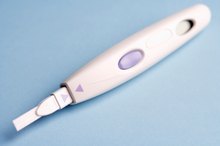
The American Pregnancy Association states that home pregnancy test are 97% accurate when used correctly 12. Although many tests indicate you can test as soon as five days before your next period, the most accurate results will be obtained after you have missed your period and the earliest a test can provide an accurate reading is 14 days after conception. Tests differ in sensitivity in detecting hCG in the urine. When the egg implanted in the uterus determines how early hCG will be built up in the system enough to produce a positive result. You can test early and possibly get a positive result. However, if the result is negative, wait until you miss your period and test again as the results will be more accurate at that time.
- The American Pregnancy Association states that home pregnancy test are 97% accurate when used correctly 1.
- However, if the result is negative, wait until you miss your period and test again as the results will be more accurate at that time.
Blood Tests
Blood tests are performed in doctors offices and detect the level of hCG in the blood. Blood tests are generally more sensitive than urine tests and can detect a pregnancy earlier than urine tests. However, most doctors will not perform a blood test until you have missed your period to reduce the possibility of a false result.
Charting
Normal Levels of HCG & Progesterone
Learn More
If you are charting your cycles to predict ovulation, you may have another indicator of pregnancy 1. Basal body temperature has a sudden rise after ovulation and remains steady until menstruation starts when it drops back to pre-ovulation levels. Some women will experience a second spike in basal body temperature after ovulation when implantation occurs. If this second spike is maintained and you have been accurately taking and recording your temperature each morning, this may be an indication of pregnancy even before you miss your period.
- If you are charting your cycles to predict ovulation, you may have another indicator of pregnancy 1.
- Some women will experience a second spike in basal body temperature after ovulation when implantation occurs.
Early Pregnancy Symptoms
Some women experience pregnancy symptoms before a missed period beginning as early as when implantation occurs. Early pregnancy symptoms can include morning sickness, a strong aversion to certain smells, increased breast tenderness and increased urinary frequency. Though these symptoms do not apply exclusively to pregnancy, they can be an early sign that successful conception has occurred.
Related Articles

Can Low Progesterone Keep the HCG Levels From Rising?
Learn More

Normal Levels of HCG & Progesterone
Learn More

Symptoms of Pregnancy If HCG Injection Is Taken
Learn More

Causes of Not Having Menstrual Period in 6 Months
Learn More

Side Effects of Missing Your Contraceptive Injection
Learn More
Does Low Progesterone Cause No Pregnancy Signs?
Learn More

Cervical Twinges and Signs of Early Pregnancy
Learn More

Signs of HCG Increasing
Learn More

Why Period Might Come One Week Early
Learn More

Light Pink Spotting While Breastfeeding
Learn More
References
- American Pregnancy Association: Ovulation
- American Pregnancy Association: Tests
- Kamalanathan S, Sahoo JP, Sathyapalan T. Pregnancy in polycystic ovary syndrome. Indian J Endocrinol Metab. 2013;17(1):37–43. doi:10.4103/2230-8210.107830
- Legro RS. Evaluation and Treatment of Polycystic Ovary Syndrome. In: Feingold KR, Anawalt B, Boyce A, et al., editors. Endotext [Internet]. South Dartmouth (MA): MDText.com, Inc. Updated January 11, 2017.
- Chard T. Pregnancy tests: a review. Hum Reprod. 1992;7(5):701-10. doi:10.1093/oxfordjournals.humrep.a137722
- Foxcroft KF, Callaway LK, Byrne NM, Webster J. Development and validation of a pregnancy symptoms inventory. BMC Pregnancy Childbirth. 2013;13:3. doi:10.1186/1471-2393-13-3
- Rostami Dovom M, Ramezani Tehrani F, Djalalinia S, et al. Menstrual Cycle Irregularity and Metabolic Disorders: A Population-Based Prospective Study. PLoS One. 2016;11(12):e0168402. doi:10.1371/journal.pone.0168402
- Moran LJ, Harrison CL, Hutchison SK. Exercise decreases anti-müllerian hormone in anovulatory overweight women with polycystic ovary syndrome: a pilot study. Horm Metab Res. 2011;43(13):977-9.
- Palomba S, De wilde MA, Falbo A, Koster MP, La sala GB, Fauser BC. Pregnancy complications in women with polycystic ovary syndrome. Hum Reprod Update. 2015;21(5):575-92. doi:10.1093/humupd/dmv029
- Moran LJ, Harrison CL, Hutchison SK. Exercise decreases anti-müllerian hormone in anovulatory overweight women with polycystic ovary syndrome: a pilot study. Horm Metab Res. 2011 Dec;43(13):977-9.
Writer Bio
Leigh Anthony has provided ghostwritten content for a variety of small-business sites since 2004. Her work appears on eHow and Chron.com. Her areas of expertise include marketing, human resources, finance and leadership. She holds a Master of Business Administration from the University of Georgia.