
What Kind of Bike Is Best for a Sprint Triathlon?
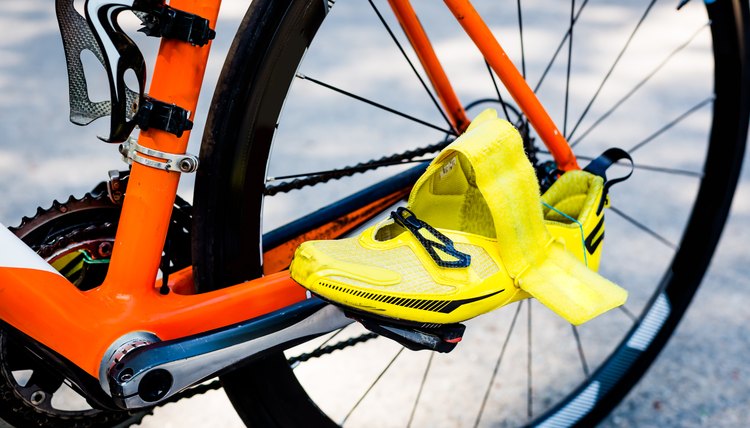
The cycling section of a triathlon is a completely different animal than a traditional road race. This style of race moves at a faster pace over a much shorter distance. Cyclists in triathlons use a specialized bicycle called a tri bike designed for sprints for these quick sections. A tri bike is heavier than a road bike but is much more aerodynamic and utilizes a different riding position to maximize performance at high speeds. This makes it the best choice for a cycling sprint during a triathlon, because it will be faster and more efficient than a traditional racing bike.
Ride Like the Wind
The sprint of a triathlon is a battle against air resistance. Next to the force of gravity on an incline, air resistance is the greatest force a cyclist needs to overcome, accounting for up to 90 percent of the resistance felt during a sprint. This makes the aerodynamics of a tri bike much more important than the aerodynamics of a road bike, which is designed for endurance races over a wide variety of inclines. To further improve aerodynamics, tri bikes also place the rider in a different position that maximizes pedaling power and minimizes the profile of the rider.
Getting Aero
A tri bike uses aerobars to allow a much more aggressive riding position. Aerobars are either integrated into the handlebars on a tri bike, or come as an attachment to bullhorn bars using clamps. These bars have elbow pads so that the rider can place his arms in a bent position, tightening up their profile for the best aerodynamics. In this position, your pedaling efficiency is still excellent, making it ideally suited to sprints that require a lot of power.
Life in the Slipstream
A tri bike is usually built from carbon fiber, which consists of individual fibers sealed into plies using a laminate. Carbon fiber is extremely stiff and lightweight, and can be shaped much easier than an alloy. This allows a tri bike to have a unique shape that minimizes air resistance using wing-like tapering in each section of the frame. The seat tube of the frame will usually curve around the rear wheel, giving the bike a smooth, continuous shape. The frame of a tri bike is usually heavier than a traditional road bike frame because of the extra material used in making the aerodynamically shaped tubing, but weight has a much smaller effect on speed than aerodynamics at the high speeds of a triathlon sprint.
Reinventing the Wheel
Tri bikes use carbon fiber wheels with deep rim widths to further improve aerodynamics. Some riders take this to the extreme by using a fully enclosed rear wheel, which covers the spokes in a carbon fiber dish. These wheels cut through the wind in the same way the frame's shaping does, reducing the turbulence caused by rotating spokes.
References
Resources
Writer Bio
Max Roman Dilthey is a science, health and culture writer currently pursuing a master's of sustainability science. Based in Massachusetts, he blogs about cycling at MaxTheCyclist.com.