
What Are the Rules for Competitive Swimming?
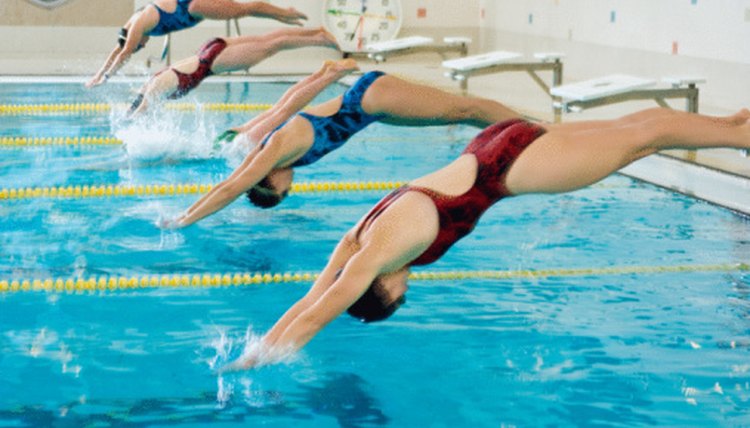
In the United States, the national governing body for swimming is USA Swimming. The rules and regulations regarding competitive swimming, covered in the USA Swimming Rule Book, are updated yearly following the U.S. Aquatic Sports Convention. The rulebook covers all points in competitive swimming, from swimwear types to doping control.
Starts
At the start of each heat, the referee signals swimmers with a series of short whistles, at which time the swimmers remove all excess clothing except swimwear. At the sound of a long whistle, the swimmers take their places on the starting platform, deck or in the water. Next, the referee stretches his arm out in a signal to the starter that the swimmers are under the starter’s control. On the starter’s command, “take your mark,” the swimmers assume the starting position with one foot in front of the starting platform; swimmers in the water must have one hand on the wall. At this time, the swimmers wait for the starting signal.
False Starts
Any swimmer starting before the signal is disqualified, if the referee observes and confirms the starter’s observation of the violation. If the starting signal is given before the swimmer is disqualified, the race continues and the swimmer who had the false start is disqualified at the end of the race. If a recall signal is sounded inadvertently, no swimmer is charged with a false start. If a swimmer responds to the “stand up” command and is charged with a false start, he may be relieved of the charge. If the starter does not correct a swimmer for an illegal starting position, the swimmer cannot be disqualified. A swimmer who notifies the referee before the race of his intent not to compete will be disqualified as a declared false start.
Strokes, Turns and Finishes
Each swimming style--breaststroke, butterfly, backstroke, freestyle, individual medley and relay--has specific stroke, turn and finish rules associated with that type of swimming. The stroke is how the style is performed. For example, in the backstroke, the swimmer must push off on his back and continue swimming on his back throughout the race. The turn rules govern how the swimmer must negotiate turning around at the end of the lap. The finish governs the rules of how the swimmer must finish. In the backstroke, the swimmer must finish by touching the wall on his back; in the breaststroke, the swimmer must touch the wall with both hands.
Disqualifications
Swimmers can be disqualified for false starts, unsportsmanlike behavior, acting in an unsafe manner, obstructing another swimmer in the water, entering the pool before a race has finished or dipping goggles into the pool prior to an event. If a swimmer stands on the bottom of the pool during any race except the freestyle, he will be disqualified from the race. A swimmer must start and finish the race in the same lane; grasping the lane dividers is not permitted.
References
Writer Bio
Caroline Thompson is a professional photojournalist who has been working for print and online publications since 1999. Her work has appeared in the "Sacramento Bee," "People Magazine," "Newsweek" and other publications. She holds a Bachelor of Arts in photojournalism from California State University at Hayward and a personal trainer certification from the university's Health and Fitness Institute.