What does fact checked mean?
At Healthfully, we strive to deliver objective content that is accurate and up-to-date. Our team periodically reviews articles in order to ensure content quality. The sources cited below consist of evidence from peer-reviewed journals, prominent medical organizations, academic associations, and government data.
The information contained on this site is for informational purposes only, and should not be used as a substitute for the advice of a professional health care provider. Please check with the appropriate physician regarding health questions and concerns. Although we strive to deliver accurate and up-to-date information, no guarantee to that effect is made.
How to Reduce Eye Redness
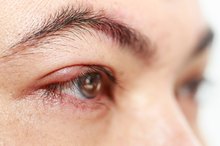
Your eyes become red or bloodshot from the blood vessels on the surface of the eyes getting irritated and enlarged. Many factors can contribute to red eyes, including dust or foreign bodies in the eye, allergies and eye injuries. Some eye infections -- including conjunctivitis and blepharitis -- can also cause eye redness, according to MedLinePlus 1. Most cases of eye redness can easily be treated at home, but if your vision is affected or you are experiencing pain you should seek medical attention 1.
If you are experiencing serious medical symptoms, seek emergency treatment immediately.
Wash your hands thoroughly with soap and warm water. When your eyes are red and irritated, you're likely to instinctively touch or rub them. Because of this, it's a good idea to wash your hands frequently throughout the day. This can be especially helpful if you have an eye infection that spreads easily.
How to Get Rid of Eye Pimples
Learn More
Lie down in a comfortable place.
Place cool compresses over your eye or eyes. If the compresses are too cold, try wrapping them in a cloth or towel.
Causes of White Eye Discharge
Learn More
Lay with the compresses over your eyes for between five and 10 minutes.
Repeat these procedures throughout the day when your eyes become irritated or uncomfortable.
Tips
Eye drops available over the counter at drugstores can also help reduce redness in the eye. Some eye drops are designed specifically for this purpose.
Try not to rub or scratch your eyes. This can cause the redness to worsen and can also contribute to the spread of an infection.
If you do not have any cool compresses handy, try using a bag of frozen vegetables such as peas or corn. The small size of peas and corn makes them ideal for use as an ice pack or cool compress.
Warnings
If your eye is infected, do not wear contact lenses or apply eye makeup until the infection has cleared completely, according to the University of Maryland Medical Center.
Related Articles
How to Get Rid of Eye Pimples
Learn More
Causes of White Eye Discharge
Learn More
How to Get Rid of Fat Pockets Under Your Eyes
Learn More

How to Remove Sawdust From Your Eye
Learn More
Effects of Asbestos on the Eyes
Learn More
Different Color Blobs & Shapes in Vision
Learn More
Cold in the Eye Symptoms
Learn More
Types of Growths on the Eye
Learn More
How to Get Rid of a Sty on Your Eye
Learn More
How to Get Rid of Styes in Your Eyelids
Learn More
References
- MedLinePlus: Eye Redness
- Sheppard AL, Wolffsohn JS. Digital eye strain: prevalence, measurement and amelioration. BMJ Open Ophthalmol. 2018;3(1):e000146. doi:10.1136/bmjophth-2018-000146
- Javadi MA, Feizi S. Dry eye syndrome. J Ophthalmic Vis Res. 2011;6(3):192-8.
- Solano D, Czyz CN. Viral Conjunctivitis. StatPearls Publishing. Updated November 18, 2018.
- Putnam CM. Diagnosis and management of blepharitis: an optometrist's perspective. Clin Optom (Auckl). 2016;8:71-78. doi:10.2147/OPTO.S84795
- Duplechain A, Conrady CD, Patel BC, Baker S. Uveitis. StatPearls Publishing. Updated June 3, 2019.
- Shimizu A, Maruyama K, Yokoyama Y, Tsuda S, Ryu M, Nakazawa T. Characteristics of uveitic glaucoma and evaluation of its surgical treatment. Clin Ophthalmol. 2014;8:2383-9. doi:10.2147/OPTH.S72383
- Mclaurin E, Cavet ME, Gomes PJ, Ciolino JB. Brimonidine Ophthalmic Solution 0.025% for Reduction of Ocular Redness: A Randomized Clinical Trial. Optom Vis Sci. 2018;95(3):264-271. doi:10.1097/OPX.0000000000001182
- Hazlett L, Suvas S, Mcclellan S, Ekanayaka S. Challenges of corneal infections. Expert Rev Ophthalmol. 2016;11(4):285-297. doi:10.1080/17469899.2016.1203254
- Sahinoglu-keskek N, Cevher S, Ergin A. Analysis of subconjunctival hemorrhage. Pak J Med Sci. 2013;29(1):132-4. doi:10.12669/pjms.291.2802
- Petsas A, Chapman G, Stewart R. Acute angle closure glaucoma - A potential blind spot in critical care. J Intensive Care Soc. 2017;18(3):244-246. doi:10.1177/1751143717701946
- Salama A, Elsheikh A, Alweis R. Is this a worrisome red eye? Episcleritis in the primary care setting. J Community Hosp Intern Med Perspect. 2018;8(1):46-48. doi:10.1080/20009666.2017.1418110
- Yenerel NM, Küçümen RB. Pregnancy and the Eye. Turk J Ophthalmol. 2015;45(5):213-219. doi:10.4274/tjo.43815
- Portello JK, Rosenfield M, Chu CA. Blink rate, incomplete blinks and computer vision syndrome. Optom Vis Sci. 2013;90(5):482-7. doi:10.1097/OPX.0b013e31828f09a7
- Talhout R, Schulz T, Florek E, Van benthem J, Wester P, Opperhuizen A. Hazardous compounds in tobacco smoke. Int J Environ Res Public Health. 2011;8(2):613-28. doi:10.3390/ijerph8020613
- Vella LD, Cameron-smith D. Alcohol, athletic performance and recovery. Nutrients. 2010;2(8):781-9. doi:10.3390/nu2080781
- 1.Wu, Brian. "Red eyes: List of common causes." Medical News Today, 4 Mar 2017.
- 2. Chaudhary, Omar R, MD. "What causes red eye?" Eyesmart, American Academy of Ophthalmology, 17 June 2015.
Tips
- Eye drops available over the counter at drugstores can also help reduce redness in the eye. Some eye drops are designed specifically for this purpose.
- Try not to rub or scratch your eyes. This can cause the redness to worsen and can also contribute to the spread of an infection.
- If you do not have any cool compresses handy, try using a bag of frozen vegetables such as peas or corn. The small size of peas and corn makes them ideal for use as an ice pack or cool compress.
Warnings
- If your eye is infected, do not wear contact lenses or apply eye makeup until the infection has cleared completely, according to the University of Maryland Medical Center.
Writer Bio
Anna Aronson began working as a journalist in 2000 and spent six years at suburban Chicago newspapers before pursuing freelance work. She enjoys writing about health care topics, in particular obstetrics, pediatrics and nutrition. She received a Bachelor of Arts in journalism from Eastern Illinois University and is now studying for a Master of Science in medicine degree to become a physician's assistant.