
What does fact checked mean?
At SportsRec, we strive to deliver objective content that is accurate and up-to-date. Our team periodically reviews articles in order to ensure content quality. The sources cited below consist of evidence from peer-reviewed journals, prominent medical organizations, academic associations, and government data.
The information contained on this site is for informational purposes only, and should not be used as a substitute for the advice of a professional health care provider. Please check with the appropriate physician regarding health questions and concerns. Although we strive to deliver accurate and up-to-date information, no guarantee to that effect is made.
Speed & Agility Drills for Softball
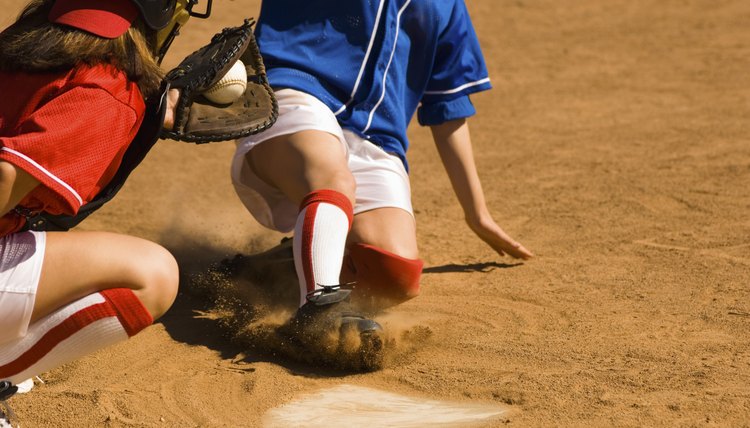
Improving your speed and agility can make a significant improvement in your softball performance. You’ll be able to pick up more ground balls, track down fly balls and make your way around the bases faster. To see notable improvements, incorporate speed and agility drills into your regimen two to three days per week. You could fit the drills in before or after practice. Participate in a 10-minute dynamic warm-up before each session.
Side Shuffles
Because you don’t have much time to react when a ball is hit, being able to quickly move laterally will help infielders get in front of balls to make more plays. Side shuffles will help you improve lateral agility. Perform the drill in the infield so that it better mimics what you’ll be doing during a game. Set two cones or draw two lines in the dirt five yards apart. Begin at the right cone and then shuffle quickly to your left to reach the left cone. Change directions to shuffle back to the right cone. Don’t allow your feet to cross over as you shuffle. Once you feel comfortable, wear a glove and imagine you’re fielding a ground ball at each cone.
Shuttle Runs
Shuttle runs will help a softball player accelerate, decelerate and change directions quickly. You’ll need three cones. Set one up along the third base foul line between home and third base and another one at the center of the base path between first and second. Place the third cone between these two cones so that all three are positioned in a straight line. Begin at the center cone. Turn and sprint toward the cone along the third base line. Touch it and immediately change directions, sprinting to the cone set along the base path between first and second. Touch that cone and then change directions and sprint to the cone where you started. Wait 30 seconds and go again. Complete three to five sets.
Over-the-Shoulder Catches
To improve your speed, agility and reaction time, incorporate over-the-shoulder catches with a partner. While wearing your glove, stand facing your partner, who’s holding a softball. On her call, turn around and sprint away from her. While you’re sprinting, she'll throw the ball over your left or right shoulder. Upon release, she'll call out either “left” or “right.” When she does, you’re allowed to turn and look over that shoulder and sprint diagonally to try and catch the ball. Bring the ball back to your partner and repeat.
Sprint Drills
Incorporating sprints into your workout will help you improve your speed and develop anaerobic endurance. According to ExRx.net, softball players should keep their sprints to distances of about 30 yards, as this reflects the average distance needed to sprint during competition. Complete five to 10 sprints and rest for 30 to 60 seconds in between each one.
References
- Championship Productions: 20 Drills to Increase Speed, Agility and Quickness
- ExRx.net: Speed, Quickness & Agility Training
- Milanović Z, Sporiš G, Trajković N, James N, Samija K. Effects of a 12 Week SAQ Training Programme on Agility with and without the Ball among Young Soccer Players. J Sports Sci Med. 2013;12(1):97–103. Published 2013 Mar 1.
- Kutlu M, Yapici H, Yilmaz A. Reliability and Validity of a New Test of Agility and Skill for Female Amateur Soccer Players. J Hum Kinet. 2017;56:219–227. Published 2017 Mar 12. doi:10.1515/hukin-2017-0039
- Feito Y, Heinrich KM, Butcher SJ, Poston WSC. High-intensity functional training (hift): definition and research implications for improved fitness. Sports (Basel). 2018;6(3):76. Published 2018 Aug 7. doi:10.3390/sports6030076
- Kutlu M, Yapıcı H, Yoncalık O, Celik S. Comparison of a new test for agility and skill in soccer with other agility tests. J Hum Kinet. 2012;33:143–150. doi:10.2478/v10078-012-0053-1
Writer Bio
Kim Nunley has been screenwriting and working as an online health and fitness writer since 2005. She’s had multiple short screenplays produced and her feature scripts have placed at the Austin Film Festival. Prior to writing full-time, she worked as a strength coach, athletic coach and college instructor. She holds a master's degree in kinesiology from California State University, Fullerton.