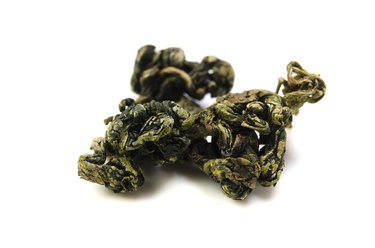
Jiaogulan is a climbing vine native to China, Japan and Korea. As a member of the Cucurbitaceae family of plants, it is related to the watermelon, cucumber, pumpkin and other melons and gourds. There are several health benefits attributed to drinking jiaogulan tea, with no documented toxicity or drug interactions. However, there are a few potential side effects associated with this herb, including nausea. In addition, the safety of this herb during pregnancy and breastfeeding has not been established.
Adaptogenic Benefits
Video of the Day
This plant has a long history of use in Traditional Chinese Medicine. In fact, it is known locally as the "herb of immortality" and "Southern Ginseng." These nicknames likely stem from the Guizhou Province, where the people are reputed to live very long lives as the result of drinking jiaogulan tea daily. Although jiaogulan tea has been consumed as a "Qi" restorative in Southern China since the 15th century, it has been "discovered" by the West only fairly recently.
Video of the Day
Modern herbalists classify jiaogulan as an adaptogen, a term used to describe an herb that helps the body resist the effects of stress. Adaptogen herbs also promote homeostasis, which means it helps the body to achieve a state of balance by regulating multiple internal processes. Specifically, adaptogen herbs like jiaogulan address both excessive output and deficiency in certain body systems, most notably the immune system and the endocrine system.
Antioxidant Properties
Jiaogulan contains chemical compounds collectively referred to as gypenosides. According to the drug information database supplied by Drugs.com, jiaogulan gypenosides enhance the function of phagocytes, specialized white blood cells charged with the task of digesting cellular waste products and invading pathogens. These compounds demonstrate similar protective effects in the endothelium, the layer of cells that line the blood vessels.
Researchers at China's Tangdu Hospital think that jiaogulan gypenosides may offer some protection from oxidative stress in the brain that leads to Parkinson's disease. In the May-June 2010 issue of the Journal of International Medical Research, the scientists reported that the introduction of gypenosides to mouse brains chemically induced to mimic the symptoms of the disease resulted in an increase in glutathione output and superoxide dismutase activity in the substantia nigra, the area of the brain most impacted by Parkinson's disease.
Cholesterol Management
According to Drugs.com, animal-based studies from the 1980s and 1990s have shown that jiaogulan may lower cholesterol. For instance, rats and quail given a decoction, or strong tea, that combined jiaogulan, sacred lotus and Japanese hawthorn, showed a decrease in total cholesterol and triglyceride levels. Similar results were seen in studies where rats were given liquid standardized extracts.
Based on these preliminary studies, researchers from the University of Sydney set out to investigate the effects of jiaogulan gypenosides in rats with induced hyperlipidemia. In the Sept. 16, 2005 edition of the Journal of Pharmacy and Pharmaceutical Sciences, the study team reported that the herb reduced nitrate levels as effectively as the prescription drug atorvastatin. In addition, a decrease in triglyceride and total cholesterol levels were observed.
- Drugs.com: Jiaogulan
- Journal of International Medical Research: Neuroprotective Effect of Gypenosides Against Oxidative Injury in the Substantia Nigra of a Mouse Model of Parkinson's Disease; Wang P et al.; May-June 2010
- Journal of Pharmacy and Pharmaceutical Sciences: Phytopreventative Anti-hyperlipidemic Effects of Gynostemma Pentaphyllum in Rats; Megalli S et al.; Sept. 16, 2005