
What does fact checked mean?
At SportsRec, we strive to deliver objective content that is accurate and up-to-date. Our team periodically reviews articles in order to ensure content quality. The sources cited below consist of evidence from peer-reviewed journals, prominent medical organizations, academic associations, and government data.
The information contained on this site is for informational purposes only, and should not be used as a substitute for the advice of a professional health care provider. Please check with the appropriate physician regarding health questions and concerns. Although we strive to deliver accurate and up-to-date information, no guarantee to that effect is made.
What Fluids to Drink Before a Basketball Game
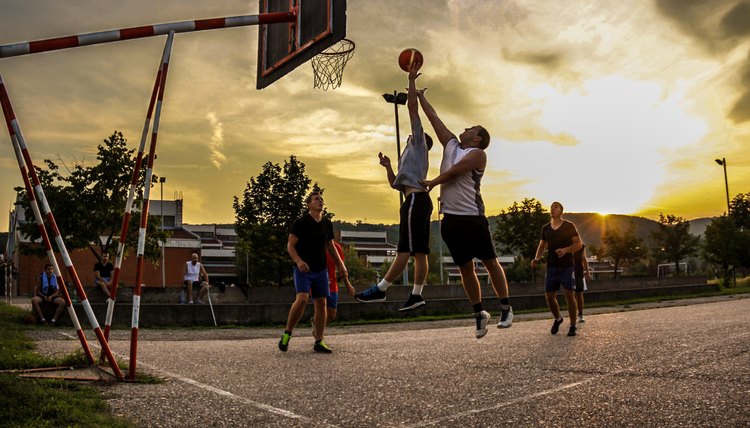
Preparing for a basketball game requires proper hydration. Basketball players burn a high amount of calories due to the game's intense and fast-paced nature. Players that are not properly hydrated run the risk of becoming fatigued early in a game, or developing headaches and cramping up. Conversely, drinking too much water can also adversely affect a player and his performance.
Water
The most essential fluid a basketball player can drink before, as well as during and after a game, is water. Water regulates your body's temperature and makes up about 75 percent of your muscle tissue. Additionally, more than half of your body consists of water. This makes drinking water vital, especially since your body loses a lot of water during intense physical activity, such as a basketball game.
Sports Drinks
After water, basketball players should consume sports drinks, such as Gatorade or PowerAid, which primarily contain water. Sports drinks also contain sugar, which can help raise your glucose levels. Sugar levels play an important role in your overall energy levels. Low sugar levels can lead to fatigue and tiredness. Sports drinks are not a significant source of calories or nutrients, so don't rely on them to provide you with enough energy to last an entire game.
Hydration
You should begin hydrating 24 hours prior to a game or intense training. Drink 400 to 600 ml of water or a sports drink two to three hours prior to a game or intense training. Shortly before the game and during active warm-up, consume approximately 240 ml of water or a sports drink -- about eight gulps. Notice that just before intense activity begins, the amount of fluid you should consume decreases. This is so you avoid playing with a stomach full of fluids, which could result in side stitches.
Water Intoxication
It is possible to consume too much water, which can result in water intoxication. Extreme cases of water intoxication can be fatal. The key is to space out your drinking before a basketball game. Do not force yourself to drink a lot of water all at once. Give your body enough time to digest the water and absorb it into its system. If you drink too much water all at once, you are overloading your system, which can affect your performance or even sideline you.
References
- American Council on Exercise: Healthy Hydration
- Power Bar: Basketball Nutrition Tips
- MSNBC: Woman Dies After Water-Drinking Contest
- Ohashi Y, Sakai K, Hase H, Joki N. Dry weight targeting: The art and science of conventional hemodialysis. Semin Dial. 2018;31(6):551-556. doi:10.1111/sdi.12721
- Beverages, water, tap, drinking. FoodData Central. U.S. Department of Agriculture. Published April 1, 2019.
- Dietary reference intakes for water, potassium, sodium, chloride, and sulfate. National Academies Press, 2005.
- Jéquier E, Constant F. Water as an essential nutrient: The physiological basis of hydration. Eur J Clin Nutr. 2010;64(2):115-23. doi:10.1038/ejcn.2009.111
- Popkin BM, D'Anci KE, Rosenberg IH. Water, hydration, and health. Nutr Rev. 2010;68(8):439-4358. doi:10.1111/j.1753-4887.2010.00304.x
- Adan A. Cognitive performance and dehydration. J Am Coll Nutr. 2012;31(2):71-8. doi:10.1080/07315724.2012.10720011
- Dennis EA, Dengo AL, Comber DL, et al. Water consumption increases weight loss during a hypocaloric diet intervention in middle-aged and older adults. Obesity (Silver Spring). 2010;18(2):300-307. doi:10.1038/oby.2009.235
- National Institutes of Health Genetic and Rare Diseases Information Center. Aquagenic urticaria. Updated June 20, 2016.
- Centers for Disease Control and Prevention. Well testing. Updated April 10, 2009.
Writer Bio
Dan Harriman began writing professionally in 2009 and has a varied background in marketing, ranging from sports management to music promotion. Harriman holds a Bachelor of Science in journalism with an emphasis on strategic communications from the University of Kansas and earned the International Advertising Association's diploma in marketing communications.