
What Bicycle Frame Size Do I Need?
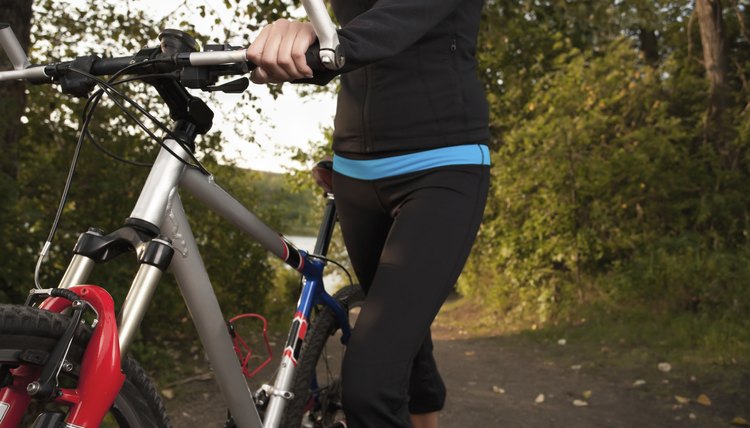
Choosing the correct bicycle frame size can make or break your cycling experience. The frame size influences your riding comfort and affects your agility, speed and safety. Determining which frame size fits you best is a matter of variables such as your height, inseam and riding style, but it is also a matter of personal preference, so sizing a bicycle is not an exact science. Still, there are guidelines that can help you "frame" your perfect match.
Measurements
You probably know your overall height, but you might be unsure what your inseam is. To measure your inseam, take off your shoes and stand flat against a wall with a book or ruler between your legs. Pull the book or ruler up to your crotch to mimic the seat position. Have a partner measure the distance from the floor to the top of the ruler or book to get your inseam. Since frame size is proportional to both leg and torso length, according to bicycle designer Gary Klein, you need to determine your torso height by measuring the distance from your crotch--the top of the book--to your collarbone. This will help you getting an idea of which crossbar length you should consider.
If you are shopping for a hybrid, multiply the inseam by .67 to determine the frame size. For a mountain bike frame, subtract 4 inches from this number. Road bike measurements are in centimeters instead of inches, so you first need to multiply your inseam by 2.54 to convert the inches to centimeters, then multiply the result by .67 to get the approximate frame size.
Seat Tube vs. Top Tube
Well into the 1980s, bicycle frames usually came with a fixed length for the crossbar, or top tube. Frame sizes varied most in terms of the seat tube length and tube angles. But now most standard bicycle frames are proportional, with longer top tubes in larger frame sizes. While this newer standard is an improvement for riders with an average build, cyclists with long or short torsos might need to try a little harder to find a bike frame that fits their body type well. Focus on finding the ideal top tube length first, according to bicycle mechanic Sheldon Brown, who notes that today's seat posts are sturdy enough to give you flexibility to adjust the saddle height to your leg length once you've found the perfect top tube.
Testing for Frame Size
You need to take a seat to find out if you and the bike are a match. Mount the bicycle, and reach for the handlebar. You should be able to reach the handlebar comfortably and operate the brake levers with your elbows in a slightly bent position. With your butt on the saddle, the balls of your feet should lightly touch the ground. If you put the balls of your feet on the pedals, your legs should be at 80 percent to 90 percent of full extension in the lowest pedal position. Your overall position should feel comfortable. If the position feels crouched or even painful, try another bike. If the position suits you, take the bike for a test ride.
Adjusting Seat and Handlebar
In addition to picking the correct frame size, you probably will need to adjust the handlebar height and saddle height as well as the saddle's front and back positioning. Keep in mind that while your buttocks and feet are made to carry your weight, your hands and wrists are not. To prevent hand discomfort and numbness as well as shoulder, back and neck pain, try tweaking the seat and handlebar position. For example, if your seat is too far forward you put extra pressure on your hands. The ideal seat and handlebar positions also are related to your preferred riding style. If you are a casual rider pedaling with a lower cadence, you probably want your handlebar farther back and in a higher position than an ambitious road racer would choose.
Tips
Register your new bicycle with the manufacturer, if possible. This way you will get informed in case of factory recall.
Choose a specialized bicycle retailer for your selection process. You will benefit from the expertise that well-trained sales associates can provide as well as from the larger selection of bicycle frames.
References
Writer Bio
Based in the Tampa Bay, Fla., area, Alexandra Becker has been a full-time writer with a focus on sports, travel, science and health-related topics since 1996. Her work has appeared in a variety of national and international magazines, newspapers and online publications. She has won two journalism awards.