
What does fact checked mean?
At SportsRec, we strive to deliver objective content that is accurate and up-to-date. Our team periodically reviews articles in order to ensure content quality. The sources cited below consist of evidence from peer-reviewed journals, prominent medical organizations, academic associations, and government data.
- ExRx.net: Barbell Incline Bench Press
- ExRx.net: Pectoralis Major (Clavicular Head)
- ExRx.net: Deltoid (Anterior)
- ExRx.net: Triceps Brachii
- ExRx.net: Dumbbell Incline Bench Press
- American Council on Exercise: Dumbbell Incline Press
The information contained on this site is for informational purposes only, and should not be used as a substitute for the advice of a professional health care provider. Please check with the appropriate physician regarding health questions and concerns. Although we strive to deliver accurate and up-to-date information, no guarantee to that effect is made.
What Muscles Does an Incline Bench Press Work?
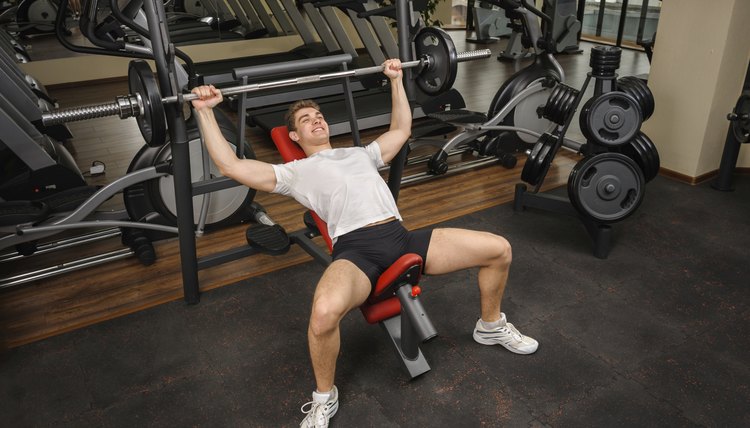
The incline bench press is a bench press exercise and is one the most popular of the bench press variations. It is considered a compound exercise because multiple joints are involved. To perform the exercise, there is movement at both the shoulders and elbows, which means that there is activation in numerous muscle groups in order to coordinate the movement. The upper chest muscles handle most of the load, but your shoulders and triceps also contribute to the exercise. This is why it is a popular upper body exercise, along with chest press and flat bench press, in the bodybuilding community.
List of incline bench press muscles worked:
- pectorolais major (or upper pecs)
- anterior deltoid (AD)
- triceps brachii (TB) medial head
Using Proper Form
The incline bench press can be performed with either a pair of dumbbells or with a barbell in order to do barbell bench press. This can be a very good strength training chest exercise if done correctly. This is why many do dumbbell bench press exercises in order to build muscle. But improper form can cause imbalances in lifters muscles like the front deltoids.
- Set the adjustable bench so that it’s at an 45 degree angle.
- Sit and lean back on the bench.
- If you are using dumbbells, hold them next to your armpit (upper chest) area with your elbows positioned directly under your wrists and palms facing forward.
- If using a barbell, grip the bar with your hands set to slightly outside shoulder-width.
- Hold it at your upper chest with your palms facing forward.
- Press the weight overhead until your arms are fully extended.
- Lower your arms and bend your elbows to return the weight back to the starting position while limiting range of motion. Do this for multiple repetitions, or reps
Bringing your Arms Together
The major muscle involved in the incline bench press is the clavicular head of the pectoral muscles, which is the upper section of the major muscle in your chest. It originates at your sternum and then runs across your chest and out toward each of your shoulders where it inserts at the top of your upper arm bone.
The pectoralis major is responsible for horizontally adducting your shoulders, which means it brings your arms across your chest and brings them together.
Lifting your Arms
As you push the weight over your head, your arms are lifting up in front of you. This movement at the shoulders is handled by your anterior deltoid, which is the front section of your major shoulder muscle. The anterior deltoid originates at your clavicle, where then it runs over your shoulders and then inserts at your upper arm bone.
Handling the Elbows
The triceps brachii muscle runs down the back of your upper arm, originating at the back of your shoulder blades and then inserting at your elbow. When it contracts, it extends your forearm at your elbow joint.
During incline bench press, as you push the weight overhead, it is your triceps that are responsible for your arms straightening as they move from a bent to a fully extended position.
Explore In Depth
References
Writer Bio
Kim Nunley has been screenwriting and working as an online health and fitness writer since 2005. She’s had multiple short screenplays produced and her feature scripts have placed at the Austin Film Festival. Prior to writing full-time, she worked as a strength coach, athletic coach and college instructor. She holds a master's degree in kinesiology from California State University, Fullerton.