What does fact checked mean?
At Healthfully, we strive to deliver objective content that is accurate and up-to-date. Our team periodically reviews articles in order to ensure content quality. The sources cited below consist of evidence from peer-reviewed journals, prominent medical organizations, academic associations, and government data.
The information contained on this site is for informational purposes only, and should not be used as a substitute for the advice of a professional health care provider. Please check with the appropriate physician regarding health questions and concerns. Although we strive to deliver accurate and up-to-date information, no guarantee to that effect is made.
The Stages of Shingles Rash
A shingles rash can affect anyone who's had chicken pox, although it usually targets people over the age of 50 or those with weakened immune systems 1. The stages of a shingles rash are distinctly noticeable to those who've experienced this painful condition, with unpleasant symptoms beginning even before the rash itself erupts 1.
If you are experiencing serious medical symptoms, seek emergency treatment immediately.
What Causes Shingles?
Shingles, which is also called herpes zoster, is caused by the varicella zoster virus--a member of the herpes family 1. However, this is not the type of herpes virus that causes genital or oral outbreaks. Varicella zoster first causes chicken pox, usually in children, although after the skin lesions have healed, the virus itself continues to reside in the nervous system. When varicella zoster reactivates, it doesn't result in another outbreak of chicken pox, but rather a shingles rash 1. Most people only get one shingles rash, although there are some who experience two or three 1. While age and poor health are factors that could trigger shingles, it can also erupt for unknown reasons 1.
The First Signs of Shingles
Can Shingles Be on Your Penis?
Learn More
The earliest stage of shingles is the prodomal stage 1. Typical signs and symptoms during this time include pain, burning or a tingling sensation in the area of your skin where the rash will eventually appear. Typically, this is on the chest or back, but the rash can also appear on your abdomen, arm, leg or area around your face. Often a person in the early stage of shingles experiences symptoms of the flu, such as chills, nausea and diarrhea, as well as swelling of the lymph nodes 1.
The Shingles Rash
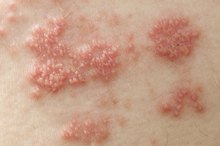
Three to four days after the prodomal stage, the shingles rash erupts 1. Usually, it will be on only one side of the body. The rash is comprised of many tiny watery blisters that are more painful that they are itchy; the nerve roots that the varicella virus transverses often cause a sharp, pinlike sensation merely on palpation of the rash. The blisters rupture and eventually scab over in about five days, with the rash itself resolving after two to four weeks.
- Three to four days after the prodomal stage, the shingles rash erupts 1.
Post-Shingles Complications
A Rash After the Shingles Vaccine
Learn More
Sometimes the pain caused by shingles lingers for a long time after the rash itself is gone and results in a condition called postherpetic neuralgia, which may require pain management until symptoms subside 1. More serious complications of shingles may include loss of vision (when the rash occurs around the eye) and neurological problems, such as facial paralysis, encephalitis and problems with hearing and balance 1.
Shingles Rash Treatment
Shingles can heal on their own without the need for medical treatment 1. However, certain medications can aid the healing process. A doctor may prescribe an antiviral medication such as Zovirax, Valtrex or Famvir--the same medications used to treat oral and genital herpes--as soon as the first signs and symptoms of shingles arise 1. For patients who experience extreme pain, a narcotic pain medication may be prescribed. Other ways to reduce pain caused by a shingles rash may include use of tricyclic antidepressants, anticonvulsants and topical numbing creams 1.
Related Articles

Can Shingles Be on Your Penis?
Learn More
A Rash After the Shingles Vaccine
Learn More
Pain in Lymph Nodes Shingles
Learn More
What Are the Causes of Intense Painful Itching?
Learn More

A Mild Case of Shingles
Learn More
Symptoms of Head Shingles
Learn More
Armpit Shingles
Learn More

Back Pain From Shingles
Learn More
On What Parts of Your Body Are Shingles Found?
Learn More

Facial Herpes Symptoms
Learn More
References
- NIH: Shingles
- Mayo Clinic: Shingles
- Centers for Disease Control and Prevention. Shingles (Herpes Zoster) Signs & Symptoms.
- John AR, Canaday DH. Herpes Zoster in the Older Adult. Infect Dis Clin North Am. 2017;31(4):811-826. doi: 10.1016/j.idc.2017.07.016
- Yun H, Xie F, Baddley JW, Winthrop K, Saag KG, Curtis JR. Longterm Effectiveness of Herpes Zoster Vaccine among Patients with Autoimmune and Inflammatory Diseases. J Rheumatol. 2017;44(7):1083-1087. doi: 10.3899/jrheum.160685
- Cohen KR, Salbu RL, Frank J, Israel I. Presentation and Management of Herpes Zoster (Shingles) in the Geriatric Population. P T. 2013;38(4): 217-224, 227.
- Galetta KM, Gilden D. Zeroing in on zoster: A tale of many disorders produced by one virus. J Neurol Sci. 2015;358(1-2):38-45. doi: 10.1016/j.jns.2015.10.004
- Blank LJ, Polydefkis MJ, Moore RD, Gebo KA. Herpes zoster among persons living with HIV in the current antiretroviral therapy era. J Acquir Immune Defic Syndr. 2012;61(2):203-7. doi: 10.1097/QAI.0b013e318266cd3c
- Mallick-searle T, Snodgrass B, Brant JM. Postherpetic neuralgia: epidemiology, pathophysiology, and pain management pharmacology. J Multidiscip Healthc. 2016;9:447-454. doi: 10.2147/JMDH.S106340
- Johnson RW, Bouhassira D, Kassianos G, Leplège A, Schmader KE, Weinke T. The impact of herpes zoster and post-herpetic neuralgia on quality-of-life. BMC Med. 2010;8:37. doi: 10.1186/1741-7015-8-37
- Sampathkumar P, Drage LA, Martin DP. Herpes zoster (shingles) and postherpetic neuralgia. Mayo Clin Proc. 2009;84(3):274-80.
- Pereira LB. Impetigo - review. An Bras Dermatol. 2014;89(2):293-9. doi: 10.1590/abd1806-4841.20142283
- Gershon AA, Breuer J, Cohen JI, et al. Varicella zoster virus infection. Nat Rev Dis Primers. 2015;1:15016. doi: 10.1038/nrdp.2015.16
- Naveen KN, Pradeep AV, Kumar JS, Hegde SP, Pai VV, Athanikar SB. Herpes zoster affecting all three divisions of trigeminal nerve in an immunocompetent male: a rare presentation. Indian J Dermatol. 2014;59(4):423. doi: 10.4103/0019-5154.135548
- Opstelten W, Zaal MJ. Managing ophthalmic herpes zoster in primary care. BMJ. 2005;331(7509):147-51. doi: 10.1136/bmj.331.7509.147
- Jeon Y, Lee H. Ramsay Hunt syndrome. J Dent Anesth Pain Med. 2018;18(6):333-337. doi: 10.17245/jdapm.2018.18.6.333
- Kim SH, Choi SM, Kim BC, et al. Risk Factors for Aseptic Meningitis in Herpes Zoster Patients. Ann Dermatol. 2017;29(3):283-287. doi: 10.5021/ad.2017.29.3.283
- Saxena A, Khiangte B, Tiewsoh I, Jajoo UN. Herpes zoster encephalitis presenting as multiple cerebral hemorrhages - a rare presentation: a case report. J Med Case Rep. 2013;7:155. doi: 10.1186/1752-1947-7-155
- Teo HK, Chawla M, Kaushik M. A Rare Complication of Herpes Zoster: Segmental Zoster Paresis. Case Rep Med. 2016;2016:7827140. doi: 10.1155/2016/7827140
- American Academy of Dermatology. Cellulitis: Overview.
- American Academy of Ophthalmology. Herpes Zoster Ophthalmicus.
- Centers for Disease Control and Prevention. Shingles (Herpes Zoster): Clinical Overview. Feb 21, 2018.
- Mayo Clinic. Postherpetic Neuralgia. Sept 16, 2015.
Writer Bio
Lisa Sefcik has been writing professionally since 1987. Her subject matter includes pet care, travel, consumer reviews, classical music and entertainment. She's worked as a policy analyst, news reporter and freelance writer/columnist for Cox Publications and numerous national print publications. Sefcik holds a paralegal certification as well as degrees in journalism and piano performance from the University of Texas at Austin.