What does fact checked mean?
At Healthfully, we strive to deliver objective content that is accurate and up-to-date. Our team periodically reviews articles in order to ensure content quality. The sources cited below consist of evidence from peer-reviewed journals, prominent medical organizations, academic associations, and government data.
The information contained on this site is for informational purposes only, and should not be used as a substitute for the advice of a professional health care provider. Please check with the appropriate physician regarding health questions and concerns. Although we strive to deliver accurate and up-to-date information, no guarantee to that effect is made.
Why Do My Feet Swell When I'm on My Period?
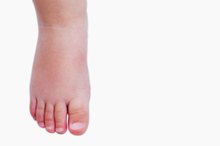
Foot swelling around the time of your menstrual cycle can be a symptom of premenstrual syndrome, or PMS 3. In addition to swollen feet, some women experience swelling in the hands or abdomen. Although foot swelling is a common occurrence, it is a symptom that must be monitored.
Water Retention
Water retention happens when the body literally retains too much water 2. When this takes place, the water will gather in certain areas of the body, causing bloating in the hands, feet and abdomen. Water retention is sometimes called bloating or edema 2. It has several causes, including medical conditions and medication side effects. It usually lasts for a few days to a week.
PMS
How to Lose Water Retention Weight During Your Period
Learn More
Water retention occurs a week or so before your period begins 2. Women prone to PMS often experience it along with other symptoms such as cramping, fatigue, headaches and mood swings. According to the Mayo Clinic, the causes of PMS and its associated symptoms are unknown, although researchers are sure that hormonal changes trigger them.
- Water retention occurs a week or so before your period begins 2.
- According to the Mayo Clinic, the causes of PMS and its associated symptoms are unknown, although researchers are sure that hormonal changes trigger them.
Severity
Water retention affects each woman in a different way 2. To some, it’s just a symptom that causes no discomfort, while for others it can be bad enough to stop them from doing everyday activities.
Treatment
Fluid Buildup in the Calf
Learn More
There is no medication that stops the swelling of feet due to PMS water retention 2. However, there are ways to minimize the discomfort and the extent of the swelling. One is a good exercise routine. According to the Mayo Clinic, women who participate in daily exercise report fewer PMS symptoms. You should also skip the salt. Salt contains a substance called sodium, which causes swelling. Also, you should limit the intake of foods that contain sodium, such as soy sauce, canned vegetables and processed meats.
- There is no medication that stops the swelling of feet due to PMS water retention 2.
Special Considerations
If your symptoms are lasting longer than a week or if your swollen feet are accompanied by cramping or pain, see your physician immediately. The physician may recommend an oral contraceptive prescription to reduce PMS symptoms. Oral contraceptives contain a low dose of the hormone estrogen. This low dose works to control the menstrual cycle in order to prevent pregnancy as well as regulate hormones. Hormonal imbalances cause premenstrual syndrome, so taking these pills can greatly help to reduce it 3.
- If your symptoms are lasting longer than a week or if your swollen feet are accompanied by cramping or pain, see your physician immediately.
- Oral contraceptives contain a low dose of the hormone estrogen.
Related Articles
How to Lose Water Retention Weight During Your Period
Learn More

Fluid Buildup in the Calf
Learn More
My Feet & Hands Are Swelling After Having a Baby
Learn More
Junel Side Effects
Learn More

How to Beat Birth Control Bloat
Learn More
Symptoms of Bone Spur in the Foot
Learn More
What Causes Feet to Swell?
Learn More
Directions to Take Water Pills
Learn More

Hiking & Swelling Hands
Learn More
Exercises for Leg Edema
Learn More
References
Writer Bio
April Khan is a medical journalist who began writing in 2005. She has contributed to publications such as "BBC Focus." In 2012, Khan received her Doctor of Public Health from the University of Medicine and Dentistry of New Jersey. She also holds an Associate of Arts from the Art Institute of Dallas and a Master of Science in international health from University College London.