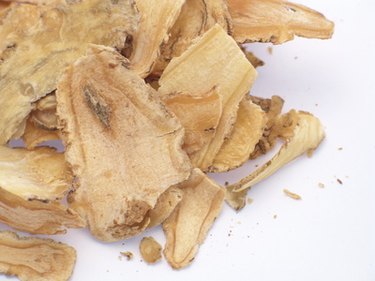
Ginseng royal jelly combines the medicinal properties of Panax ginseng, also known as Chinese or Asian ginseng, and royal jelly, the nutrient-rich food source of the queen honeybee. Practitioners of Chinese traditional medicine consider ginseng the "king of herbs," according to the Tao of Herbs website, and its combination with royal jelly has become one of the most popular herbal tonics throughout Asia. Check with your health care practitioner before taking ginseng royal jelly.
Manage Blood Sugar
Video of the Day
The National Center for Complementary and Alternative Medicine reports that studies of ginseng, which makes up half of this herbal tonic, indicate the herb has promise in managing blood sugar levels. In an effort to conclusively confirm ginseng's potential for diabetes control, NCCAM has underwritten research on the herb's effectiveness in treating insulin resistance. Boyd E. Metzger, author of the "American Medical Association Guide to Living with Diabetes," points out that practitioners of traditional Chinese medicine have treated diabetes for centuries with ginseng and recommends larger, longer-term studies to determine how the herb can be better utilized in controlling blood glucose levels.
Video of the Day
Combats Fatigue
Both ginseng and royal jelly are widely used to combat fatigue and increase alertness. Chinese herbalists value ginseng for its normalizing and restorative powers, according to "Nature's Medicines," written by Gale Maleskey in collaboration with the editors of Prevention Health Books. This property makes the herb useful in treating chronic fatigue syndrome and the fatigue-related symptoms of both fibromyalgia and depression.
Royal jelly, a thick, milky substance secreted by young nurse honeybees to feed a bee colony's larvae, most notably the queen larvae, is a rich source of nutrients, as well as acetycholine, a neurotransmitter that plays a critical role in cognitive function. Erica F. Verrillo and Lauren M. Gellman, authors of "Chronic Fatigue Syndrome: A Treatment Guide," report that many patients with chronic fatigue and immune dysfunction syndrome have shown a sharp increase in energy and stamina levels after taking royal jelly.
Infection-Fighting Properties
The royal jelly in this widely used herbal tonic appears to have some potent antibacterial properties, according to Donald Goldberg, Arnold Gitomer and Robert Abel, authors of "The Best Supplements for Your Health." Additionally, royal jelly and ginseng have shown immune-stimulating properties. Taken together, these characteristics make the combination product a useful weapon for fighting off infection.
Of the combination product, Linda Page, author of "Linda Page's Healthy Healing," writes that ginseng and royal jelly "have synergistic activity in combination," creating a good example of a product in which the whole is greater than the sum of its parts. If you're in the early stages of a bacterial infection, Bill Schoenbart, author of "Pocket Guide to Chinese Patent Medicines," says the normal dosage of ginseng royal jelly, known in Chinese as "renshen feng wang jiang," is one to two 10-ml vials daily.