What does fact checked mean?
At Healthfully, we strive to deliver objective content that is accurate and up-to-date. Our team periodically reviews articles in order to ensure content quality. The sources cited below consist of evidence from peer-reviewed journals, prominent medical organizations, academic associations, and government data.
- MayoClinic.com: Antiobiotics: Misuse Puts You and Others at Risk
- MedlinePlus: Cuts and Puncture Wounds
The information contained on this site is for informational purposes only, and should not be used as a substitute for the advice of a professional health care provider. Please check with the appropriate physician regarding health questions and concerns. Although we strive to deliver accurate and up-to-date information, no guarantee to that effect is made.
Reaction to an Incision Closed With Staples
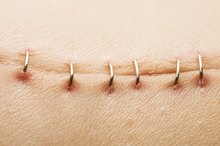
Even when a surgical procedure goes smoothly, you are still at risk for complications until you have healed completely. Staples to close an incision can cause allergic reaction or lead to infections. To prevent harmful reactions, tell your surgeon about any known allergies, and seek medical advice if you suspect that you are having abnormal symptoms after your surgery.
If you are experiencing serious medical symptoms, seek emergency treatment immediately.
Background
Staples hold skin together to close incisions, prevent bleeding and allow your wound to heal properly. You may require staples to close incisions after you undergo surgery, such as a bone graft procedure, removal of a tumor or vein ligation. Your doctor may also use staples to close an incision after you cut yourself in an accident. In some cases, staples can replace sutures, or surgical stitches, to close incisions. Close monitoring of your wound can lead to early detection of a reaction to your staples so that you can get treatment.
- Staples hold skin together to close incisions, prevent bleeding and allow your wound to heal properly.
- You may require staples to close incisions after you undergo surgery, such as a bone graft procedure, removal of a tumor or vein ligation.
Allergic Reactions
Symptoms of a Staph Infection After Surgery
Learn More
An allergic reaction occurs when a substance triggers an immune response, according to MayoClinic.com. The staples used to close your incision could cause a reaction if you are allergic to their material. For example, many staples are made from titanium, which is a strong and lightweight metal alloy, according to the International Titanium Association. However, titanium can include nickel, which is a known allergen. Symptoms of allergic reactions to nickel may include itching, red skin and a rash. Dental work and medical implants may also contain titanium.
- An allergic reaction occurs when a substance triggers an immune response, according to MayoClinic.com.
- For example, many staples are made from titanium, which is a strong and lightweight metal alloy, according to the International Titanium Association.
Infections
Staples help hold your incision closed and keep it clean, but you can still get an infection before your wound is fully healed. You can reduce your risk of infections by keeping the incision area clean. According to MedlinePlus, symptoms of infections include redness, swelling and throbbing pain. If you get an infection in an incision closed with staples, a topical antibacterial ointment may prevent complications. Antibiotics can treat some surface infections, according to MayoClinic.com 1. Follow your doctor’s instructions for taking antiobiotics.
- Staples help hold your incision closed and keep it clean, but you can still get an infection before your wound is fully healed.
- You can reduce your risk of infections by keeping the incision area clean.
Considerations
How Long Do Surgical Staples Stay In?
Learn More
You can lower your risk for complications after surgery by following your surgeon’s instructions. You may need to keep the incision area dry or refrain from placing too much pressure on the area. If you do have a reaction to your staples, get medical help as soon as possible. A nickel allergy may require corticosteroid treatment, according to MayoClinic.com. Untreated infections can spread and lead to complications such as organ failure or infections in your bloodstream.
- You can lower your risk for complications after surgery by following your surgeon’s instructions.
Related Articles

Symptoms of a Staph Infection After Surgery
Learn More
How Long Do Surgical Staples Stay In?
Learn More

Do Nose Piercings Leave Scars?
Learn More
Signs and Symptoms of Infection in a Scrape
Learn More

Uses of Antiseptic Cream
Learn More

Care of Skin After Cryosurgery
Learn More

Allergies to Brass
Learn More
Glue Allergies
Learn More
Insect Bites That Leave Stingers
Learn More

How to Treat an infected ear piercing
Learn More
References
- MayoClinic.com: Antiobiotics: Misuse Puts You and Others at Risk
- MedlinePlus: Cuts and Puncture Wounds
- U.S. National Library of Medicine. MedlinePlus. Surgical wound care - closed. Reviewed June 11, 2018.
- Wound Care Centers. Dehisced Wounds.
- familydoctor.org. American Academy of Family Physicians. Caring for Your Incision After Surgery. Updated: March 14, 2017
- Post-op Instructions: Taking Care of Yourself After Your Operation. National Institutes of Health.
Writer Bio
Natalie Stein specializes in weight loss and sports nutrition. She is based in Los Angeles and is an assistant professor with the Program for Public Health at Michigan State University. Stein holds a master of science degree in nutrition and a master of public health degree from Michigan State University.