
What does fact checked mean?
At SportsRec, we strive to deliver objective content that is accurate and up-to-date. Our team periodically reviews articles in order to ensure content quality. The sources cited below consist of evidence from peer-reviewed journals, prominent medical organizations, academic associations, and government data.
- American Council on Exercise: Bent Knee Pushup
- American Council on Exercise: The Perfect Pushup
- American Council on Exercise: Pushup
The information contained on this site is for informational purposes only, and should not be used as a substitute for the advice of a professional health care provider. Please check with the appropriate physician regarding health questions and concerns. Although we strive to deliver accurate and up-to-date information, no guarantee to that effect is made.
Safety Precautions Associated With Push Ups
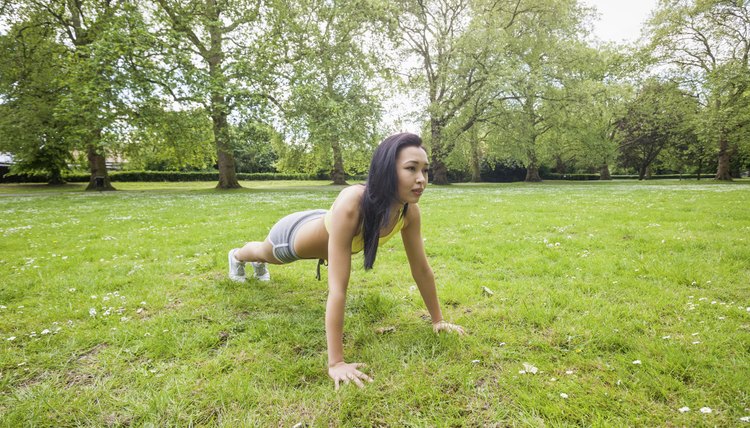
If you have a regular exercise routine that includes performing pushups, make sure you are practicing your pushups correctly. Performing pushups improperly could cause injury or lead to strain or fatigue during your workout. Consider working with a personal trainer to determine whether you are performing your pushups correctly.
Wrist Pressure
Performing pushups puts a lot of strain on your wrists, according to the American Council on Exercise. You can protect your wrists while doing pushups using dumbbells. Hold a dumbbell in each hand and, rather than placing your palms flat on the floor to do pushups, place the dumbbells on the floor and use the weights to lift your body into a pushup. If you use dumbbells to perform pushups, don't lower your body all the way to the floor -- lower your body until it is even with the top of the dumbbells, then push back up into a tall pushup position again.
Shoulder Injuries
Practicing a proper pushup requires significant shoulder strength, reports the American Council on Exercise. If you are suffering from a shoulder injury, you should not perform any type of pushups without first talking to your doctor. Doing pushups when your shoulders are not strong and healthy could lead to further injury. If you feel pain or hear a clicking noise in your shoulders while performing pushups, stop immediately and contact your doctor.
Overdoing It
If it is difficult for you to do a regular pushup, start by performing modified pushups on your knees instead of your toes until you build enough strength to do a regular pushup. Forcing yourself to do toe pushups too soon could result in injury. Take your time and work on perfecting your form in a modified pushup before moving on to standard pushups.
Spine Weakness
When performing any kind of pushup, it's important to keep your head and neck in a straight line, according to the American Council on Exercise. Consider working with a personal trainer or workout buddy who can look at your pushup position and tell you whether or not you are keeping your spine in proper alignment. Also, keep your abdominal muscles engaged as you perform your pushups to help align your spine and prevent back injury.
Explore In Depth
References
- American Council on Exercise: Bent Knee Pushup
- American Council on Exercise: The Perfect Pushup
- American Council on Exercise: Pushup
- Escamilla RF, Hooks TR, Wilk KE. Optimal management of shoulder impingement syndrome. Open Access J Sports Med. 2014;5:13–24. Published 2014 Feb 28. doi:10.2147/OAJSM.S36646
Resources
Writer Bio
Leigh Good has been writing for magazines and newspapers for more than 10 years. Her work has been published in numerous print and online publications. Good has a bachelor's degree in print journalism from Georgia State University.