
How to Place Bike Reflectors on Your Bike
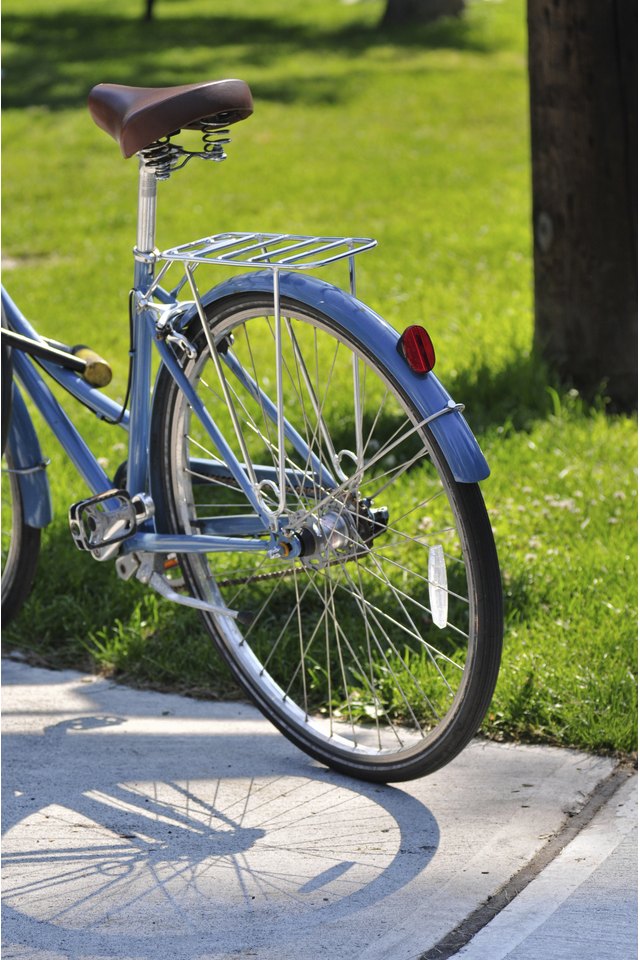
Bike reflectors are required by law, with states enforcing their own rules regarding color, location, alternatives and amount of visibility. There are a variety of ways reflectors attach to your bicycle, but you’ll find some common methods, such as straps, bolts and plugged grooves.
Front and Back Reflectors
Front and back reflectors usually have a bracket that fits around a stem or handlebar. The bracket could snap shut or have small screws that link the ends of the bracket together. Front reflectors usually go on the handlebar or front stem near where the handlebars and stem meet. Back reflectors usually go on the stem below the seat. Don’t place the back reflector too high, or its reflection might be blocked by the seat or the bottom of your shirt. If you have a rear rack, fit the reflector on the rack so that it isn’t blocked by cargo.
Pedal Strips
For bike pedals that don’t have built-in reflectors, one option is to replace the pedals with same-sized ones that do have reflectors. Screw the new pedals into the slots on the pedal arms. Manufacturers also make reflector attachments that bolt to your pedals if the pedals have spaces along the edges, as well as platforms that snap onto the top of your pedals.
Tire Spoke Reflectors
Basic plastic tire reflectors have a groove in which the spoke sits, and there’s a plug that you insert to wedge the spoke against the reflector. On some reflectors, these snap on, but others have to be inserted and twisted so that the lip of the plug fits under the lip of the opening in the reflector.
Writer Bio
Suzanne S. Wiley is an editor and writer in Southern California. She has been editing since 1989 and began writing in 2009. Wiley received her master's degree from the University of Texas and her work appears on various websites.