
What does fact checked mean?
At SportsRec, we strive to deliver objective content that is accurate and up-to-date. Our team periodically reviews articles in order to ensure content quality. The sources cited below consist of evidence from peer-reviewed journals, prominent medical organizations, academic associations, and government data.
- National Athletic Trainers' Association, Inc: Surface Electromyographic Activity of the Abdominal Muscles During Pelvic-Tilt and Abdominal-Hollowing Exercises
- National Athletic Trainers' Association, Inc: Surface Electromyographic Activity of the Abdominal Muscles During Pelvic-Tilt and Abdominal-Hollowing Exercises
- ExRx.net: Abdominal Vacuum
The information contained on this site is for informational purposes only, and should not be used as a substitute for the advice of a professional health care provider. Please check with the appropriate physician regarding health questions and concerns. Although we strive to deliver accurate and up-to-date information, no guarantee to that effect is made.
Abdominal Hollowing Exercises
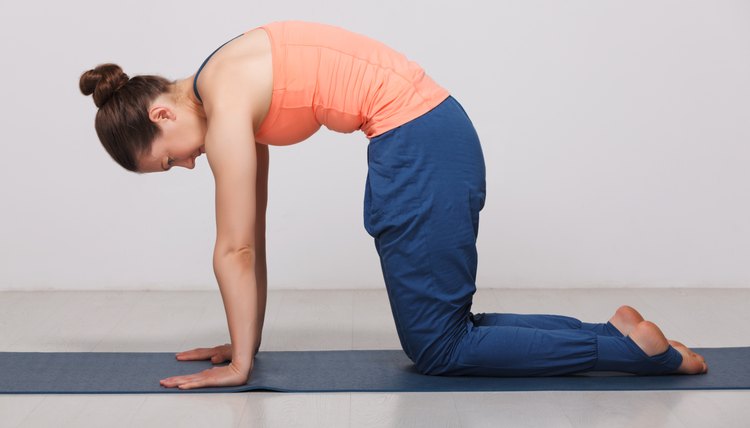
The abdominal hollowing exercise targets the transverse abdominus muscle. The transverse abdominus is a muscle deep in the abdomen that holds in the abdominal contents and supports the trunk. The exercise doesn't produce much activity in the obliques or rectus abdominus muscles, which are the more superficial ab muscles. To isolate the transverse abdominus, perform abdominal hollowing in a variety of body positions.
All Fours
The abdominal hollowing exercise is meant to hollow your stomach by pulling your abs in. Instead of the abdomen rounding out for those people whose stomachs are not completely flat, the stomach will cave inwards when the transverse abdominus contracts. To ensure that your stomach is in fact hollowing, perform the all fours exercise sideways to a mirror that reaches the floor.
Begin on your hands and knees and turn your head to the mirror to check your alignment. The spine is straight with a flat back and your arms and thighs are perpendicular to the floor.
Place hands shoulder-width apart on the floor and the knees are hip-width apart. Before you begin, relax your abs to see your abdomen curve out naturally.
Then, breathe out and suck in your abs until there's a slight curve inwards. Do not squeeze so tightly that you cannot breathe. Hold the contraction for as along as you can.
Abdominal Hollowing while Sitting
Practicing the abdominal hollowing exercise while sitting is one of the most practical exercises because most people spend copious amounts of time in this position throughout their lives. Hollowing your abs when you sit promotes good lower back posture. To do this exercise, sit up tall with your shoulders pulled back, your chin parallel to the floor and your lower back in neutral alignment without rounding or arching. Pull in your abs and hold for as long as you can. You may sit sideways to a mirror so you can watch your stomach and be sure it hollows.
Abdominal Hollowing while Standing
Standing up to do an abdominal hollowing exercise is also practical as your abs should be contracted slightly when you stand, walk or move around to support your spine. A strong transverse abdominus is particularly beneficial for athletes, but concentrating on doing this exercise while also keeping your mind on a game is difficult. Practice the abdominal hollowing while simply standing without any other distractions is much easier. Stand up tall with your knees bent slightly to do this exercise. Pull your abs in as as you exhale as if trying to bring the inside of your navel to your spine. Hold as long as you can.
References
Resources
Writer Bio
Sarka-Jonae Miller has been a freelance writer and editor since 2003. She was a personal trainer for four years with certifications from AFAA and NASM. Miller also worked at 24 Hour Fitness, LA Fitness and as a mobile trainer. Her career in the fitness industry begin in 2000 as a martial arts, yoga and group exercise instructor. She graduated cum laude from Syracuse University.