
Racquetball Vs. Squash
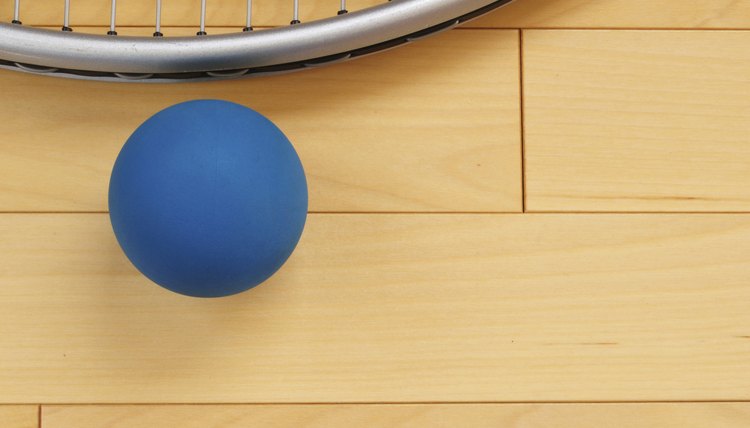
Racquetball and squash have many similarities at first glance, such as both games are played with rackets on enclosed courts. However, the sports have major differences in the way they are played. Due to the ball bounces higher and can hit any surface, racquetball's pace is faster. Racket and ball size are among the other vast differences between the two games. Here are the differences between squash vs racquetball.
When was Squash and Raquetball invented?
Squash was invented in 1830 by the students at Harrow School in England as a variation on a game called "rackets." They discovered that when you toss a punctured ball against the wall -- or "squashed" it -- it bounced back in a variety of different ways to make a more challenging game. Racquetball had a similar beginning, just much later. In 1949, Joe Sobek of Connecticut was a bit bored of his indoor sports options, so he combined his love of tennis and handball into racquetball. He created a prototype for a racket, and the game took off like crazy in the 1970s and 80s.
What is the Racket and Ball Differences?
While both games are racket sports, they share big differences. The rackets for both were once made of wood, but now feature composite materials or metals like graphite or titanium. Squash rackets measure up to 27 inches long, 5 inches more than the maximum length for racquetball. Squash rackets once had circular heads and looked like badminton or tennis rackets, but, beginning in the 1980s, they took on a tear-drop shape similar to racquetball racquets. The head is still wider for racquetball. Squash balls measure 4 cm in diameter. The rubber racquetball balls are larger balls and are close to 6 cm in diameter. They also bounce much higher than squash balls. Both balls are rubber balls so the differences are smaller.
What are the Court Dimensions for squash vs racquetball?
Both games are played on indoor courts, but the playing surface and size are different. The racquetball court measures 20 by 40 by 20 feet; a squash court is 21 by 32 by 15 feet. Every surface, including the ceiling, is considered in bounds in racquetball, while you're not permitted to hit the ceiling in squash. There are also boundary lines along the front and back walls of a squash court, in addition to diagonal boundary lines on the side walls. In addition, a 19-inch high tin strip is out-of-bounds at the base of the front wall. Both courts also contain service boxes from which you are required to serve.
Serving the Balls
A squash player is only allowed one serve at the start of each point, while racquetball players, like tennis, are permitted two. In squash, you hit the ball while it's airborne, without letting it bounce first. In racquetball, you must bounce the ball before hitting it. For racquetball, your serve can hit any part of the front wall and then land behind what's called the "short line." In squash, the server must get the ball into one of two alternating serving boxes, and the ball must land above the tin line yet below the service line to be good.
What is the Scoring for racquetball vs squash?
In both sports, you must win by two points -- squash games go to nine points in regular play and 11 in tournament play. Racquetball games go to 15 points, but you can only earn points on your serve. As in tennis, a squash player wins a point if he wins a rally regardless of who served. A return is good if it's above the tin line and below the out line, without bouncing twice on the floor. In racquetball, you also can't let the ball bounce twice, but it must hit the front wall before touching the floor. In squash, you must win three games to claim the match; in racquetball you only need to win two.
References
Writer Bio
Leigh Reason has almost 20 years of journalism experience, editing and writing for publications such as "Movieline," "Live! Magazine," WeddingChannel.com, FYI Living, Healthline.com and Citysearch.com. She has written extensively on fitness and nutrition, tennis, wedding planning and etiquette, cooking, restaurants, parenting, pets and gardening. She holds a Bachelor of Science in English from Skidmore College.