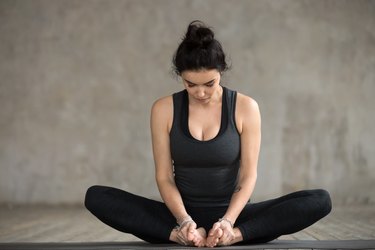
If you feel unbalanced or like one leg is longer than the other, you're not alone. Minor issues with your hips and pelvis are common and often easy to correct with hip alignment exercises. Performing these corrective exercises three to five days a week will have you feeling better in no time.
Hips Out of Alignment
Video of the Day
It's not uncommon for your pelvis to feel off balance or out of alignment, which can lead to low back, hip, knee and ankle problems. When this happens, the first thing you want to do is determine why your hips are misaligned.
Video of the Day
"This disparity can happen because of a leg length discrepancy, which is when one leg appears longer or shorter than the other, causing the hip above to compensate and either raise or lower," Dr. Bianca Beldini, DPT, MSOM, LAc, SFMA, tells LIVESTRONG.com. She also points out that it can happen because of overuse of one side and overdeveloped musculature, or it can be an actual bony pelvis anomaly where one half of the pelvic bone is larger or smaller than the other.
When you have a lack of stabilization in certain parts of your body, you may also experience faulty movement patterns that can cause your hips to feel out of alignment. According to the Athletic Medicine program at Princeton University, the muscles that play a role in pelvic stabilization include the deep core muscles, gluteus maximus, gluteus medius and the piriformis muscles. Performing hip alignment exercises can help correct these imbalances.
Read more: 12 Moves for a Stronger Core and Better Posture
Hip Alignment Symptoms
When you're physically active, there's a good chance you will feel tight and sore in parts of your body, especially after an intense workout. But when this pain gets worse or doesn't go away, it might be time to figure out if your hips are to blame.
Beldini says some of the more common hip alignment symptoms to be aware of include:
- Low back pain on one side.
- Weakness in the gluteals on one side.
- Decreased stability standing on one leg (feeling more unstable or unable to stand on your leg without extreme fatigue or like you might fall over).
- Scuffed shoe or sneaker on one of the toes or heels of the shoe (toe scuff typically indicates a longer limb not swinging through fast enough / wear down of one heel means more compression upon heel strike on the shorter limb.
- Pant hems are uneven.
Additionally, if you have a tilted pelvis, you can experience muscle tightness, pain or fatigue in the low back. Other symptoms of a tilted pelvis include a shortening of the hip flexor on the anteriorly tilted side and painful popping noise from the pubic bone when squeezing the knees together.
Read more: Exercises to Avoid If You Have Hip Pain
Hip Alignment Exercises
When your pelvis is out of alignment, you may find it difficult to maintain good posture. According to the American Council on Exercise, proper posture helps us participate in daily activities such as standing, sitting and walking in positions that don't strain supporting muscles and ligaments. Performing hip alignment correction exercises can help encourage proper posture and re-align your hips.
1. Clamshell Exercise
The clamshell exercise strengthens the gluteus medius, which is responsible for keeping the sides of the pelvis level and control the hip drop in single-leg stance. Single-leg stance happens every time you walk or run. Weakness in the gluteus medius can cause your pelvis to drop, which can further reinforce asymmetry and malalignment.
- Lie on your side with hips and knees bent.
- Lift your top knee up while keeping your feet stacked, one on top of the other. Repeat 10 times then change legs.
2. Single-Leg Stance (Hip Hikes) Exercise
Single-leg stance or hip hikes strengthen the gluteus medius in a functional standing position, which also challenges your balance.
- Stand sideways on a box or bottom stair and hang one leg off the side. Keep your core engaged and pelvis level.
- Drop the leg that is hanging off towards the floor. To do this, allow your pelvis to drop down slowly.
- Hold this for a few seconds then use the hip muscles in the standing leg (the one on the step or bench) to raise your pelvis up to the starting position. Repeat 10 times then change sides.
3. Bridging With Ball Exercise
Bridging while squeezing a ball between your knees is a co-contraction of the glute max, pelvic floor and lower abdominals. This exercise improves strength and stabilization throughout the low back and hips.
- Lie on your back with knees bent and spine in a neutral position.
- Place a soft ball between your knees and squeeze.
- Push your feet into the ground and squeeze your glutes to extend the hips. Lift your hips until your body is in a straight line from shoulders to hips to knees.
- Stay in this position for five to 10 seconds by contracting your glutes and then lower your body down to the starting position. Repeat 10 to 12 times.
4. Air Squat Exercise
Air squats are an excellent hip mobility exercise. This movement mobilizes the low back, hips, knees and ankles to function as a unit. "Air squats engage the posterior chain, in which all joints of the low back and lower extremity move in alignment," Beldini adds.
- Stand with feet a little wider than shoulder-width apart. Arms will be at the side. This is your starting position.
- Engage your core and keep your abdominal muscles contracted throughout the entire movement.
- Extend arms out in front of you and slowly bend your legs to squat down. While bending, focus on pushing your hips like you are going to sit on a chair.
- Squat down until your thighs are parallel to the floor. Arms will still be out in front of you and your gaze looking straight ahead. Your knees should be over your toes.
- Pause in this position. Exhale, and reverse the move by pressing into the mid-foot to straighten legs and stand up. As you rise, lower your arms back to your side. Repeat 10 to 12 times.
- Princeton University Athletic Medicine: "Pelvic Stabilization, Lateral Hip and Gluteal Strengthening Program"
- Sundala Center for Wellness: "Dr. Bianca Beldini / DPT, MSOM, LAc, SFMA: Personal Interview"
- American Council on Exercise: "Identifying and Working With Common Posture Deviations"
- American Council on Exercise: "5 Exercises to Add to Your Lower Back Exercise Program"
- American Council on Exercise: "Pilates Ball Core-Strengthening Exercises"
- National Association of Sports Medicine: "Squat Form – What Does It Tell Us?"