
Exercises After Foot Surgery
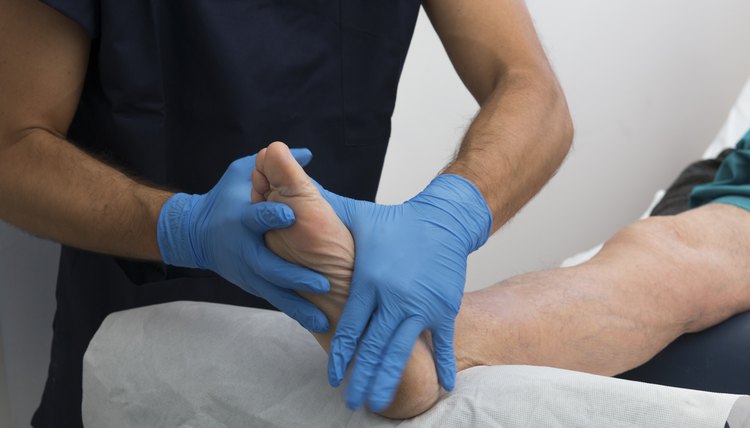
After foot surgery, it is common for your foot to feel weak, tight and sore. Elevation combined with exercises can help you regain the range of motion that may have been lost as a result of the surgery. In addition, active movement of the foot and ankle will help to reduce swelling and decrease pain. Make sure your surgeon or physical therapist has given you clearance before beginning an exercise program.
Ankle Pumps
Ankle pumps work to actively push fluid out of the foot, ankle and lower leg back into the body. It is not uncommon after foot surgery for your ankle motion to feel restricted. Increased swelling around a joint can limit the joint’s ability to move. To perform ankle pumps, sit with both feet straight out in front of you. Slowly bring your toes back up towards your head. Then point your toes away from your body in a straight line. Repeat this exercise 10 times, twice an hour while awake.
Towel Curls
Active motion of the toes works to decrease swelling and encourage fine motor movement of the toes. Towel curls encourage toe movement to act as a pump. To perform towel curls, place a small hand towel flat on the floor. Sit in a chair with both feet on the floor, your surgical foot resting with just the toes on the edge of the towel. Slowly grip the towel with your toes, and scrunch it towards your foot. Be sure to keep your foot and heel flat on the floor. Repeat this exercise two times, twice per day.
Marbles
Another exercise to encourage toe movement is to pick up small objects, such as marbles, with your toes. Place a variety of small objects, such as marbles or coins, on a towel. Sit with your foot on the towel. Pick up objects individually with your toes, and place them into a small dish or cup. Repeat this exercise two times, twice per day. To increase the challenge, use smaller objects, or objects that lay flat to the floor, such as buttons or coins.
Achilles Stretch
Stretching is also a vital part of recovering any motion that may have been lost after surgery. To stretch your Achilles tendon, sit with your legs straight out in front of you. Loop a towel around the toes on your surgical foot. Be sure to keep your toes pointed straight up towards the ceiling. By lightly pulling on the towel, slowly bring your toes back towards you until you feel a stretch. Hold this position for 20 to 30 seconds; repeat three times, twice per day.
References
Writer Bio
Tyler Shultz is a third-year doctor of physical therapy student at the Medical College of Georgia in Augusta, Ga. His articles have appeared in numerous physical therapy blogs since 2009, including PT ThinkTank and AAOMPT-sSIG blog. Tyler graduated from the University of Georgia with a Bachelor of Science in health promotion in 2007.