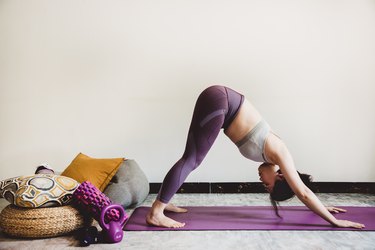
Pretty much anyone who's gone to a yoga class has done downward facing dog. Even if you're not a yogi, you've likely performed this popular posture during a dynamic warmup or a post-workout cooldown. That's because this classic yoga pose provides so many mind and body benefits.
"It strengthens and stretches almost every muscle in the body and builds bone density, as it is considered a weight-bearing exercise," Koya Webb, yoga instructor, creator of the Get Loved Up Online Yoga Teacher Training and author of Let Your Fears Make You Fierce, tells LIVESTRONG.com. Plus, doing poses like downward dog may help ease stress, anxiety and depression, she says.
Video of the Day
Video of the Day
This asana can also help improve circulation, boost blood flow to your brain, help balance the endocrine system and calm the nervous system, Gillian Walker, yoga instructor and founder of The Hot Yoga Dome, tells LIVESTRONG.com.
While this beginner pose may seem straightforward, it can be quite difficult to perfect, as it involves total-body coordination. That may explain why you have problems nailing the proper form.
Here, Webb and Walker share some common issues you may run into with downward dog and offer tips to help make it more safe, effective and comfortable for your body.
You Have Tight Calves
Tight calves pull on the Achilles tendon and limit ankle flexion, making it difficult for your heels to reach the ground in downward dog, Webb says.
What's more, you may be compensating for tight calves by walking your hands closer to your feet to help your heels touch the ground. But "this short stance causes spinal flexion and compression in the front of the body, leading to a rounded spine" and possibly strain on your back, Webb says.
Plus, "tight calves will cause your shoulders and wrists to hold most of your weight," Walker says.
Fix It
“If you have tight calves, bend the knees in down dog and/or use blocks under your hands to help even out the weight distribution,” Walker says.
You can also incorporate foam rolling and calf stretches to help resolve the tightness in your calf muscles, Webb says. Try doing a seated forward fold with a block at the soles of your feet. Wrap a strap around the block and pull it toward you for a deep calf stretch.
You Lack Shoulder Mobility
If you sit slumped over a laptop all day, odds are you have tight shoulders. And this shoulder tension tends to put a damper on downward dog. "Shoulder issues will cause pain and discomfort in down dog," Walker says.
And if your lack of mobility isn't due to a specific injury, it's likely linked to tight chest muscles, she says. That's because when you sit most of the day, you often round your back and scrunch your shoulders. When this happens, the front of your body — i.e., your chest — and your back relaxes/weakens.
Fix It
“If you have shoulder mobility issues, do not push yourself in down dog,” Walker says.
Instead, modify the move. Webb recommends incorporating yoga blocks by positioning each hands on a block. You can also experiment with placing your hands on a wall or a chair), she says. Stand a leg’s length away from the wall, place your hands on the wall as high as your hips, then push your hands into the wall and bring your back parallel to the ground.
In addition, you can perform exercises that strengthen your shoulders and stretches that open up your chest, Walker says, like child's pose or bench prayer stretch.
Your Hamstrings Are Tight
A mostly sedentary lifestyle can also be the source of stiff hamstrings, which can hamper your down dog.
"Just like tight calves, tight hamstrings will cause you to dump most of your weight into your upper body," Walker says. And stiff hamstrings hinder your form in other ways. Specifically, they tug on the sitting bones and cause the back to round, Webb says.
Fix It
Walker recommends practicing poses and stretches that will lengthen the hamstrings such as Janusirsasana (head-to-knee pose), Uttanasana (standing forward fold) and Padahastasana (hand-under-foot pose).
You can also try bending your knees in downward dog. This “will allow the pelvis to tilt more, therefore allowing the spine to lengthen,” Webb says.
You Have Weak Upper-Body Muscles
"A weak upper body will cause down dog to feel like anything but the resting posture that it is," Walker says.
"You'll probably compensate by scrunching your shoulders up near your ears," Webb says. But this can result in a domino effect of other problems. If you have weakness or instability in the shoulders, this can then lead to abnormal pressure and pain in the wrists, Webb says.
Fix It
“Some of the fastest ways to strengthen the upper body are pull-ups and push-ups,” says Walker, noting you may need to modify these exercises until you’ve built enough strength. For example, you can do incline push-ups and eccentric pull-ups to make those moves easier.
Similarly, strengthening your core — with exercises like dead bugs, glute bridges and planks — will help you shift weight away from your shoulders in the pose, Webb says.
You can also work on your form in downward dog: Draw your shoulders away from your ears, double check that the inside of your elbows are facing their opposite corners on the mat and broaden through the collarbones and chest, Webb says.
You Have Inflexible Wrists
"Weak wrists can make it difficult to properly distribute the weight of the upper body in downward dog," Webb says. What's worse, "weak and inflexible wrists will cause down dog to be a painful experience," Walker says.
Fix It
Walker recommends using yoga blocks to help balance the weight, which takes the pressure off the wrists. Similarly, you can use a foam wedge under your hands (or roll up another yoga mat, blanket or towel).
“This decreases the angle of extension at your wrist and can make the pose easier,” Webb says.
Make sure to spread your fingers wide and press into the thumb and index finger. This will shift the weight from your wrists, outer hands and arms and into the upper back, where much larger, stronger muscles can better handle the load, Webb says.
Your Ankle Mobility Is Limited
"Limited ankle mobility makes it difficult for the heels to go down toward the floor in downward dog, which can have an effect all the way up the back body to the spine," Webb says. And much like tight calves and hamstrings, weak, stiff ankles will unevenly load the weight onto the upper body, Walker says.
Fix It
“One of the best yoga postures for helping ankle flexibility is Hero pose,” Walker says. “Start with as many blocks as you need under your seat and slowly work your way down.”
You can also modify Downward Dog to make it more comfortable. Webb recommends folding or rolling a blanket and placing it under your heels. “As you do the pose, push your heels down into the blanket toward the ground,” she says.
You’re Not Actively Engaging Your Muscles
While downward dog is supposed to be a chill, resting pose, that doesn't mean you should just hang there. If you don't actively contract your muscles, there's less balance in the distribution of your body weight, Webb says. When this happens, your form suffers, which can lead to discomfort.
Fix It
Be present in the pose. “Focus on rotating the shoulders and spreading the fingers wide, reach the heels toward the floor and actively concentrate on finding full body balance in the posture,” Walker says.